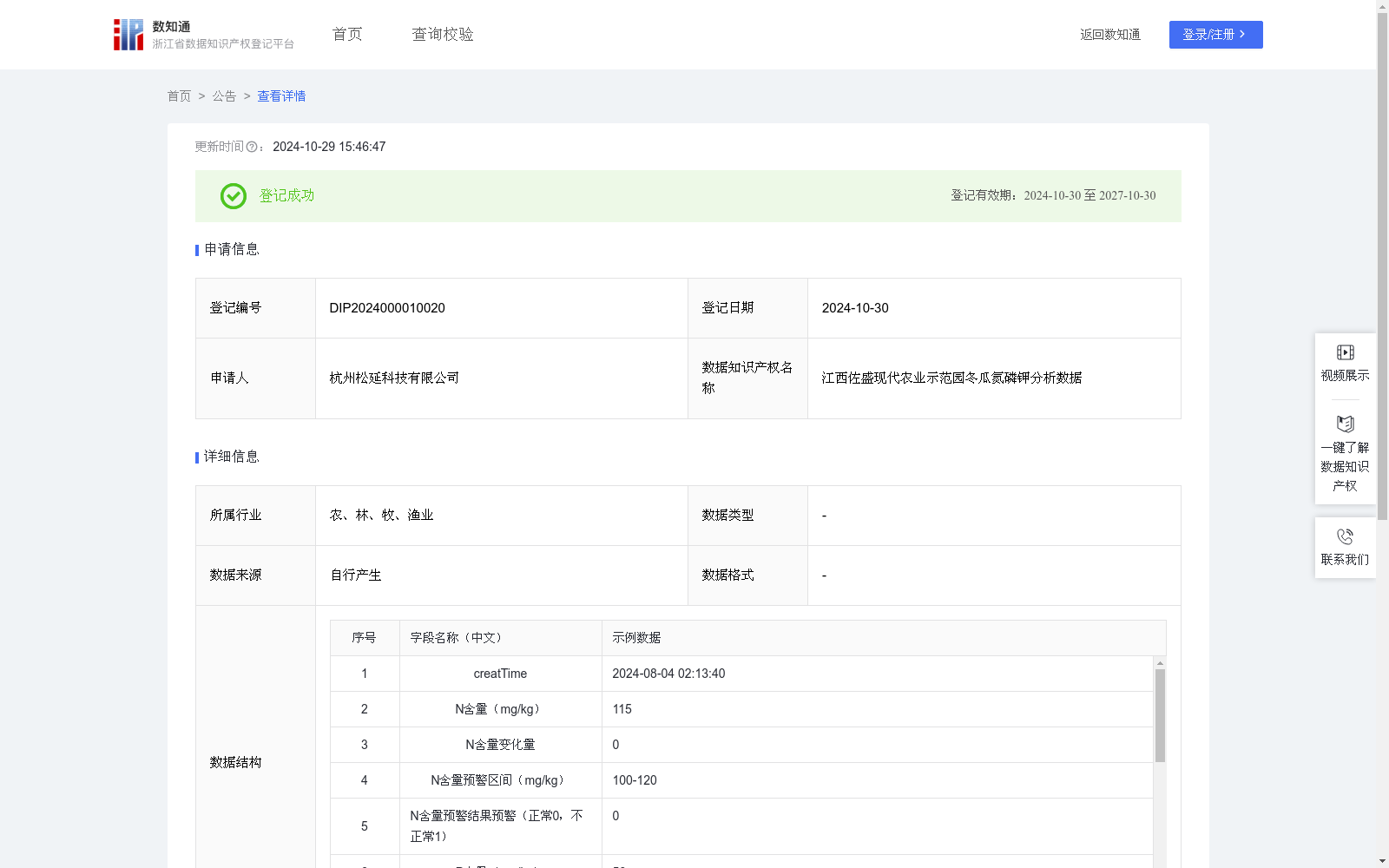
江西佐盛现代农业示范园冬瓜氮磷钾分析数据
收藏资源简介:
通过监测江西佐盛现代农业示范园地区冬瓜作物土壤中营养元素的含量数据,分析NPK配比数据,用于精准定制科学施肥方案、调整种植结构、监测土壤质量等场景,确保作物获得最佳营养,同时减少成本与环境污染,维持土壤健康;同时可指导作物品种选择与轮作,适应气候变化,提升农业应对环境变化的能力,提高农业生产效率,推动生态保护和经济双赢的农业发展模式。采集了氮、磷、钾土壤化学元素含量数据,分析土壤中N、P、K化学元素占比: 含量变化量=当前时间该元素含量-开始时间该元素含量; 含量预警区间代表了土壤中该元素正常含量的区间,含量正常时预警为0,含量不正常时预警为1。 NPK配比要求指的是N(氮)、P(磷)、K(钾)三种元素在科学计算后得出的该作物成长需要的最合适的占比,NPK实际占比=N含量/P含量:P含量/P含量:K含量/P含量,通过测量得出实际的土壤化学元素含量占比,通过和配比要求进行对比,为今后指导施肥、调整作物结构提供帮助。 通过科学合理地利用氮磷钾含量分析,可以更好地保护土壤资源、提高农业生产效率、促进生态环境的可持续发展。
This dataset is developed based on monitoring the nutrient element content in the soil of winter melon crops in Jiangxi Zuosheng Modern Agricultural Demonstration Park, and analyzing the NPK ratio data. It serves multiple application scenarios including precise formulation of scientific fertilization schemes, adjustment of planting structure, and soil quality monitoring, with the goals of ensuring crops receive optimal nutrition, reducing production costs and environmental pollution, and maintaining soil health. Furthermore, it can provide guidance for crop variety selection and crop rotation, help adapt to climate change, enhance agricultural resilience to environmental changes, improve agricultural production efficiency, and promote an agricultural development model that achieves a win-win outcome between ecological protection and economic benefits. Soil chemical element content data of nitrogen (N), phosphorus (P) and potassium (K) were collected, and the proportions of these three elements in the soil were analyzed as follows: - Element content change = current element content at the current monitoring time - initial element content at the start of monitoring; - The content warning interval denotes the normal content range of the corresponding element in the soil. The warning value is 0 when the element content is within the normal range, and 1 when the content is abnormal. The required NPK ratio refers to the optimal proportion of N, P and K required for the growth of the target winter melon crop, derived via scientific calculation. The actual NPK ratio is calculated as (N content / P content) : (P content / P content) : (K content / P content), where the actual proportions of soil chemical elements are obtained through field measurements. By comparing the actual measured proportions with the pre-defined required NPK ratio, this dataset can offer support for subsequent fertilization guidance and crop structure adjustment. By rationally and scientifically applying the analysis results of nitrogen, phosphorus and potassium contents, this dataset can better protect soil resources, elevate agricultural production efficiency, and facilitate the sustainable development of the ecological environment.