青藏工程走廊地温现状分布图(2010-2015)
收藏资源简介:
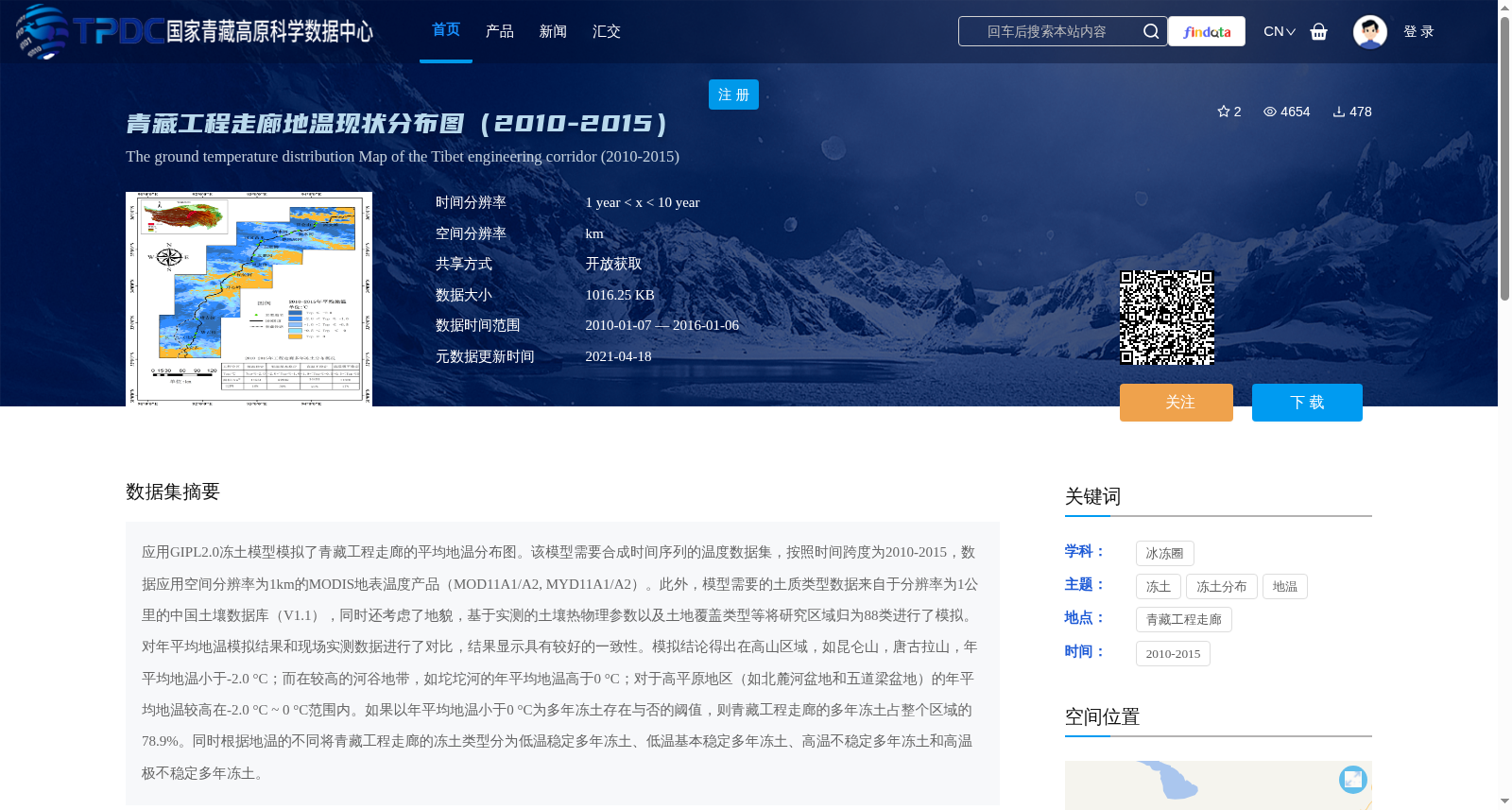
应用GIPL2.0冻土模型模拟了青藏工程走廊的平均地温分布图。该模型需要合成时间序列的温度数据集,按照时间跨度为2010-2015,数据应用空间分辨率为1km的MODIS地表温度产品(MOD11A1/A2, MYD11A1/A2)。此外,模型需要的土质类型数据来自于分辨率为1公里的中国土壤数据库(V1.1),同时还考虑了地貌,基于实测的土壤热物理参数以及土地覆盖类型等将研究区域归为88类进行了模拟。 对年平均地温模拟结果和现场实测数据进行了对比,结果显示具有较好的一致性。模拟结论得出在高山区域,如昆仑山,唐古拉山,年平均地温小于-2.0 °C;而在较高的河谷地带,如坨坨河的年平均地温高于0 °C;对于高平原地区(如北麓河盆地和五道梁盆地)的年平均地温较高在-2.0 °C ~ 0 °C范围内。如果以年平均地温小于0 °C为多年冻土存在与否的阈值,则青藏工程走廊的多年冻土占整个区域的78.9%。同时根据地温的不同将青藏工程走廊的冻土类型分为低温稳定多年冻土、低温基本稳定多年冻土、高温不稳定多年冻土和高温极不稳定多年冻土。
The GIPL2.0 frozen soil model was applied to simulate the average ground temperature distribution map of the Qinghai-Tibet Engineering Corridor. This model requires synthesized time-series temperature datasets with a temporal span of 2010–2015, using MODIS land surface temperature products (MOD11A1/A2, MYD11A1/A2) with a spatial resolution of 1 km. In addition, the soil type data required by the model were sourced from the 1 km-resolution China Soil Database (V1.1). Meanwhile, geomorphology was also considered, and the study area was classified into 88 categories for simulation based on in-situ measured soil thermophysical parameters, land cover types and other relevant factors. The simulated annual average ground temperature results were compared with in-situ measured data, which showed good consistency. The simulation conclusions indicate that in alpine regions such as the Kunlun Mountains and Tanggula Mountains, the annual average ground temperature is less than -2.0 °C; while in relatively high valley zones such as the Tuotuo River, the annual average ground temperature exceeds 0 °C; for high plain areas (such as the Beiluhe Basin and Wudaoliang Basin), the annual average ground temperature ranges from -2.0 °C to 0 °C, which is relatively high. If taking the annual average ground temperature below 0 °C as the threshold for the presence of permafrost, the permafrost in the Qinghai-Tibet Engineering Corridor accounts for 78.9% of the entire study area. Meanwhile, based on the differences in ground temperature, the frozen soil types in the Qinghai-Tibet Engineering Corridor are classified into four categories: low-temperature stable permafrost, low-temperature relatively stable permafrost, high-temperature unstable permafrost and high-temperature extremely unstable permafrost.