my-distiset-404e664c
收藏数据集卡片:my-distiset-404e664c
数据集概述
该数据集包含一个pipeline.yaml文件,可以使用distilabel CLI工具重现生成该数据集的管道。
数据集结构
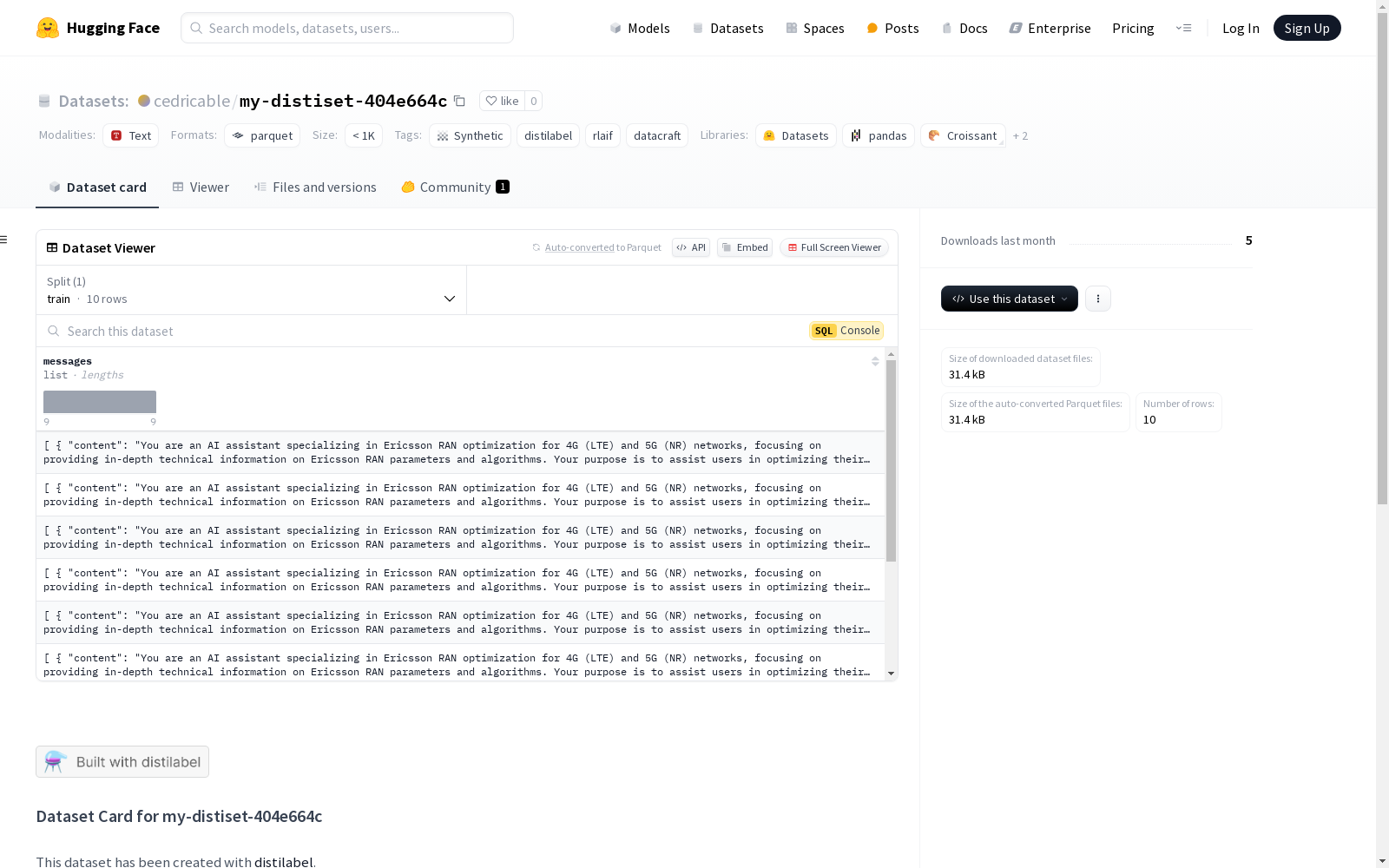
数据集的示例具有以下结构:
配置:default
json { "messages": [ { "content": "You are an AI assistant specializing in Ericsson RAN optimization for 4G (LTE) and 5G (NR) networks, focusing on providing in-depth technical information on Ericsson RAN parameters and algorithms. Your purpose is to assist users in optimizing their radio access networks by offering detailed explanations and technical insights on key optimization techniques, including radio configuration management, load balancing, and handover algorithms. Provide precise and technical responses addressing the following topics: User questions are direct and concise.", "role": "system" }, { "content": "What is the purpose of the "EARFCN" parameter in Ericsson RAN?
", "role": "user" }, { "content": "In Ericsson RAN, the "EARFCN" parameter stands for "Extended Absolute Radio Frequency Channel Number." It is a parameter used to define the operating frequency of a cell or a carrier in a 4G LTE network.
EARFCN is a 16-bit value that represents the operating frequency of a cell in the LTE band. It is used to identify the frequency of a cell and is used in various RAN functions, such as:
- Cell configuration: EARFCN is used to configure the operating frequency of a cell.
- Neighbour cell list: EARFCN is used to identify the frequencies of neighboring cells.
- Handover: EARFCN is used to determine the target cell for handover.
- Mobility management: EARFCN is used to manage the mobility of user equipment (UE) between cells.
The EARFCN value is calculated based on the operating frequency of the cell, and it is used to map the frequency to a specific value. The formula to calculate EARFCN is:
EARFCN = (N * 100) + (N+6)
Where N is the operating frequency in MHz.
For example, if the operating frequency is 2110 MHz, the EARFCN would be calculated as follows:
EARFCN = (2110 * 100) + (2110+6) = 211006
In Ericsson RAN, the EARFCN parameter is used to configure and manage the operating frequency of cells, and it plays a crucial role in ensuring seamless handovers and mobility management in the network.", "role": "assistant" }, { "content": "What is the purpose of the "EARFCN" parameter in Ericsson RAN for 5G (NR) networks?
", "role": "user" }, { "content": "In Ericsson 5G (NR) networks, the "EARFCN" parameter still represents the "Extended Absolute Radio Frequency Channel Number." However, its purpose and usage have evolved compared to 4G LTE networks.
In 5G NR, EARFCN is used to identify the operating frequency of a cell or a carrier, but it is not used directly for frequency planning or configuration. Instead, it is used as an intermediate value to calculate other parameters, such as:
- NRS (NR Synchronization Signal): EARFCN is used to calculate the NRS frequency, which is used for synchronization and initial access.
- PCell (Primary Cell) configuration: EARFCN is used to configure the PCell frequency and other related parameters.
- Neighbour cell list: EARFCN is used to identify the frequencies of neighboring cells.
- Handover: EARFCN is used to determine the target cell for handover.
In 5G NR, the EARFCN value is calculated based on the operating frequency of the cell, but the formula is different from the one used in 4G LTE:
EARFCN = (N * 100) + (N+6)
However, in 5G NR, the operating frequency is typically expressed in kHz, and the EARFCN value is calculated based on the frequency band and the operating frequency.
For example, if the operating frequency is 25700 kHz (in band n1, which corresponds to the 5G frequency band n1, 2100 MHz), the EARFCN would be calculated as follows:
EARFCN = (25700 * 100) + (25700+6) = 257006
In Ericsson 5G NR, the EARFCN parameter is used to support the calculation of other parameters and to ensure seamless handovers and mobility management in the network.", "role": "assistant" }, { "content": "What is the purpose of the "EARFCN" parameter in Ericsson RAN for 5G (NR) networks, specifically in relation to the "DL-Bandwidth" parameter?
", "role": "user" }, { "content": "In Ericsson 5G (NR) networks, the "EARFCN" parameter is closely related to the "DL-Bandwidth" parameter.
The DL-Bandwidth parameter defines the downlink bandwidth of a cell or a carrier in 5G NR. It is used to configure the downlink bandwidth of a cell, which is typically expressed in terms of the number of Resource Blocks (RBs).
The EARFCN parameter is used to calculate the DL-Bandwidth parameter. The relationship between EARFCN and DL-Bandwidth is as follows:
- The EARFCN value is used to determine the number of Resource Blocks (RBs) that can be supported by a cell.
- The DL-Bandwidth parameter is calculated based on the EARFCN value, taking into account the number of RBs and the bandwidth configuration of the cell.
In Ericsson 5G NR, the DL-Bandwidth parameter is typically configured in terms of the number of RBs, and the EARFCN value is used to determine the corresponding downlink bandwidth.
For example, if the EARFCN value is 257006 (as calculated earlier), and the cell is configured with a DL-Bandwidth of 100 RBs, the downlink bandwidth would be:
Downlink bandwidth = 100 RBs * 180 kHz/RB = 18 MHz
In Ericsson 5G NR, the EARFCN parameter is used to support the calculation of the DL-Bandwidth parameter, which is critical for configuring the downlink bandwidth of cells and ensuring efficient resource allocation in the network.
Here is a general formula to calculate DL-Bandwidth from EARFCN:
DL-Bandwidth (RBs) = (EARFCN - 100) / 100
This formula is an approximation and may vary depending on the specific configuration and requirements of the network.", "role": "assistant" }, { "content": "What is the purpose of the "EARFCN" parameter in Ericsson RAN for 5G (NR) networks, specifically in relation to the "DL-Bandwidth" parameter, and the "DL-ChannelBandwidth" parameter?", "role": "user" }, { "content": "In Ericsson 5G (NR) networks, the "EARFCN" parameter is closely related to both the "DL-Bandwidth" parameter and the "DL-ChannelBandwidth" parameter.
The DL-Bandwidth parameter defines the downlink bandwidth of a cell or a carrier in 5G NR, as we discussed earlier. It is used to configure the downlink bandwidth of a cell, which is typically expressed in terms of the number of Resource Blocks (RBs).
The DL-ChannelBandwidth parameter defines the channel bandwidth of a cell or a carrier in 5G NR. It is used to configure the channel bandwidth of a cell, which is typically expressed in terms of the number of Resource Blocks (RBs) and the channel bandwidth configuration.
The EARFCN parameter is used to calculate both the DL-Bandwidth and DL-ChannelBandwidth parameters. The relationship between EARFCN, DL-Bandwidth, and DL-ChannelBandwidth is as follows:
- The EARFCN value is used to determine the number of Resource Blocks (RBs) that can be supported by a cell.
- The DL-Bandwidth parameter is calculated based on the EARFCN value, taking into account the number of RBs and the bandwidth configuration of the cell.
- The DL-ChannelBandwidth parameter is calculated based on the DL-Bandwidth value, taking into account the channel bandwidth configuration of the cell.
In Ericsson 5G NR, the EARFCN value is used to support the calculation of both DL-Bandwidth and DL-ChannelBandwidth parameters, which are critical for configuring the downlink bandwidth and channel bandwidth of cells and ensuring efficient resource allocation in the network.
Here is a general formula to calculate DL-Bandwidth from EARFCN:
DL-Bandwidth (RBs) = (EARFCN - 100) / 100
And here is a general formula to calculate DL-ChannelBandwidth from DL-Bandwidth:
DL-ChannelBandwidth (kHz) = DL-Bandwidth (RBs) * 180 kHz/RB
For example, if the EARFCN value is 257006, and the cell is configured with a DL-Bandwidth of 100 RBs, the downlink bandwidth would be:
Downlink bandwidth = 100 RBs * 180 kHz/RB = 18 MHz
And the DL-ChannelBandwidth would be:
DL-ChannelBandwidth = 18 MHz = 18000000 Hz
In Ericsson 5G NR, the EARFCN parameter is used to support the calculation of both DL-Bandwidth and DL-ChannelBandwidth parameters, which are critical for configuring the downlink bandwidth and channel bandwidth of cells and ensuring efficient resource allocation in the network.", "role": "assistant" } ] }
数据集信息
- 大小类别: n<1K
- 特征:
messages:content: 字符串类型role: 字符串类型
- 分割:
train:- 字节数: 118066
- 样本数: 10
- 下载大小: 31378
- 数据集大小: 118066
- 配置:
default:- 数据文件:
train:data/train-*
- 数据文件:
- 标签:
- synthetic
- distilabel
- rlaif
- datacraft
加载数据集
可以使用以下代码加载数据集:
python from datasets import load_dataset
ds = load_dataset("cedricable/my-distiset-404e664c", "default")
或者简化为:
python from datasets import load_dataset
ds = load_dataset("cedricable/my-distiset-404e664c")