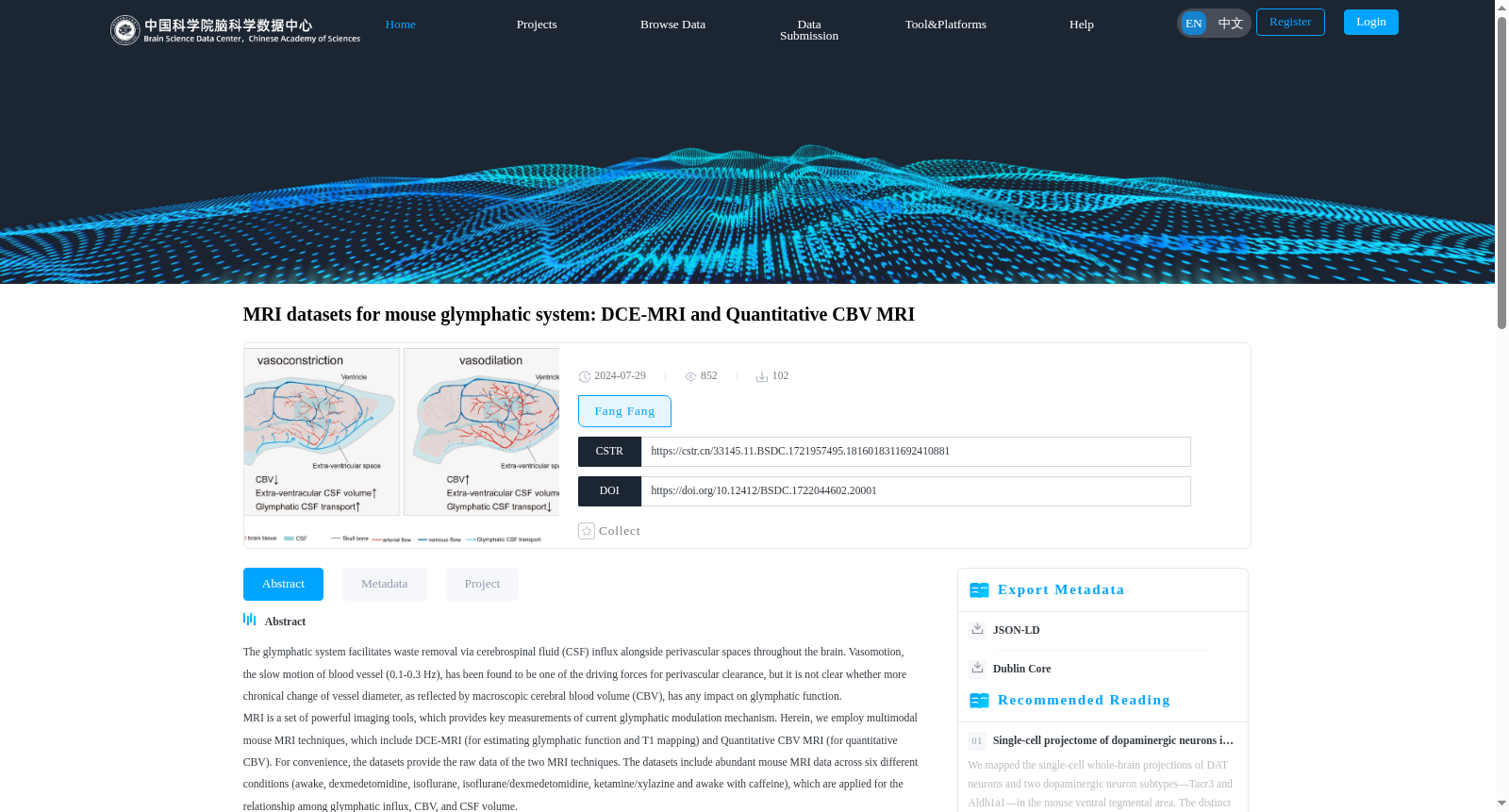
不同状态下小鼠类淋巴系统DCE-MRI和脑血流MRI数据集
收藏资源简介:
类淋巴系统通过脑脊液(CSF)沿着整个大脑的血管周围空间流入,促进废物的清除。血管舒缩,即血管的缓慢运动(0.1-0.3 Hz),已被发现是血管周围清除的动力之一,但尚不清楚宏观脑血容量(CBV)所反映的血管直径的更慢性变化是否对淋巴功能有影响。结合多模态小鼠MRI技术(DCE-MRI检测类淋巴功能、Bookend MRI定量CBV和T1 MRI定量脑脊液容量),本项目研究了六种不同条件下(清醒、右美托咪定、异氟醚、异氟醚/右美托咪定、氯胺酮/噻嗪和咖啡因清醒)类淋巴内流、CBV、脑脊液容量之间的关系。
The glymphatic system flows into the brain via cerebrospinal fluid (CSF) through the perivascular spaces of the entire brain, facilitating waste clearance. Vasomotion, referring to the slow rhythmic movement of blood vessels (0.1–0.3 Hz), has been identified as one of the driving forces for perivascular clearance. However, whether more chronic changes in vascular diameter, as reflected by macroscopic cerebral blood volume (CBV), affect glymphatic function remains unclear. Using multimodal mouse MRI techniques—including DCE-MRI for glymphatic function assessment, Bookend MRI for quantitative CBV measurement, and T1 MRI for quantitative cerebrospinal fluid volume quantification—this study investigated the relationships among glymphatic influx, CBV, and cerebrospinal fluid volume under six distinct conditions: awake, dexmedetomidine-treated, isoflurane-anesthetized, isoflurane/dexmedetomidine-coadministered, ketamine/thiazine-treated, and caffeine-administered awake.