qpl-multi-decomposer-fixed-ds
收藏资源简介:
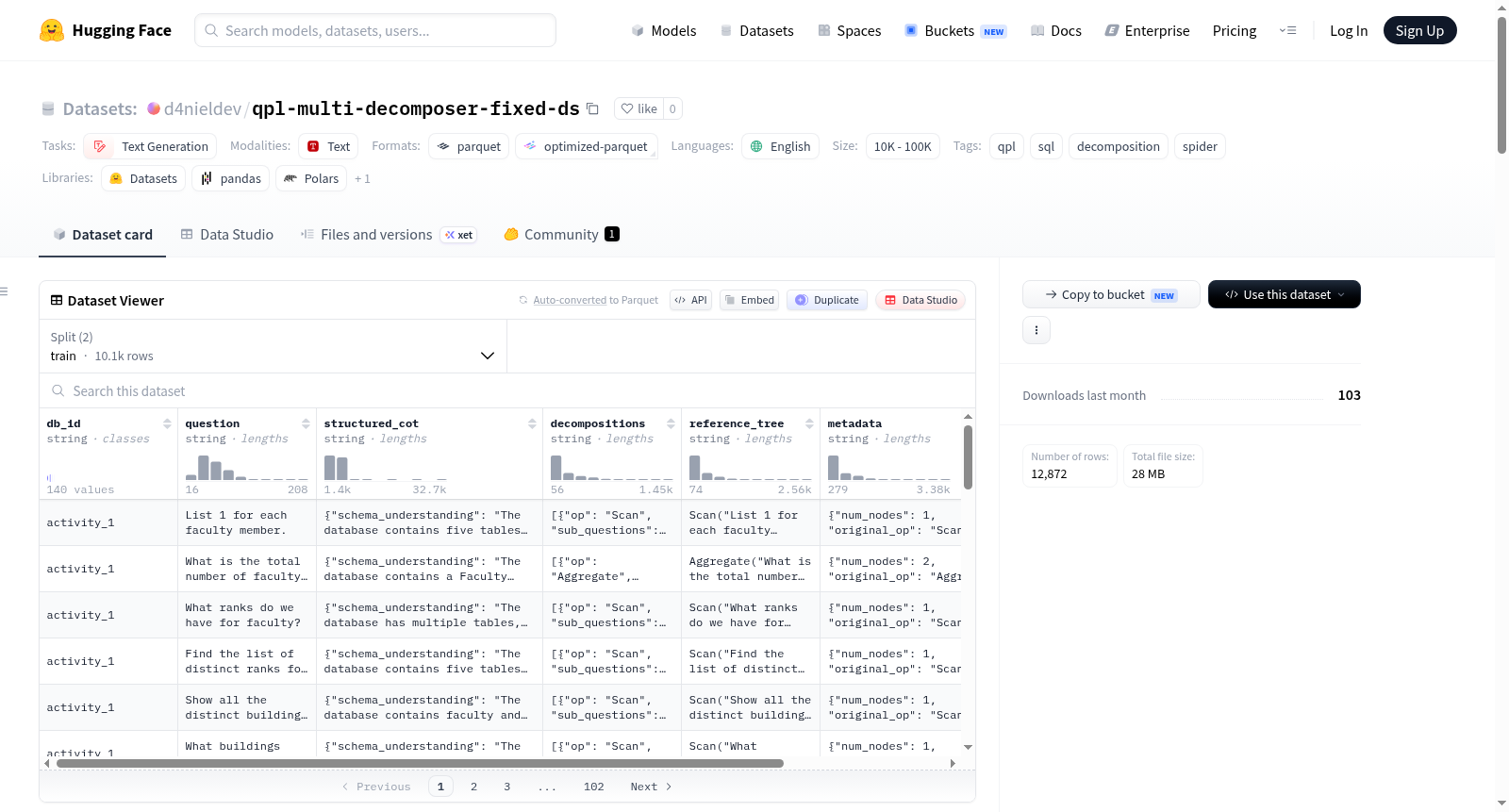
QPL Multi-Decomposer Dataset — Fixed 是一个经过人工审查和清理的文本生成数据集,专门用于查询规划语言(QPL)的分解任务。该数据集基于 Spider 数据库,旨在通过链式思维推理和多操作符分解,将自然语言问题转化为结构化的查询规划。数据集包含训练集(10,143 个样本)和验证集(2,729 个样本),总计超过 12,800 个样本。每个样本包含 7 个关键字段:数据库标识(db_id)、自然语言问题(question)、结构化的链式思维推理(structured_cot,以 JSON 字符串形式包含模式理解和 9 种 QPL 操作符的探索过程)、所有有效的顶层分解列表(decompositions,JSON 字符串)、参考 QPL 树(reference_tree)、元数据(metadata)以及 QPL 表达式(qpl)。数据集的核心改进在于对原始 LLM 生成数据中约 25% 的训练样本进行了人工审查,识别并移除了 22.4% 的无效分解(如牵强的“NOT X” Except、冗余的自连接等),并重写了这些无效操作的推理链为拒绝解释。修改后,训练集中操作符的分布为:Scan(5,524)、Filter(4,333)、Join(3,624)、Aggregate(2,185)、Except(1,105)、TopSort(565)、Intersect(557)、Sort(293)、Union(224)。验证集则保持原始版本不变,作为保留评估数据。该数据集适用于训练和评估文本到 SQL 分解模型、查询规划生成模型以及多步推理系统。
The QPL Multi-Decomposer Dataset — Fixed is a human-reviewed and curated text generation dataset dedicated to Query Planning Language (QPL) decomposition tasks. Built upon the Spider database, this dataset aims to convert natural language questions into structured query plans via Chain-of-Thought (CoT) reasoning and multi-operator decomposition. It comprises a training set (10,143 samples) and a validation set (2,729 samples), with a total of over 12,800 samples. Each sample contains 7 key fields: database ID (db_id), natural language question (question), structured Chain-of-Thought reasoning (structured_cot, a JSON string containing schema understanding and the exploration process of 9 QPL operators), list of all valid top-level decompositions (decompositions, JSON string), reference QPL tree (reference_tree), metadata, and QPL expression (qpl). The core improvement of this dataset is realized through human review of approximately 25% of the training samples from the raw LLM-generated data: 22.4% of invalid decompositions (such as far-fetched "NOT X" Except clauses, redundant self-joins, etc.) were identified and removed, and the reasoning chains of these invalid operations were rewritten into rejection explanations. After modification, the operator distribution in the training set is as follows: Scan (5,524), Filter (4,333), Join (3,624), Aggregate (2,185), Except (1,105), TopSort (565), Intersect (557), Sort (293), Union (224). The validation set remains unchanged from the original version, serving as the held-out evaluation data. This dataset is applicable for training and evaluating text-to-SQL decomposition models, query planning generation models, and multi-step reasoning systems.