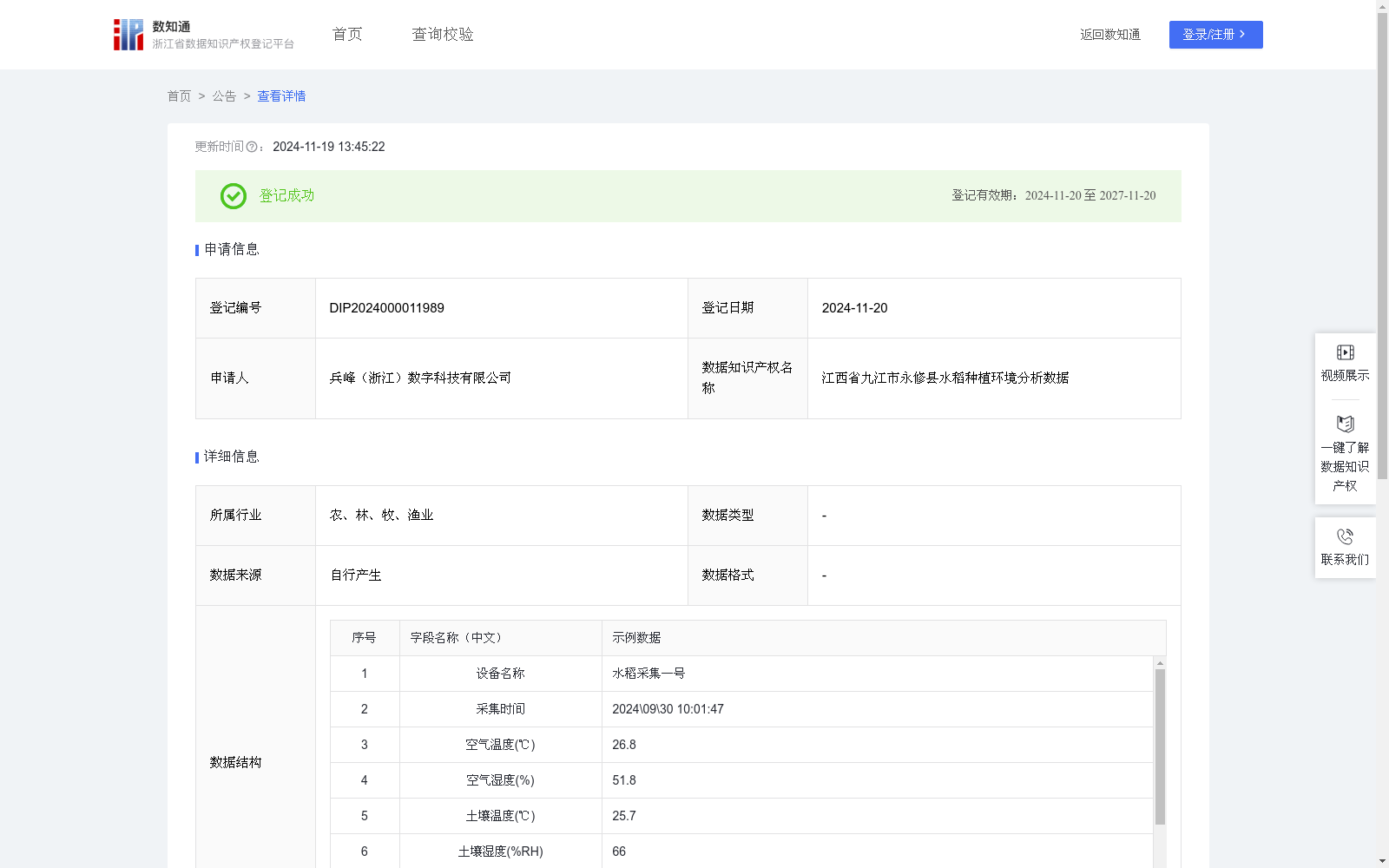
江西省九江市永修县水稻种植环境分析数据
收藏资源简介:
采集水稻种植的土壤湿温度、光照强度、二氧化碳浓度、空气温湿度等数据,全面评估不同环境条件对水稻生长的具体影响。如确定适宜的土壤温度和湿度水平,以保障水稻种子的顺利发芽和根系的稳固生长。明确合适的光照强度和时长,促使水稻进行充分的光合作用,积累足够的养分。把握恰当的二氧化碳浓度,助力水稻提高光合效率,增强生长活力。同时,监测适宜的空气温湿度,为水稻生长创造良好的大气环境。利用这些数据构建水稻品质与环境参数关联的深度网络模型,深入探索何种环境条件组合可以使水稻具有更高的产量、更优的米质和更好的抗病虫害能力等,为显著提升水稻品质奠定基础。基于数据驱动的方式,为水稻种植环境的智能调控提供有效的支持,依据实时数据自动调整灌溉量、通风强度以及遮阳程度等,为水稻创造适宜的生长环境,提高种植效率和产量。将优化后的环境调控经验推广应用至不同地区的水稻种植中,形成多维度细粒度的感知与控制模式,有力推动水稻种植产业朝着科学、高效、模式可移植的方向发展,全面提升整个产业的竞争力。1.数据采集:本系统通过空气湿温度传感器、光照传感器、土壤温湿度传感器等物联网设备,结合4G/5G、Wi-Fi与有线网络,实时采集种植环境中的空气湿温度、光照、土壤湿温度、二氧化碳等多维数据。 2.算法规则:系统采用环境参数评分算法,对环境数据进行评分。基于作物生长理想条件(如温度、湿度、光照等),并通过以下公式计算:环境参数评分=100-Σ(w_i×|当前值_i-理想值_i|/容差_i),其中,Σ表示对所有参数的累加,w_i是第i个参数的权重。当前值_i是第i个参数的实际测量值,理想值_i是第i个参数的理想值。容差_i是第i个参数的允许波动范围。权重、理想值和容差范围设定基于历史数据分析以及实际种植经验的确定。对作物生长影响较大的参数获得较高的权重。容差范围则考虑到环境因素的波动性,针对作物对不同环境变化的耐受性设定进行适当设定,环境参数偏离理想值越多,扣分越大,以空气温度为例,其权重为3,理想值设定为28℃,容差范围为±2℃,扣分计算如下:空气温度扣分=3×|26.8-28|/2=3×0.6=1.8。根据这些评分生成具体的环境优化方案。
This dataset collects multi-dimensional environmental data including soil temperature and humidity, light intensity, carbon dioxide concentration, and air temperature and humidity during rice planting, to comprehensively evaluate the specific impacts of different environmental conditions on rice growth. Specifically, it aims to determine suitable soil temperature and humidity levels to ensure smooth germination of rice seeds and stable growth of their root systems; define appropriate light intensity and duration to promote sufficient photosynthesis and nutrient accumulation in rice; grasp proper carbon dioxide concentration to enhance rice photosynthetic efficiency and growth vitality; and monitor suitable air temperature and humidity to create a favorable atmospheric environment for rice growth. Using these data, a deep neural network model correlating rice quality with environmental parameters is constructed to deeply explore which combination of environmental conditions can enable higher rice yield, better grain quality, and stronger pest and disease resistance, laying a foundation for significantly improving rice quality. Adopting a data-driven approach, this work provides effective support for intelligent regulation of rice planting environments: automatically adjusting irrigation volume, ventilation intensity, shading degree, etc., based on real-time data to create suitable growth environments for rice and improve planting efficiency and yield. The optimized environmental regulation experience will be promoted and applied to rice planting in different regions, forming a multi-dimensional and fine-grained perception and control mode, effectively promoting the rice planting industry towards a scientific, efficient, and transferable development direction, and comprehensively enhancing the competitiveness of the entire industry. 1. Data Collection: This system collects real-time multi-dimensional data of the planting environment, including air temperature and humidity, light, soil temperature and humidity, carbon dioxide, etc., via IoT devices such as air temperature and humidity sensors, light sensors, and soil temperature and humidity sensors, combined with 4G/5G, Wi-Fi, and wired networks. 2. Algorithm Rules: The system uses an environmental parameter scoring algorithm to evaluate environmental data. The scoring is calculated based on the ideal conditions for crop growth (such as temperature, humidity, light, etc.) using the following formula: Environmental Parameter Score = 100 - Σ(w_i × |Current Value_i - Ideal Value_i| / Tolerance_i) Where Σ represents the summation over all parameters, w_i is the weight of the i-th parameter, Current Value_i is the actual measured value of the i-th parameter, Ideal Value_i is the ideal value of the i-th parameter, and Tolerance_i is the allowable fluctuation range of the i-th parameter. The weights, ideal values, and tolerance ranges are determined based on historical data analysis and actual planting experience. Parameters with greater impacts on crop growth are assigned higher weights. The tolerance ranges are appropriately set considering the volatility of environmental factors and the crop's tolerance to different environmental changes. The more the environmental parameter deviates from the ideal value, the greater the deduction. Taking air temperature as an example, its weight is 3, the ideal value is set to 28℃, and the tolerance range is ±2℃. The deduction calculation is as follows: Air Temperature Deduction = 3 × |26.8 - 28| / 2 = 3 × 0.6 = 1.8. Specific environmental optimization schemes are generated based on these scores.