genter-ajibawa-name-filled
收藏资源简介:
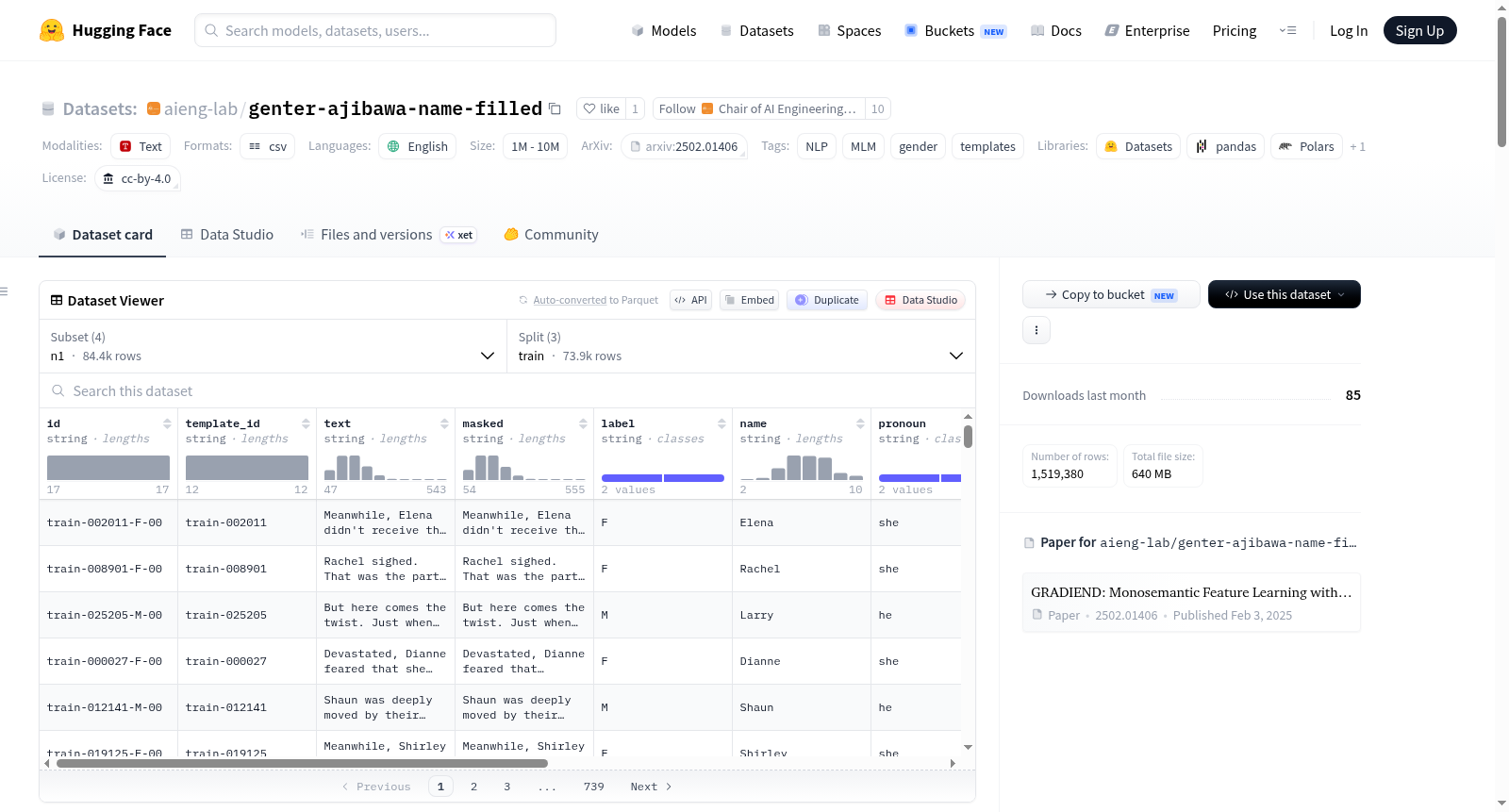
GENTER Ajibawa Name-Filled 是一个基于模板和真实姓名填充的英文数据集,用于自然语言处理中的性别偏见研究及掩码语言模型训练。该数据集扩展了 aieng-lab/genter-ajibawa 模板数据集,将具体的姓名和匹配的代词直接插入每个模板句子中,生成可直接用于训练的文本,而非保留占位符。数据集通过 Hugging Face 配置提供四个子集(n1、n2、n5、n10),分别对应每个模板和每个性别插入 1、2、5 或 10 个姓名变体,且子集是递增嵌套的(n1 包含于 n2,依此类推)。每个配置均划分为训练集、验证集和测试集。数据字段包括:唯一 ID、对应模板 ID、填充后的文本、用于训练的可掩码文本(代词位置替换为 [MASK])、目标代词、性别标签、插入的姓名、代词、以及原始模板的性别关联信息等。该数据集适用于需要具体文本而非占位符的偏见分析实验,也可与 gradiend Python 包结合使用进行 GRADIEND 训练。数据来源:模板来自基于 Apache-2.0 许可的 ajibawa-2023/General-Stories-Collection,姓名来自 CC-BY-4.0 许可的 aieng-lab/namexact,本衍生数据集采用 CC-BY-4.0 许可。注意:由于每个模板仅使用固定样本的姓名,数据集不代表姓名的真实频率分布,建议使用 original_gender 字段区分保持原始模板性别关联的样本与反事实样本。
GENTER Ajibawa Name-Filled is an English dataset based on templates and real name filling, designed for gender bias research in natural language processing and masked language model training. It extends the aieng-lab/genter-ajibawa template dataset by directly inserting specific names and matching pronouns into each template sentence, generating text ready for training rather than retaining placeholders. The dataset provides four subsets (n1, n2, n5, n10) via Hugging Face configurations, corresponding to inserting 1, 2, 5, or 10 name variants per template and per gender, with subsets being incrementally nested (n1 contained in n2, etc.). Each configuration is split into training, validation, and test sets. Data fields include: unique ID, corresponding template ID, filled text, maskable text for training (pronoun positions replaced with [MASK]), target pronoun, gender label, inserted name, pronoun, and original template gender association information. The dataset is suitable for bias analysis experiments requiring concrete text rather than placeholders, and can be used with the gradiend Python package for GRADIEND training. Data sources: templates from the Apache-2.0 licensed ajibawa-2023/General-Stories-Collection, names from the CC-BY-4.0 licensed aieng-lab/namexact, and this derivative dataset is licensed under CC-BY-4.0. Note: Since each template uses only a fixed sample of names, the dataset does not represent the real frequency distribution of names. It is recommended to use the original_gender field to distinguish samples that retain the original template gender association from counterfactual samples.
GENTER Ajibawa Name-Filled 数据集详情
数据集概述
该数据集扩展自 aieng-lab/genter-ajibawa,通过向每个模板中插入具体人名生成。数据集提供嵌套的 Hugging Face 配置,每个性别和模板包含 1、2、5 或 10 个名字。该数据集适用于需要具体文本而非 [NAME]/[PRONOUN] 占位符的实验,同时保持与模板数据集的关联。
基本信息
- 语言:英语(en)
- 许可证:CC-BY-4.0
- 标签:NLP、MLM、性别、模板
- 论文:https://arxiv.org/abs/2502.01406
- 仓库:https://github.com/aieng-lab/gradiend-bias
- 数据集作者:jdrechsel
数据来源
- 模板数据:
aieng-lab/genter-ajibawa(基于ajibawa-2023/General-Stories-Collection) - 姓名数据:
aieng-lab/namexact - 模板文本许可证:Apache-2.0(源自 Ajibawa)
- 姓名数据许可证:CC-BY-4.0(NAMEXACT)
数据集结构
数据行字段说明
| 字段 | 说明 |
|---|---|
id |
稳定的姓名填充示例 ID |
template_id |
对应 aieng-lab/genter-ajibawa 中的行 ID |
text |
包含具体姓名和匹配代词的填充后文本 |
training_masked |
可训练文本,具体姓名保留,代词位置替换为 [MASK] |
target |
training_masked 的代词目标 |
masked |
与 training_masked 相同的掩码文本,兼容默认 GRADIEND 列名 |
label |
插入姓名的性别标签(F 或 M) |
name |
插入的姓名 |
pronoun |
插入的代词(F 对应 she,M 对应 he) |
original_gender |
插入性别是否与原始模板性别匹配 |
original_label |
原始模板性别标签 |
original_name |
模板提取时发现的原始姓名 |
original_pronoun |
模板提取时发现的原始代词 |
pronoun_count |
模板中代词占位符的数量 |
配置与分割
数据集提供 4 种配置(n1、n2、n5、n10),默认配置为 n1。配置间为自然子集关系:n1 中的数据行全部包含于 n2,n2 包含于 n5,n5 包含于 n10。
| 配置 | 分割 | 样本数 |
|---|---|---|
| n1 | train | 73,860 |
| n1 | validation | 2,110 |
| n1 | test | 8,440 |
| n2 | train | 147,720 |
| n2 | validation | 4,220 |
| n2 | test | 16,880 |
| n5 | train | 369,300 |
| n5 | validation | 10,550 |
| n5 | test | 42,200 |
| n10 | train | 738,600 |
| n10 | validation | 21,100 |
| n10 | test | 84,400 |
使用方式
该数据集可与 gradiend Python 包配合使用,用于 GRADIEND 训练,无需手动填充姓名:
python from gradiend import TextPredictionTrainer, TrainingArguments
trainer = TextPredictionTrainer( model="bert-base-cased", hf_dataset="aieng-lab/genter-ajibawa-name-filled", hf_subset="n1", target_classes=["M", "F"], masked_col="training_masked", label_col="target", label_class_col="label", args=TrainingArguments(max_steps=100, train_batch_size=32), ) trainer.train()
所有配置均包含 train、validation 和 test 三个分割。
偏差、风险与局限性
该数据集将每个模板与固定的人名样本相乘,因此不代表真实的人名频率分布。可使用 original_gender 字段区分保留原始模板性别关联的示例与反事实姓名/代词实例。
引用
bibtex @inproceedings{drechsel2026gradiend, title = {{GRADIEND}: Feature Learning within Neural Networks Exemplified through Biases}, author = {Drechsel, Jonathan and Herbold, Steffen}, booktitle = {Proceedings of the International Conference on Learning Representations}, year = {2026}, url = {https://arxiv.org/abs/2502.01406} }