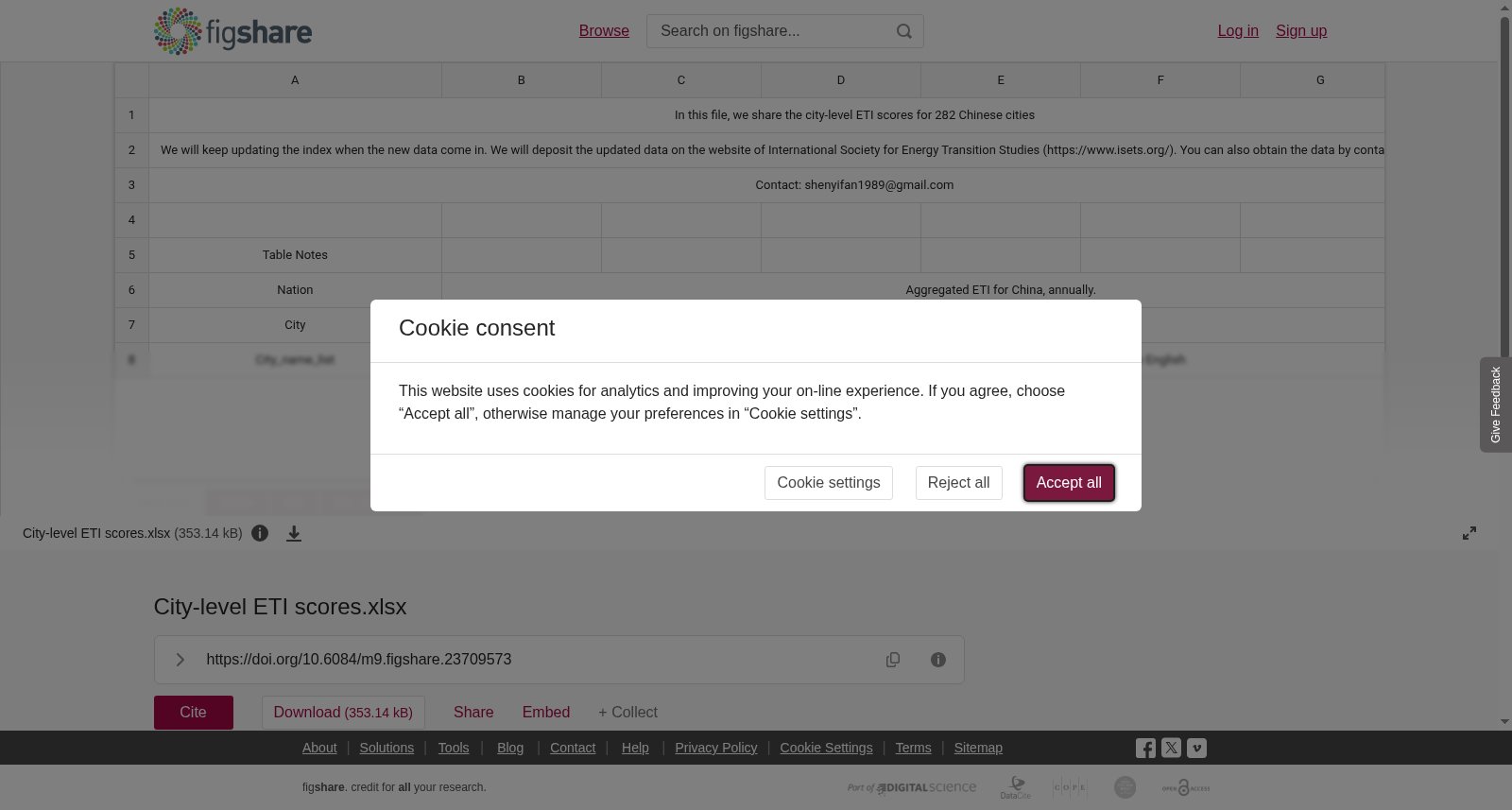
City-level ETI scores.xlsx
收藏资源简介:
The global target of limiting the increase in temperature to 1.5°C requires a shift from fossil fuels to renewable sources of energy, particularly in urban areas that house over half of the world's population and are major consumers of energy and emitters of carbon. However, cities vary in their energy systems and socioeconomic capacities to transition to renewable energy. To address this heterogeneity, this study proposes an Energy Transition Index (ETI) specifically designed for cities, and applies it to track the progress of energy transition in Chinese cities. The city-level ETI framework is based on the national ETI developed by the World Economic Forum (WEF) and comprises two sub-indexes: the Energy System Performance sub-index, which evaluates the current status of cities' energy systems in terms of energy transition, and the Transition Readiness sub-index, which assesses their socioeconomic capacity for future energy transition. The Energy System Performance sub-index includes two dimensions and seven components, while the Transition Readiness sub-index has four dimensions and eleven components. Each component consists of one or more indicators. The initial version of the dataset includes ETI and its sub-indexes for 282 Chinese cities from 2003 to 2019, with annual updates planned. The spatiotemporal data provided by the dataset facilitates research into the energy transition roadmap for different cities, which can help China achieve its energy transition goals.
将全球气温升幅限制在1.5℃以内的全球目标,要求能源体系从化石燃料向可再生能源转型,尤其在承载全球过半人口、同时为能源消费与碳排放大户的城市地区。但不同城市的能源系统与可再生能源转型的社会经济能力存在显著异质性。为应对这一异质性,本研究提出了专为城市打造的能源转型指数(Energy Transition Index, ETI),并将其用于追踪中国城市的能源转型进程。城市级能源转型指数框架依托世界经济论坛(World Economic Forum, WEF)制定的国家级能源转型指数构建,包含两大分指数:其一为能源系统绩效分指数,用于从能源转型维度评估城市当前的能源系统现状;其二为转型准备度分指数,用以评估城市未来开展能源转型的社会经济能力。能源系统绩效分指数包含2个维度与7个构成项,转型准备度分指数则涵盖4个维度与11个构成项,每个构成项均由1个或多个指标组成。本数据集的初始版本涵盖2003年至2019年中国282座城市的能源转型指数及其分指数数据,并计划按年度进行更新。本数据集提供的时空数据,可为不同城市的能源转型路径研究提供支撑,助力中国达成能源转型目标。