ethara/milo-bench-samples
收藏资源简介:
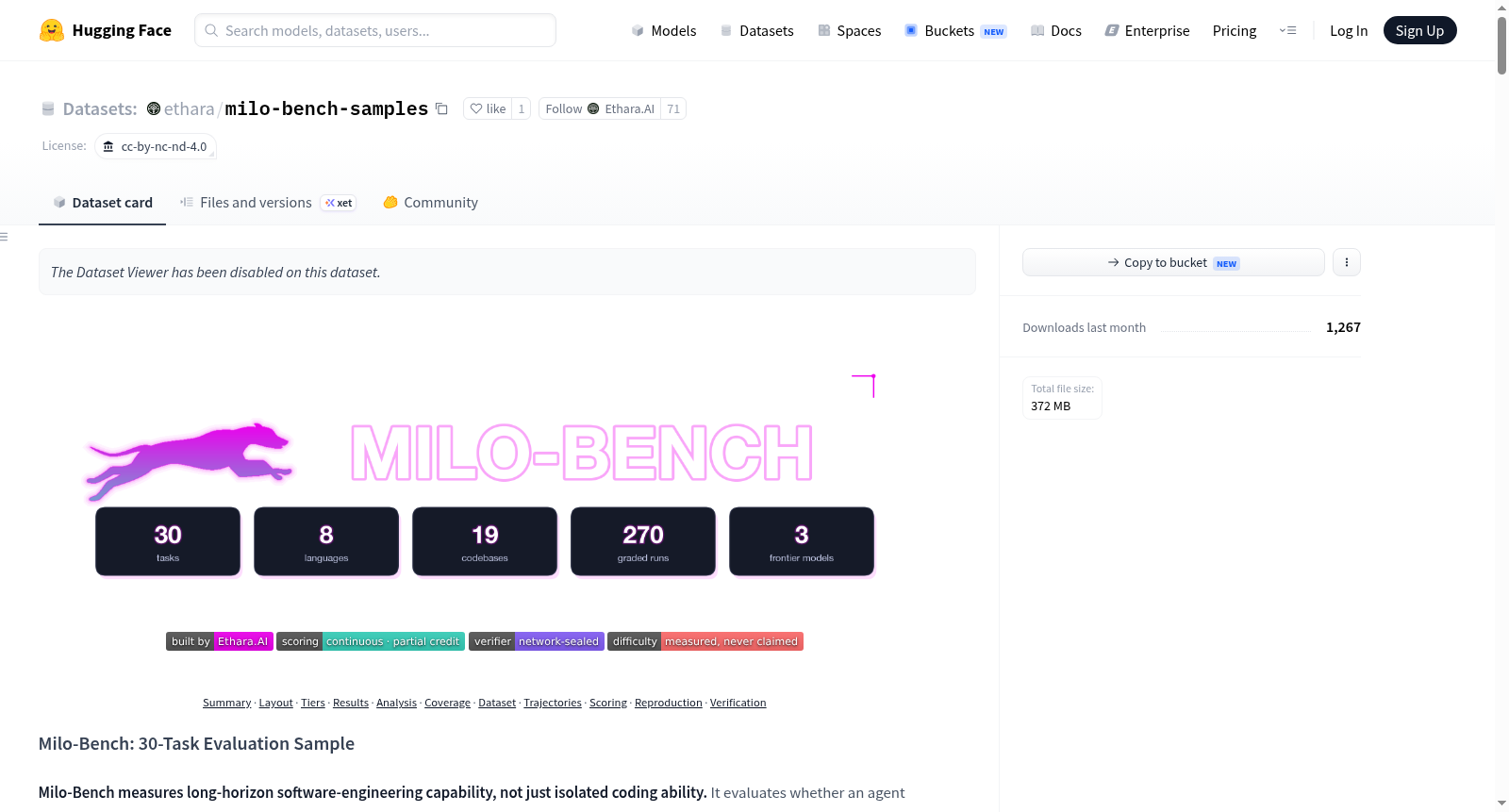
Milo-Bench是一个用于评估长视野软件工程能力的基准测试数据集,专注于里程碑规模的工程任务,而非孤立的编码能力。它测量代理是否能够完成跨越多个文件、语言和架构组件的里程碑规模工程任务,同时保持现有生产代码库的正确性。数据集包含30个任务,分为五个难度等级(Trivial、Easy、Medium、Hard、Expert),基于观察到的难度进行校准。任务覆盖8种编程语言(Go、Python、TypeScript、Rust、C、Java、JavaScript、C++)和19个代码库。每个任务都包含三个前沿模型(Claude Opus 4.8、Gemini 3.1 Pro、GPT-5.5)的完整代理轨迹,每个模型运行3次,总共270次评分运行。评分采用连续部分信用机制,范围从0到1,通过网络密封的验证器进行评分,确保公平性。数据集是完整Milo-Bench语料库的代表性样本,用于评估,其格式、轨迹和评分与生产基准相同。
Milo-Bench is a benchmark dataset designed to evaluate long-horizon software engineering capabilities, focusing on milestone-scale engineering tasks rather than isolated coding abilities. It measures whether AI Agents can complete milestone-scale engineering tasks spanning multiple files, programming languages and architectural components, while preserving the correctness of existing production codebases. The dataset contains 30 tasks divided into five difficulty levels (Trivial, Easy, Medium, Hard, Expert), calibrated based on observed task difficulty. The tasks cover 8 programming languages (Go, Python, TypeScript, Rust, C, Java, JavaScript, C++) and involve 19 codebases. Each task includes complete agent execution trajectories from three state-of-the-art models: Claude Opus 4.8, Gemini 3.1 Pro, and GPT-5.5, with 3 runs per model, totaling 270 scored evaluation runs. Scoring adopts a continuous partial credit mechanism ranging from 0 to 1, and is conducted via web-sealed validators to ensure evaluation fairness. This dataset is a representative sample of the full Milo-Bench corpus for evaluation purposes, with its format, trajectory data and scoring protocol identical to those of the official production benchmark.