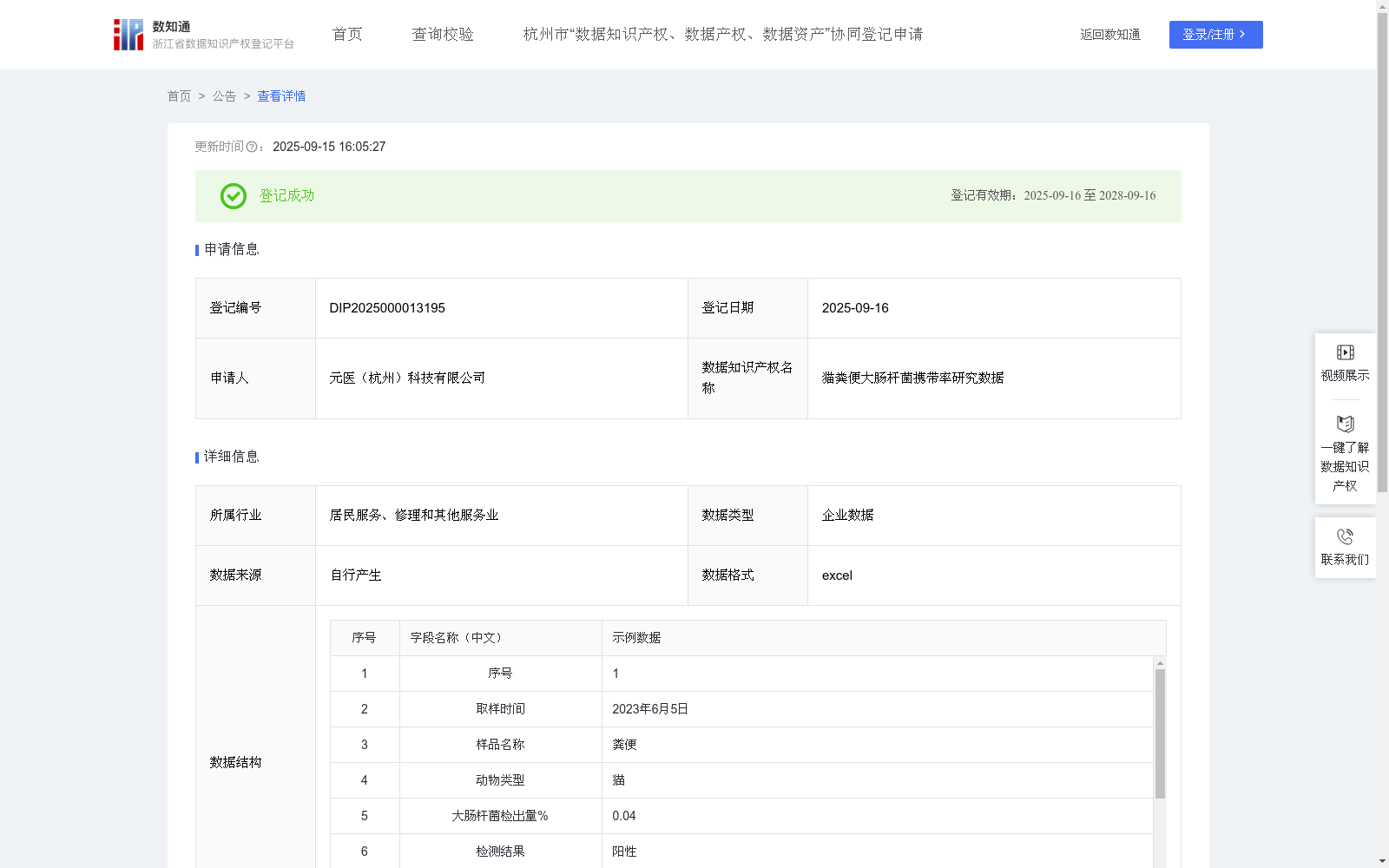
猫粪便大肠杆菌携带率研究数据
收藏资源简介:
大肠杆菌是动物肠道中常见的细菌,但在某些情况下可能致病。其携带情况是评估猫肠道微生态健康的重要指标之一,大肠杆菌的检测有助于评估猫的肠道健康情况。其次,大肠杆菌不仅影响动物健康,还可能会影响人类,导致人畜共患病。因此,监测宠物猫粪便中的大肠杆菌有助于评估公共卫生风险,并为疾病预防、控制和管理提供关键信息。猫粪便大肠杆菌携带率研究还可以为流行病学的研究提供数据支持,有助于确定中国本土区域宠物中大肠杆菌的本底流行水平,为判断后续可能出现的异常流行情况提供基线参照。1、数据采集:从宠物医院收集一批(547只)猫粪便样本,按照1-547的顺序进行样本编号,并对基础信息、临床资料进行分析调查。2、数据检测:对收集到的547只动物粪便样本分别进行16S微生物测序,按照16S微生物测序数据分析流程进行数据分析,在属水平上统计大肠杆菌检出量,检测结果大于0的样本标记为检测结果阳性。3、数据处理:① 统计阳性总数,平均携带率=阳性总数/样本总数;② 平均携带丰度=AVERAGE(大肠杆菌检出量%);③ 将大肠杆菌检出量按照从小到大的顺序排序,四分位数Q3=3 (n + 1)/4位置的检测数值,n为样本总数。4、数据应用:利用PYTHON收集群体样本大肠杆菌检出丰度,用MATPLOTLIB将该数据画出拟合图,便于研究人员观察分析。5、数据分类分级:将计算出的大肠杆菌检出量进行指标评价,分为“高、中、低“不同的类别和级别(大肠杆菌检出量值大于四分位数Q3的为“高”,大于0且小于等于Q3为“中”,值为0的为“低”)。
Escherichia coli (E. coli) is a common bacterium in the intestinal tracts of animals, yet it can cause disease under certain conditions. The carriage status of E. coli is one of the key indicators for evaluating the intestinal microecological health of cats, and detection of E. coli contributes to assessing the intestinal health of cats. Furthermore, E. coli not only affects animal health but also poses a threat to human health, leading to zoonotic diseases. Therefore, monitoring E. coli in the feces of pet cats helps evaluate public health risks and provides critical information for disease prevention, control, and management. Research on the E. coli carriage rate in cat feces can also offer data support for epidemiological studies, aiding in determining the baseline prevalence of E. coli among pets in local regions of China, and providing a baseline reference for identifying potential abnormal prevalence events in the future. 1. Data Collection: A total of 547 cat fecal samples were collected from pet hospitals, numbered sequentially from 1 to 547, and basic information and clinical data were analyzed and investigated. 2. Data Detection: All 547 collected cat fecal samples underwent 16S microbial sequencing individually. Data analysis was conducted following the standard 16S microbial sequencing data analysis workflow, and the detection quantity of E. coli was quantified at the genus level. Samples with a detection result greater than 0 were marked as positive. 3. Data Processing: ① Calculate the total number of positive samples; the average carriage rate = total number of positive samples / total number of samples; ② The average carriage abundance = AVERAGE(E. coli detection quantity percentage); ③ Sort the E. coli detection quantities in ascending order, where the third quartile (Q3) corresponds to the detection value at the position of 3*(n+1)/4, with n being the total number of samples. 4. Data Application: Python was used to collect the E. coli detection abundance of the population samples, and Matplotlib was employed to plot a fitted graph of the data, enabling researchers to conduct observation and analysis conveniently. 5. Data Classification and Grading: The calculated E. coli detection quantities were evaluated with indicator criteria and classified into three categories and levels: "high", "medium", and "low" (samples with E. coli detection quantity greater than Q3 are classified as "high", those with a value greater than 0 and less than or equal to Q3 as "medium", and those with a value of 0 as "low").