
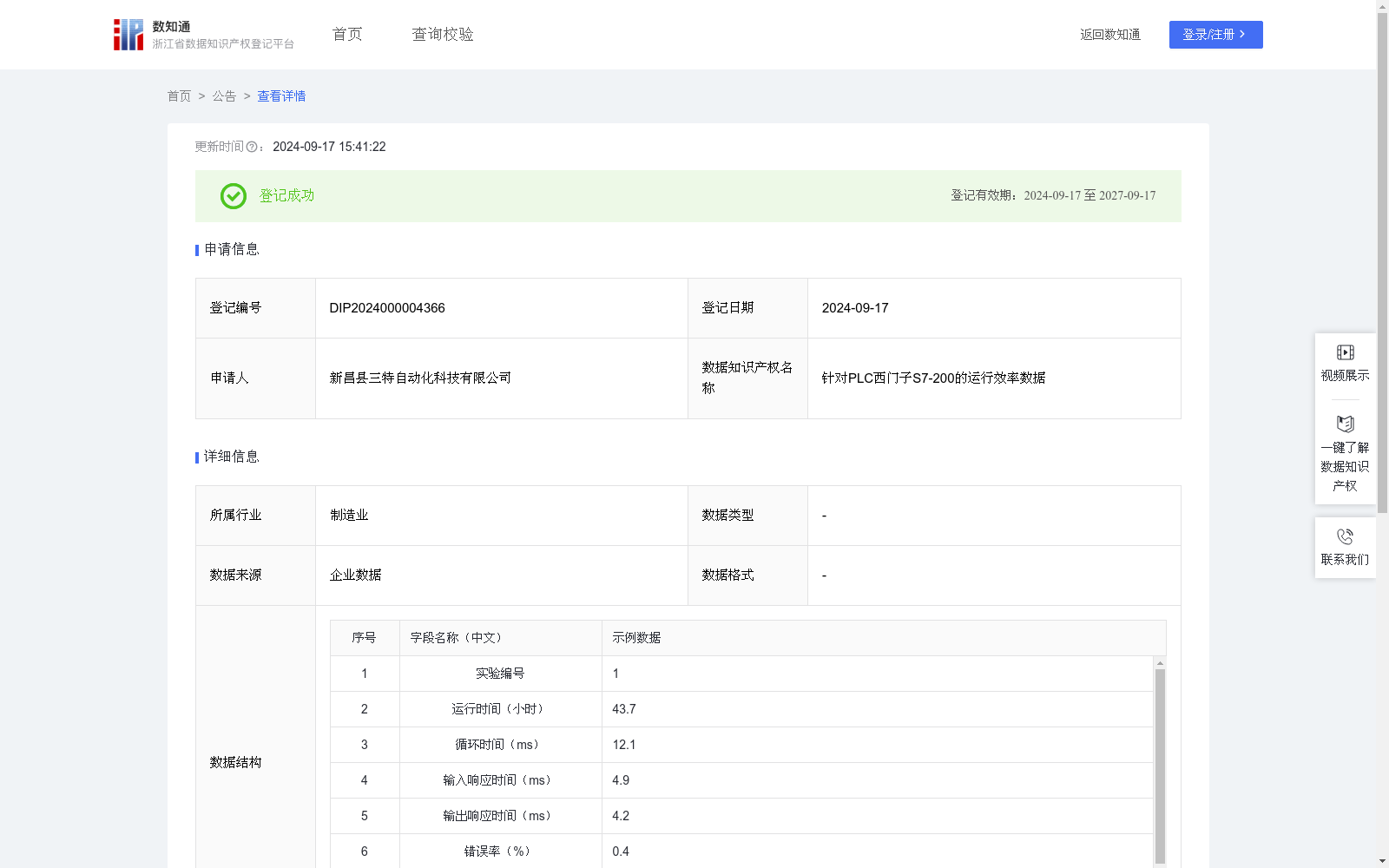
针对PLC西门子S7-200的运行效率数据
收藏浙江省数据知识产权登记平台2024-09-17 更新2024-09-19 收录
下载链接:
https://www.zjip.org.cn/home/announce/trends/62011
下载链接
链接失效反馈官方服务:
资源简介:
西门子S7-200 PLC运行效率数据在工业自动化环境中具有广泛的应用,通过合理利用这些数据和算法规则,可以提高系统性能、优化资源管理、预测性维护以及故障诊断。优化运行效率:根据循环时间和响应时间数据,优化PLC程序,减少不必要的延迟,提高系统响应速度。资源优化管理:通过监测CPU负载和内存使用率,合理分配资源,防止资源过载,提高系统整体性能。预测性维护:基于运行时间和性能指标,制定预测性维护计划,减少非计划停机时间,延长设备寿命。然而,因数据基于长时间运行结果,不适用于仅进行短时间测试的场景。非西门子设备以及无复杂任务的场景中,这些数据和规则可能不适用,需要根据具体情况进行调整和优化。算法规则:错误率的计算通常基于运行过程中记录的错误事件数量。公式如下:\text{错误率(%)} = \left( \frac{\text{错误事件数}}{\text{总运行时间(小时)} \times 60 \times 60 \times \text{每秒扫描次数}} \right) \times 100;CPU负载表示处理器在处理任务时的繁忙程度,通常是通过PLC自带的诊断工具或监控软件实时测量的。一般PLC会有一个系统寄存器专门用于记录CPU的当前负载,可以通过编程读取该值。\text{CPU负载(%)} = \left( \frac{\text{CPU实际使用时间}}{\text{CPU总可用时间}} \right) \times 100
The operating efficiency data of Siemens S7-200 PLC has widespread applications in industrial automation settings. Through the prudent utilization of this data and algorithmic rules, system performance can be improved, resource management optimized, predictive maintenance enabled, and fault diagnosis facilitated.
1. Optimizing Operational Efficiency: Based on cycle time and response time data, PLC programs can be optimized to reduce unnecessary delays and boost system response speed.
2. Resource Optimization and Management: By monitoring CPU load and memory utilization, resources can be rationally allocated to prevent resource overloading and enhance overall system performance.
3. Predictive Maintenance: Predictive maintenance plans can be formulated based on operating duration and performance metrics, reducing unplanned downtime and extending equipment service lifespan.
However, since the data is derived from long-term operating outcomes, it is not applicable to scenarios that only involve short-term testing. For non-Siemens equipment or scenarios without complex tasks, these data and rules may not be suitable, and adjustments and optimizations are required based on specific circumstances.
Algorithmic Rules: The error rate is typically calculated based on the number of error events recorded during operation. The formula is as follows:
$$ ext{Error Rate (\%)} = left( frac{ ext{Number of Error Events}}{ ext{Total Operating Time (hours)} imes 60 imes 60 imes ext{Number of Scans per Second}}
ight) imes 100$$
CPU load represents the busy degree of the processor when processing tasks, which is usually measured in real time via the PLC's built-in diagnostic tools or monitoring software. Generally, a PLC is equipped with a system register dedicated to recording the current CPU load, which can be read through programming.
$$ ext{CPU Load (\%)} = left( frac{ ext{Actual CPU Usage Time}}{ ext{Total Available CPU Time}}
ight) imes 100$$
提供机构:
新昌县三特自动化科技有限公司
创建时间:
2024-07-29
搜集汇总
数据集介绍
以上内容由遇见数据集搜集并总结生成


