玉米南方锈病图库数据集
收藏资源简介:
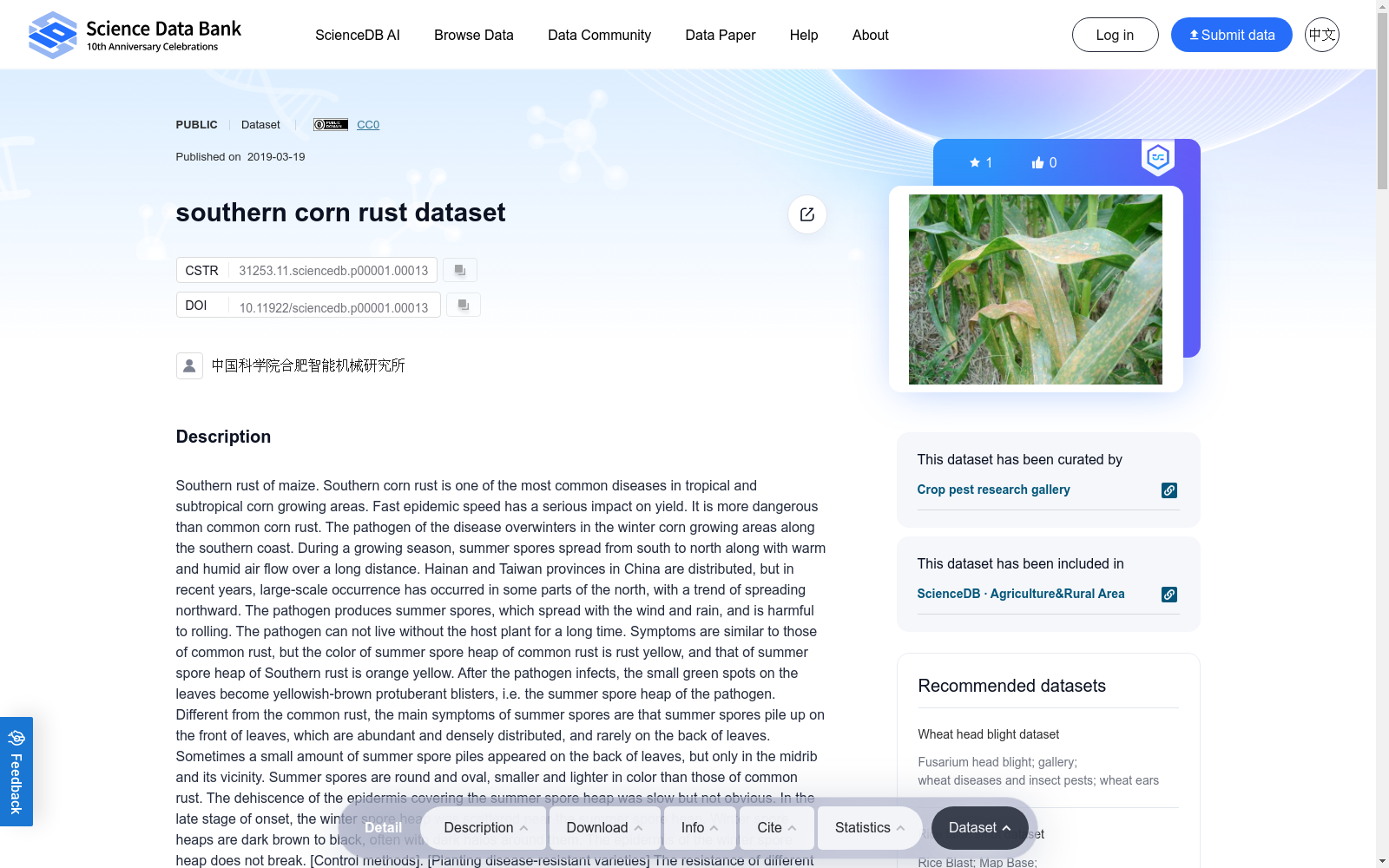
Southern rust of maize. Southern corn rust is one of the most common diseases in tropical and subtropical corn growing areas. Fast epidemic speed has a serious impact on yield. It is more dangerous than common corn rust. The pathogen of the disease overwinters in the winter corn growing areas along the southern coast. During a growing season, summer spores spread from south to north along with warm and humid air flow over a long distance. Hainan and Taiwan provinces in China are distributed, but in recent years, large-scale occurrence has occurred in some parts of the north, with a trend of spreading northward. The pathogen produces summer spores, which spread with the wind and rain, and is harmful to rolling. The pathogen can not live without the host plant for a long time. Symptoms are similar to those of common rust, but the color of summer spore heap of common rust is rust yellow, and that of summer spore heap of Southern rust is orange yellow. After the pathogen infects, the small green spots on the leaves become yellowish-brown protuberant blisters, i.e. the summer spore heap of the pathogen. Different from the common rust, the main symptoms of summer spores are that summer spores pile up on the front of leaves, which are abundant and densely distributed, and rarely on the back of leaves. Sometimes a small amount of summer spore piles appeared on the back of leaves, but only in the midrib and its vicinity. Summer spores are round and oval, smaller and lighter in color than those of common rust. The dehiscence of the epidermis covering the summer spore heap was slow but not obvious. In the late stage of onset, the winter spore heap was scattered near the summer spore heap. Winter spore heaps are dark brown to black, often with dark halos around them. The epidermis of the winter spore heap does not break. [Control methods]. [Planting disease-resistant varieties] The resistance of different maize varieties to rust is quite different, and using disease-resistant varieties is an effective way to control maize rust. [Scientific field management] timely sowing; appropriate reduction of nitrogen fertilizer, increased application of phosphorus and potassium fertilizer, timely spraying of foliar nutrients to improve disease resistance of maize plants; rational control of density, improve permeability. Early removal of plant debris in and around the field before planting, if found in the growing period should be timely pulled out and centralized destruction, maize harvest should also be timely removal of residual plants, stems and leaves, centralized burning or fertilization. Rotation and non-gramineous crop rotation can reduce the accumulation of pathogens. For sporadic maize, the diseased plants and residual disease bodies should be pulled out at any time. [Scientific field management] timely sowing; appropriate reduction of nitrogen fertilizer, increased application of phosphorus and potassium fertilizer, timely spraying of foliar nutrients to improve disease resistance of maize plants; rational control of density, improve permeability. Early removal of plant debris in and around the field before planting, if found in the growing period should be timely pulled out and centralized destruction, maize harvest should also be timely removal of residual plants, stems and leaves, centralized burning or fertilization. Rotation and non-gramineous crop rotation can reduce the accumulation of pathogens. For sporadic maize, the diseased plants and residual disease bodies should be pulled out at any time. [Pharmaceutical control, prevention mainly] Spraying agents containing difenoconazole, tebuconazole, triazolone, propiconazole, pyrimethyl ester, ethermycin ester and pyrazole ether ester can effectively alleviate the occurrence of Southern rust in late stage of maize trumpet-silking. Prevention plan: in order to prevent the occurrence of Southern rust, farmers can use 25% powder, 20%, three zolone pesticide spray control. If there is no prevention in the early stage, spraying in the early stage of rust can also control the incidence of rust and reduce the impact on production to a certain extent.
玉米南方锈病。南方玉米锈病是热带、亚热带玉米种植区最常见的病害之一,传播速度极快,对产量造成严重影响,危害程度重于普通玉米锈病。该病害的病原菌在南部沿海的冬季玉米种植区越冬。在一个生长季内,夏孢子可随暖湿气流长距离由南向北传播。我国海南、台湾两省均有分布,但近年来北方部分地区已出现大规模发生,且呈现向北扩散的态势。该病原菌产生夏孢子,夏孢子借风雨传播,可对玉米造成危害,且无法脱离寄主植物长期存活。其症状与普通玉米锈病相似,但普通玉米锈病的夏孢子堆呈锈黄色,而南方锈病的夏孢子堆为橙黄色。病原菌侵染叶片后,最初会出现小型绿色斑点,随后发展为黄褐色隆起的疱斑,即病原菌的夏孢子堆。与普通锈病不同,南方锈病的夏孢子堆主要分布于叶片正面,数量众多且分布密集,极少出现在叶片背面。仅在少数情况下,叶片背面会出现少量夏孢子堆,且仅集中于叶脉及其附近区域。夏孢子呈圆形或椭圆形,相较于普通锈病的夏孢子,其体积更小、颜色更浅。覆盖夏孢子堆的表皮开裂速度缓慢,且开裂迹象并不明显。病害发病后期,冬孢子堆会散生于夏孢子堆附近。冬孢子堆呈深褐色至黑色,周围常带有深色晕圈,且其表皮不会开裂。【防治方法】(一)种植抗病品种 不同玉米品种对锈病的抗性差异显著,选用抗病品种是防治玉米锈病的有效手段。(二)科学田间管理 适时播种;合理减少氮肥施用量,增施磷钾肥;及时喷施叶面营养剂,提升玉米植株的抗病能力;合理调控种植密度,改善田间通风透光条件。播种前及时清除田间及周边的植株残体;生长季发现病株需及时拔除并集中销毁;玉米收获后应及时清除残留植株、茎秆及叶片,集中焚烧或用作肥料。与非禾本科作物轮作可减少病原菌的积累。对于零星发生的田块,需随时拔除病株及残留病体。(三)药剂防治,坚持预防为主 喷施含有苯醚甲环唑(difenoconazole)、戊唑醇(tebuconazole)、三唑酮(triazolone)、丙环唑(propiconazole)、嘧菌酯(pyrimethyl ester)、醚菌酯(ethermycin ester)、吡唑醚菌酯(pyrazole ether ester)的药剂,可在玉米大喇叭口至抽雄期有效减轻南方锈病的发生。防治方案:为预防南方锈病发生,种植户可选用25%粉锈宁、20%三唑酮类药剂进行喷雾防治。若前期未进行预防,在锈病发病初期喷施药剂,也可控制病害发生程度,在一定程度上降低对产量的影响。