
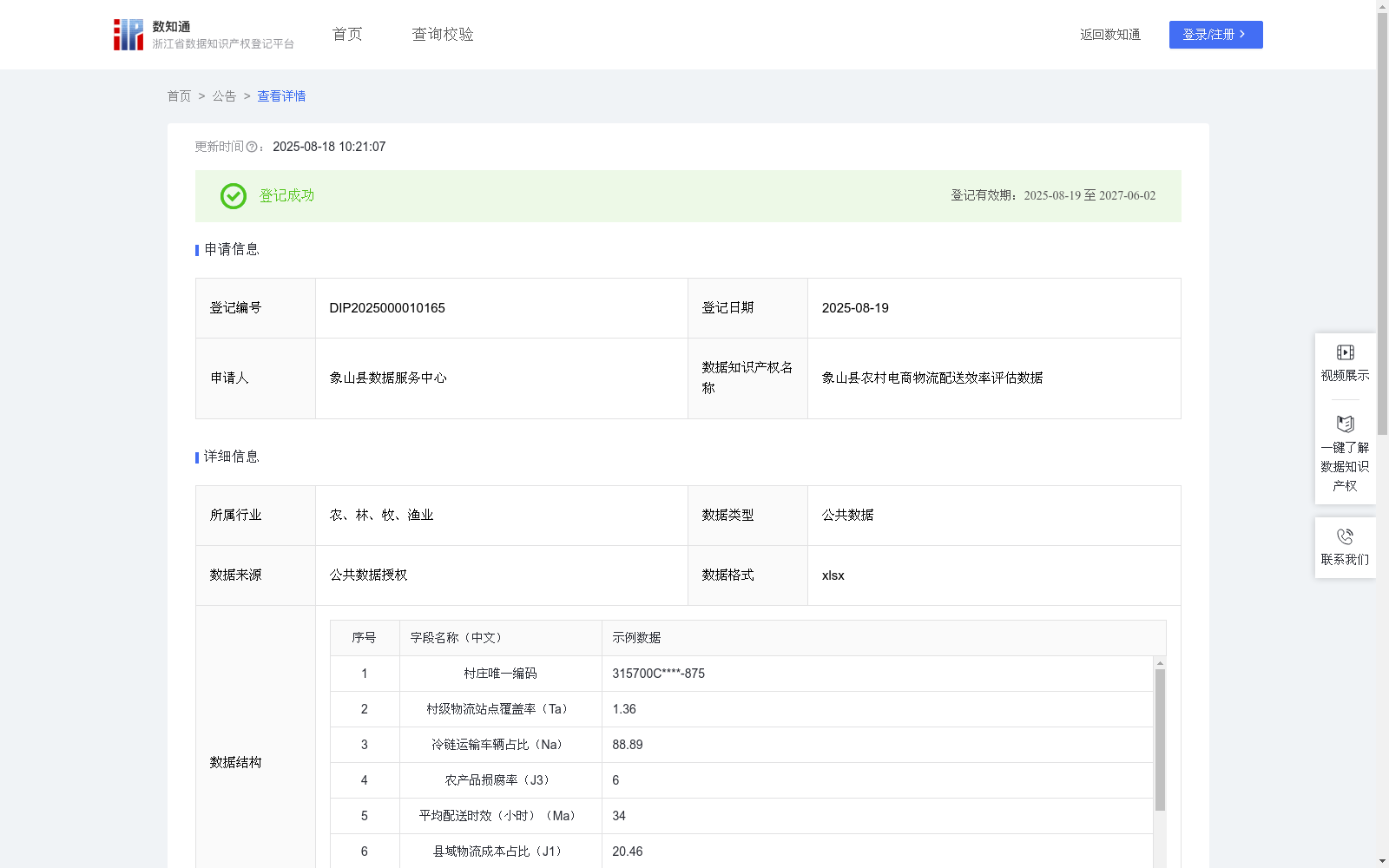
象山县农村电商物流配送效率评估数据
收藏浙江省数据知识产权登记平台2025-08-18 更新2025-08-19 收录
下载链接:
https://www.zjip.org.cn/home/announce/trends/166021
下载链接
链接失效反馈官方服务:
资源简介:
象山县农村电商物流配送效率评估数据能够帮助农业农村局精准把握县域农产品流通体系的运行质量,通过量化分析物流站点覆盖、冷链配置、时效控制等关键指标,有效识别出配送网络薄弱环节与资源错配问题。该模型可强化农村物流体系的智能化管理水平,推动形成"数据驱动-问题定位-精准施策"的闭环优化机制,促进农产品上行与工业品下乡的双向畅通,同时为制定物流基础设施投资规划、完善冷链补贴政策提供科学依据,最终实现降低流通损耗、提升农民收入与激活农村消费市场的多重目标。根据村庄邮政编码经过特殊处理获得村庄唯一编码;根据物流企业运营数据与村级台账报表数据获得村级物流站点覆盖率(%)Ta;根据车辆管理平台与实地抽检数据获得冷链运输车辆占比(%)Na;根据电商平台退货记录与农户反馈信息获得农产品损腐率(%)J3;根据物流订单跟踪数据与实际到达时间获得平均配送时效(小时)Ma;根据电商企业财务报表与抽样调查获得县域物流成本占比(%)J1;根据仓储设施巡检记录数据获得智能分拣设备普及率(%)S;根据快递面单数据汇总数据获得农产品上行件均重量J2;根据电商平台评价与入户问卷数据获得农户物流满意度Ht;所有采集汇总数据通过多因子归一化处理,最终通过线性加权法进行计算:Y=Tax0.2+Nax0.15+(30-J3)x0.15+(72-Ma)/71x0.15+(50-J1)/45x0.1+Sx0.1+J2x0.05+Htx20x0.1,最终获得象山县农村电商物流配送效率评估指标,>=75分:高效级(创新升级),核心措施:可以推广无人机配送与自动驾驶技术,建设县域智慧物流云平台,实现订单动态路由规划,试点“客货邮融合”模式,整合客运班线运力资源代运快递,降低末端成本;60-74分:达标级(固本强基),核心措施:开展共同配送联盟建设,整合物流企业共享分拣中心与运输车辆;45-59分:改善级(重点突破),核心措施:
推行“以件计补”政策,对农产品上行件均重超3kg的物流企业给予运费补贴,强制升级物流包装标准,推广可循环保温箱降低腐损率;<45分:重构级(体系再造),核心措施:可建立“红黄牌”机制,连续两季度效率未提升的运营主体取消经营资质。
The rural e-commerce logistics distribution efficiency evaluation data of Xiangshan County can help the Agricultural and Rural Affairs Bureau accurately grasp the operational quality of the county-level agricultural product circulation system. Through quantitative analysis of key indicators including logistics station coverage, cold chain configuration, and timeliness control, it effectively identifies weak links in the distribution network and resource misallocation issues. This model can enhance the intelligent management level of the rural logistics system, promote the formation of a closed-loop optimization mechanism of "data-driven, problem-located, policy-targeted", facilitate the two-way smooth circulation of agricultural products upward and industrial products downward, and provide scientific basis for formulating logistics infrastructure investment planning and improving cold chain subsidy policies, ultimately achieving multiple goals of reducing circulation losses, increasing farmers' income, and activating rural consumer markets. Unique village codes are obtained through special processing of village postal codes; the village-level logistics station coverage rate (%), denoted as Ta, is calculated based on logistics enterprise operation data and village-level account and report data; the proportion of cold chain transport vehicles (%), denoted as Na, is obtained from vehicle management platform data and on-site spot check results; the agricultural product spoilage rate (%), denoted as J3, is derived from e-commerce platform return records and farmer feedback; the average delivery timeliness (hours), denoted as Ma, is calculated based on logistics order tracking data and actual arrival times; the county-level logistics cost proportion (%), denoted as J1, is obtained from e-commerce enterprise financial statements and sampling surveys; the popularization rate of intelligent sorting equipment (%), denoted as S, is based on warehouse facility inspection records; the average weight of upward agricultural product parcels, denoted as J2, is aggregated from express waybill data; farmers' logistics satisfaction, denoted as Ht, is obtained from e-commerce platform reviews and household survey data. All collected and aggregated data undergo multi-factor normalization processing, and the final evaluation index of rural e-commerce logistics distribution efficiency in Xiangshan County is calculated via the linear weighting method: Y = Ta * 0.2 + Na * 0.15 + (30 - J3) * 0.15 + (72 - Ma)/71 * 0.15 + (50 - J1)/45 * 0.1 + S * 0.1 + J2 * 0.05 + Ht * 20 * 0.1. The evaluation results are classified as follows: 1. High-efficiency Level (Innovation and Upgrade) (score ≥75): Core measures include promoting UAV delivery and autonomous driving technologies, building a county-level smart logistics cloud platform, realizing dynamic order routing planning, piloting the "passenger-cargo-post integration" model, integrating passenger transport line capacity resources to deliver express parcels, and reducing last-mile costs. 2. Standard-compliant Level (Strengthening Foundation) (60 ≤ score ≤74): Core measures include establishing joint distribution alliances, integrating logistics enterprises to share sorting centers and transport vehicles. 3. Improvement Level (Key Breakthrough) (45 ≤ score ≤59): Core measures include implementing the "per-piece subsidy" policy, providing freight subsidies to logistics enterprises whose average parcel weight of upward agricultural products exceeds 3kg, mandating upgrades to logistics packaging standards, and promoting reusable insulated boxes to reduce spoilage rates. 4. Reconstruction Level (System Reconstruction) (score <45): Core measures include establishing a "red and yellow card" mechanism, revoking business qualifications of operating entities whose efficiency has not improved for two consecutive quarters.
提供机构:
象山县数据服务中心
创建时间:
2025-07-03
搜集汇总
数据集介绍
以上内容由遇见数据集搜集并总结生成


