
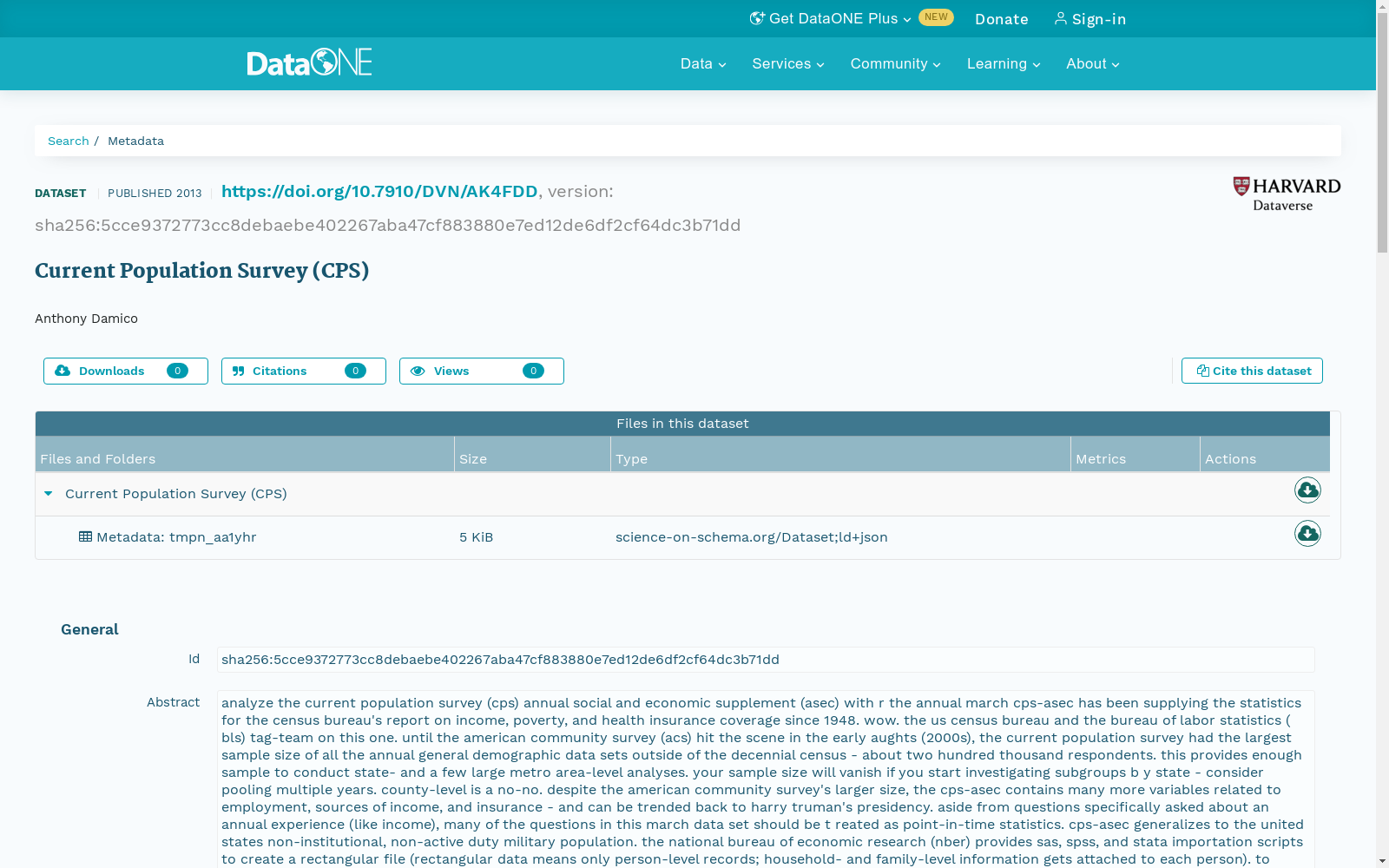
Current Population Survey (CPS)|社会经济调查数据集|数据分析数据集
收藏DataONE2015-04-11 更新2024-06-27 收录
下载链接:
https://search.dataone.org/view/sha256:5cce9372773cc8debaebe402267aba47cf883880e7ed12de6df2cf64dc3b71dd
下载链接
链接失效反馈资源简介:
analyze the current population survey (cps) annual social and economic supplement (asec) with r the annual march cps-asec has been supplying the statistics for the census bureau's report on income, poverty, and health insurance coverage since 1948. wow. the us census bureau and the bureau of labor statistics ( bls) tag-team on this one. until the american community survey (acs) hit the scene in the early aughts (2000s), the current population survey had the largest sample size of all the annual general demographic data sets outside of the decennial census - about two hundred thousand respondents. this provides enough sample to conduct state- and a few large metro area-level analyses. your sample size will vanish if you start investigating subgroups b y state - consider pooling multiple years. county-level is a no-no. despite the american community survey's larger size, the cps-asec contains many more variables related to employment, sources of income, and insurance - and can be trended back to harry truman's presidency. aside from questions specifically asked about an annual experience (like income), many of the questions in this march data set should be t reated as point-in-time statistics. cps-asec generalizes to the united states non-institutional, non-active duty military population. the national bureau of economic research (nber) provides sas, spss, and stata importation scripts to create a rectangular file (rectangular data means only person-level records; household- and family-level information gets attached to each person). to import these files into r, the parse.SAScii function uses nber's sas code to determine how to import the fixed-width file, then RSQLite to put everything into a schnazzy database. you can try reading through the nber march 2012 sas importation code yourself, but it's a bit of a proc freak show. this new github repository contains three scripts: 2005-2012 asec - download all microdata.R down load the fixed-width file containing household, family, and person records import by separating this file into three tables, then merge 'em together at the person-level download the fixed-width file containing the person-level replicate weights merge the rectangular person-level file with the replicate weights, then store it in a sql database create a new variable - one - in the data table 2012 asec - analysis examples.R connect to the sql database created by the 'download all microdata' progr am create the complex sample survey object, using the replicate weights perform a boatload of analysis examples replicate census estimates - 2011.R connect to the sql database created by the 'download all microdata' program create the complex sample survey object, using the replicate weights match the sas output shown in the png file below 2011 asec replicate weight sas output.png statistic and standard error generated from the replicate-weighted example sas script contained in this census-provided person replicate weights usage instructions document. click here to view these three scripts for more detail about the current population survey - annual social and economic supplement (cps-asec), visit: the census bureau's current population survey page the bureau of labor statistics' current population survey page the current population survey's wikipedia article notes: interviews are conducted in march about experiences during the previous year. the file labeled 2012 includes information (income, work experience, health insurance) pertaining to 2011. when you use the current populat ion survey to talk about america, subract a year from the data file name. as of the 2010 file (the interview focusing on america during 2009), the cps-asec contains exciting new medical out-of-pocket spending variables most useful for supplemental (medical spending-adjusted) poverty research. confidential to sas, spss, stata, sudaan users: why are you still rubbing two sticks together after we've invented the butane lighter? time to transition to r. :D
创建时间:
2023-11-21
AI搜集汇总
数据集介绍
构建方式
Current Population Survey (CPS) 数据集由美国人口普查局与美国劳工统计局联合构建,旨在提供关于美国劳动力市场的详细信息。该数据集通过每月对约60,000户家庭的随机抽样调查来收集数据,确保样本的代表性和广泛性。调查内容涵盖就业状况、收入、工作时间、教育水平等多个维度,通过结构化的问卷设计和严格的抽样方法,确保数据的准确性和可靠性。
特点
CPS 数据集以其全面性和时效性著称,涵盖了从宏观经济指标到微观家庭层面的多维度数据。其特点在于数据的广泛覆盖和深度分析,能够为政策制定者、研究人员和商业分析师提供详尽的劳动力市场动态。此外,CPS 数据集还具有高度的可比性,支持跨时间和地区的趋势分析,为社会科学研究提供了宝贵的资源。
使用方法
使用 CPS 数据集时,用户可以通过访问美国人口普查局的官方网站获取最新的数据文件和相关文档。数据通常以固定格式的表格或数据库形式提供,用户可以根据研究需求进行数据清洗和预处理。常见的使用方法包括描述性统计分析、回归分析和时间序列分析,以揭示劳动力市场的变化趋势和影响因素。此外,CPS 数据集还支持与其他经济和社会数据集的整合分析,以提供更全面的视角。
背景与挑战
背景概述
Current Population Survey (CPS) 是由美国劳工统计局(Bureau of Labor Statistics)和美国人口普查局(U.S. Census Bureau)联合开展的一项月度调查,自1940年首次实施以来,已成为研究美国劳动力市场动态的重要数据来源。CPS旨在收集关于就业、失业、工作时间、收入等关键经济指标的信息,为政策制定者、经济学家和社会学家提供了宝贵的数据支持。通过定期更新和广泛应用,CPS不仅在学术研究中占据重要地位,也在公共政策制定中发挥了关键作用,为理解美国劳动力市场的变化趋势提供了坚实基础。
当前挑战
尽管CPS在劳动力市场研究中具有重要地位,但其构建和维护过程中仍面临诸多挑战。首先,数据收集的复杂性要求高度的样本代表性和数据准确性,以确保结果的可靠性。其次,随着社会经济结构的变化,如何持续更新和调整调查问卷以反映最新的劳动力市场特征,是一个持续的挑战。此外,数据隐私和安全问题也是CPS必须面对的重要议题,如何在保护受访者隐私的同时,提供高质量的数据分析,是当前亟需解决的问题。
发展历史
创建时间与更新
Current Population Survey (CPS) 创建于1940年,由美国劳工统计局(BLS)和美国人口普查局(Census Bureau)共同管理。自创建以来,CPS每年进行一次更新,以反映美国劳动力市场的最新动态。
重要里程碑
CPS的一个重要里程碑是1994年,当时引入了计算机辅助个人访谈(CAPI)技术,极大地提高了数据收集的效率和准确性。此外,2004年,CPS开始发布月度就业报告,这一举措显著提升了数据集的实时性和政策参考价值。近年来,CPS还增加了对非传统就业形式的调查,如零工经济和远程工作,以更好地反映现代劳动力市场的多样性。
当前发展情况
当前,CPS已成为美国劳动力市场分析的核心数据源,广泛应用于经济学、社会学和公共政策研究。其数据不仅为政府决策提供了重要依据,还为学术界和私营部门的研究提供了丰富的资源。随着数据科学和人工智能技术的发展,CPS正在探索与大数据的融合,以进一步提升数据分析的深度和广度。此外,CPS也在不断优化其调查方法,以确保数据的高质量和代表性,从而更好地服务于社会各界的研究需求。
发展历程
- 美国劳工统计局(BLS)首次启动了当前人口调查(CPS),作为一项月度调查,旨在收集关于美国劳动力市场的详细数据。
- CPS调查扩展到包括关于就业、失业和劳动力参与率的数据,成为美国政府评估劳动力市场状况的重要工具。
- CPS开始包括关于收入和贫困的数据,进一步丰富了其数据内容,使其成为研究社会经济问题的重要资源。
- CPS进行了重大改革,引入了计算机辅助个人访谈(CAPI)技术,提高了数据收集的效率和准确性。
- CPS增加了关于工作时间和工作条件的详细问题,使得数据集能够更全面地反映劳动力市场的多样性。
- CPS开始发布年度收入和贫困报告,成为政策制定者和研究人员评估社会经济趋势的重要参考。
常用场景
经典使用场景
在社会经济研究领域,Current Population Survey (CPS) 数据集被广泛用于分析劳动力市场的动态变化。该数据集提供了详尽的就业、失业、收入和工作时间等关键指标,使得研究者能够深入探讨劳动力市场的结构与趋势。例如,通过CPS数据,学者们可以研究不同教育水平、性别和种族群体的就业差异,从而为政策制定提供科学依据。
实际应用
在实际应用中,CPS数据集被广泛用于政府和非政府组织的政策评估与规划。例如,政府部门利用CPS数据来监测和预测劳动力市场的变化,从而制定相应的就业政策。此外,非营利组织和研究机构也利用CPS数据进行社会经济研究,以评估特定政策的社会影响。CPS数据的广泛应用,使得其成为社会经济领域不可或缺的工具。
衍生相关工作
CPS数据集的丰富性和可靠性,催生了大量相关的经典研究工作。例如,许多经济学和劳动研究领域的论文都基于CPS数据进行实证分析,探讨劳动力市场的各种问题。此外,CPS数据还被用于开发和验证各种经济模型,如劳动力供给模型和收入分配模型。这些衍生工作不仅深化了对劳动力市场的理解,还推动了相关领域的理论发展。
以上内容由AI搜集并总结生成



