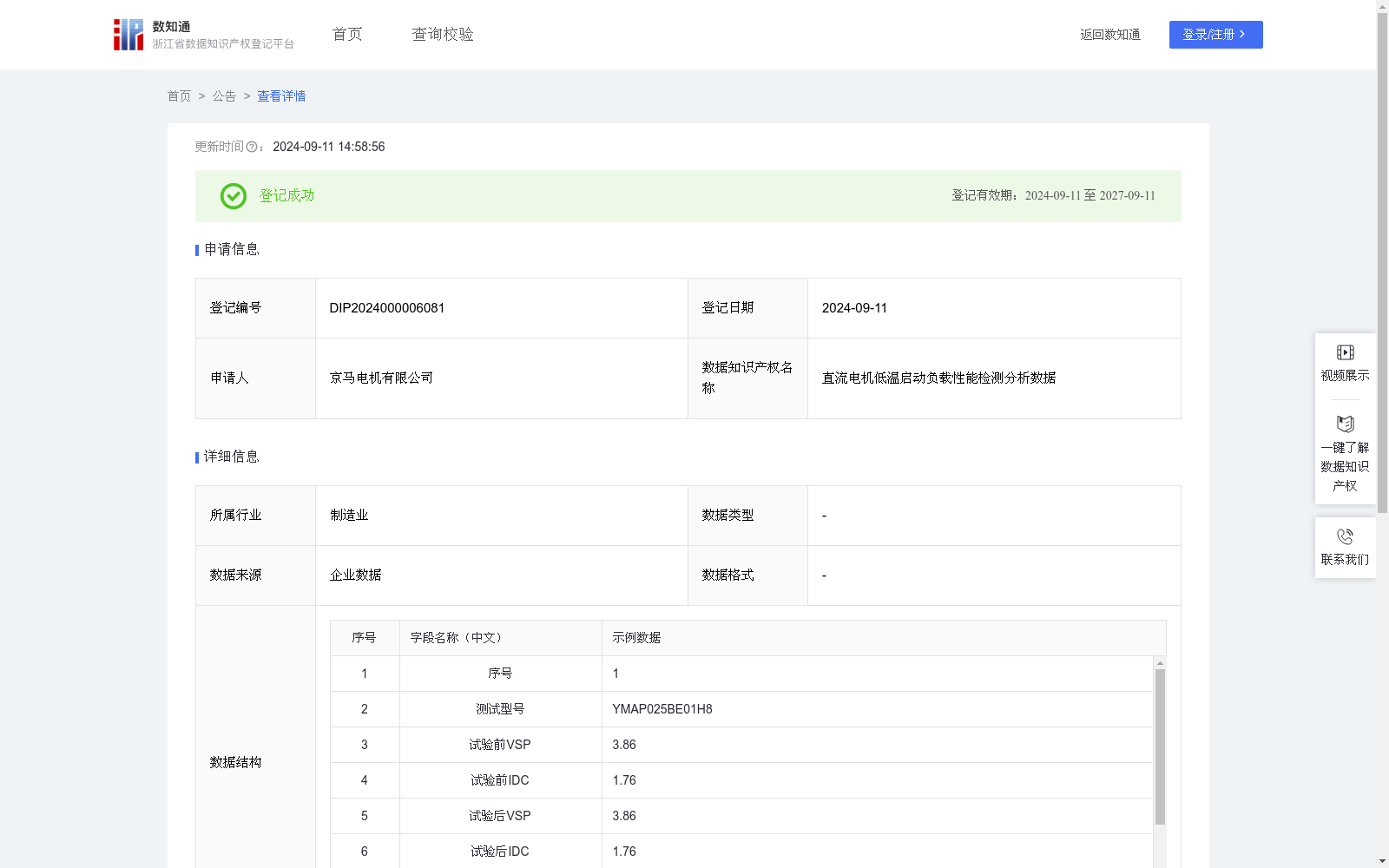
直流电机低温启动负载性能检测分析数据
收藏资源简介:
在极寒气候条件下,电机的启动性能会受到严重影响,电机内部的润滑油粘度增加,机械部件的润滑度下降,导致电机启动困难、负载能力下降,甚至出现故障。低温环境下,电机的效率往往会降低,导致能源浪费和成本增加。通过低温启动负载性能检测,可以评估电机在不同负载和温度条件下的效率表现,从而选择合适的运行工况,优化电机的运行效率。通过测试可以及时发现电机存在的问题并采取措施解决,从而保障设备安全和生产顺利进行,同时也可以发现现有技术的不足和潜在改进空间。这有助于推动电机技术的不断创新和发展,提高电机的整体性能和适应性。电机在电源电压24v、负载扭矩265毫牛下,以1200转每分钟作为电机的负载特性进行测试。1.数据采集:对直流电机进行低温启动负载性能测试,得到试验前VSP、试验前IDC、试验后VSP、试验后IDC;2.VSP差值=abs(试验前VSP-试验后VSP),IDC差值=abs(试验前IDC-试验后IDC);3.总差值=VSP差值+IDC差值。由于是低温环境下的负载测试,所以测试前后的两组数据越接近,说明电机性能越好,即总差值越接近0,性能越好;4. 数据分级: 若总差值=0,则性能为A级;若0<总差值≤0.02,则性能为B级;若0.02<总差值≤0.04,则性能为C级;若0.04<总差值≤0.06,则性能为D级;若0.06<总差值≤0.08,则性能为E级;若0.08<总差值≤0.1,则性能为F,需要对直流电机进行检查维修。
Under extreme cold climates, the starting performance of electric motors is severely compromised: the viscosity of internal lubricating oil rises, reducing the lubrication of mechanical components, leading to motor starting difficulties, diminished load capacity, and even equipment malfunctions. In low-temperature environments, motor efficiency typically declines, resulting in energy waste and elevated operational costs. Low-temperature start-up load performance testing enables the evaluation of motor efficiency across varying load and temperature conditions, allowing for the selection of appropriate operating modes to optimize motor operational efficiency. Such testing can also identify existing motor issues in a timely manner and facilitate corrective measures, ensuring equipment safety and smooth production. Additionally, it reveals shortcomings in current technologies and potential avenues for improvement, which drives continuous innovation and advancement in motor technology, while enhancing the overall performance and adaptability of electric motors. The test is conducted for DC motors with load characteristics set at a supply voltage of 24 V, a load torque of 265 millinewton-meters (mN·m), and a rotational speed of 1200 revolutions per minute (rpm). 1. Data Collection: Carry out low-temperature start-up load performance tests on DC motors to acquire pre-test VSP, pre-test IDC, post-test VSP, and post-test IDC. 2. Calculate VSP difference = abs(pre-test VSP - post-test VSP), and IDC difference = abs(pre-test IDC - post-test IDC). 3. Total difference = VSP difference + IDC difference. As this is a load test performed in a low-temperature environment, the closer the pre-test and post-test data sets are, the better the motor performance; that is, the closer the total difference is to 0, the superior the motor performance. 4. Data Grading: If the total difference equals 0, the motor performance is rated Grade A; if 0 < total difference ≤ 0.02, it is Grade B; if 0.02 < total difference ≤ 0.04, Grade C; if 0.04 < total difference ≤ 0.06, Grade D; if 0.06 < total difference ≤ 0.08, Grade E; if 0.08 < total difference ≤ 0.1, Grade F, and the DC motor requires inspection and maintenance.