
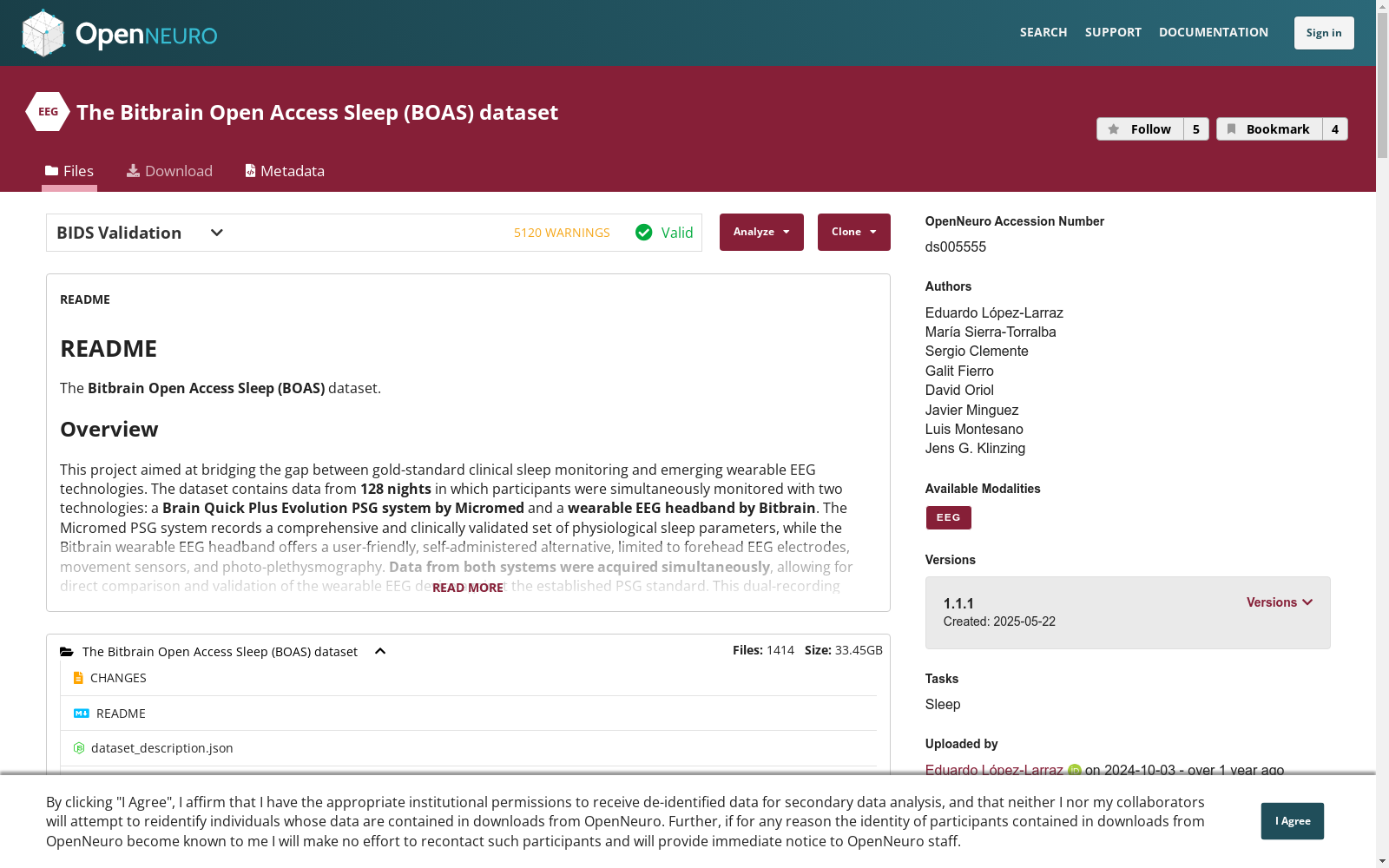
The Bitbrain Open Access Sleep (BOAS) dataset
收藏OpenNeuro2024-10-03 更新2026-03-14 收录
下载链接:
https://openneuro.org/datasets/ds005555
下载链接
链接失效反馈官方服务:
资源简介:
# README
The **Bitbrain Open Access Sleep (BOAS)** dataset.
## Overview
This project aimed at bridging the gap between gold-standard clinical sleep monitoring and emerging wearable EEG technologies. The dataset contains data from **128 nights** in which participants were simultaneously monitored with two technologies: a **Brain Quick Plus Evolution PSG system by Micromed** and a **wearable EEG headband by Bitbrain**. The Micromed PSG system records a comprehensive and clinically validated set of physiological sleep parameters, while the Bitbrain wearable EEG headband offers a user-friendly, self-administered alternative, limited to forehead EEG electrodes, movement sensors, and photo-plethysmography. **Data from both systems were acquired simultaneously**, allowing for direct comparison and validation of the wearable EEG device against the established PSG standard. This dual-recording approach provides a rich resource for evaluating the performance and potential of wearable EEG technology in sleep studies.
**Human sleep scoring:** To ensure robust and reliable sleep staging, we followed a rigorous labeling process. **Three expert sleep scorers independently annotated the PSG recordings** following criteria developed by the American Academy of Sleep Medicine (AASM) (Berry et al., 2015). From the resulting three scorings, a **consensus label** was derived: each epoch of sleep data received the label scored by at least two of the scorers. In cases where all three scorers had given different labels, a fourth scorer made the final decision. This consensus labeling approach addresses the inherent variability in human-derived sleep scoring, with an estimated inter-scorer agreement of approximately 85% (Danker-Hopfe et al., 2009; Rosenberg and Van Hout, 2013).
**Automatic scoring:** We used the human expert consensus labels to train a deep learning model (Esparza-Iaizzo et al., 2024). By implementing a cross-validation procedure, we trained and validated the model separately on the PSG and wearable EEG datasets. The model achieved an 87.13% match between human-consensus and network-provided labels for the PSG data, and an 86.71% match for the wearable EEG data.
Our dataset includes:
1. **PSG recordings** from 128 nights (files ending with "*psg_eeg.edf*"),
2. **Wearable EEG recordings** from the same nights (files ending with "*headband_eeg.edf*"),
3. **Human-consensus sleep stage labels**, obtained from the PSG recordings ("*stage_hum*" in the PSG data's event files),
4. **AI-generated sleep stage labels**, separately obtained from PSG recordings and from wearable EEG recordings ("*stage_ai*" in both the PSG and headband data's event files).
5. **Further meta data** for each recording (i.e., the participants' age, sex, and BMI, provided in the file "*participants.tsv*")
## Participants
Participants were members of the general population, provided written informed consent, and received economic compensation of 50€ per night.
In order to represent the general population, we recruited a broad spectrum of participants along the dimensions of age, sex, and body mass index. We did not recruit patients with particular health conditions but only excluded severe conditions that could have affected the feasibility or safety of the study. In detail, inclusion and exclusion criteria were as follows.
**Inclusion criteria**
- Age > 18 years,
- Sufficient knowledge of Spanish to understand the explanatory text, the consent form and study-related instructions.
**Exclusion criteria**
- Current severe medical interventions or medication,
- History of severe neurological or psychiatric disorders,
- Severe health problems in the last 12 months (especially neurological or cardiac disorders),
- Current pregnancy or nursing,
- Use of psychotropic medication, benzodiazepines, gamma-hydroxybutyric acid, and similar drugs before or during the study.
## Format
The dataset is formatted according to the Brain Imaging Data Structure (BIDS). Please note that while the recordings are named from sub-1 up to sub-128, some come from the same participants. 108 unique individuals participated in the recordings, data of which can be matched using the pid (= unique participant ID) property in the file "*participants.tsv*"
The folder of each recording contains the data recorded with the PSG ("*sub-xx_task-Sleep_acq-psg_eeg.edf*") and with the wearable EEG headband ("*sub-xx_task-Sleep_acq-headband_eeg.edf*").
**Channel groups**
Not all recordings contain data from all available sensors. The full list of available sensors for each recording can be obtained on the "*channels.tsv*" file. Channels in this file are coded in groups:
- **PSG_EEG**: Electroencephalography recorded with the PSG system. Channels available are F3, F4, C3, C4, O1, O2 (PSG_F3, PSG_F4, PSG_C3, PSG_C4, PSG_O1, PSG_O2).
- **PSG_EOG**: Electrooculography signals recorded with the PSG system. The location of the EOG electrodes was lateral of the eyes; one slightly lower than the participant's left eye and one slightly higher than the participant's right eye (according to AASM guidelines). For recordings containing only one EOG channel (PSG_EOG), the electrodes were recorded as a bipolar derivation. If two EOG channels are present (PSG_EOGR, PSG_EOGL), both electrodes were referenced against the left mastoid.
- **PSG_EMG**: Electromyography signals recorded with the PSG system. Data contain a single EMG channel (PSG_EMG), which is the result of a bipolar derivation of two chin electrodes.
- **PSG_BELTS**: Breathing activity recorded by the PSG system using abdominal and thoracic breathing belts (PSG_ABD, PSG_THOR).
- **PSG_THER**: Respiratory airflow recorded with the PSG system using a thermistor (PSG_THER).
- **PSG_CAN**: Respiratory airflow recorded with the PSG system using a nasal cannula (PSG_CAN).
- **PSG_PPG**: Photopletismographic (PPG) activity recorded with the PSG system. Channels available are pulse (PSG_PULSE), heart beat (PSG_BEAT) and oxygen saturation (PSG_SPO2).
- **HB_EEG**: Electroencephalography recorded with the wearable EEG headband. Headband channels are approximately located at AF7 and AF8 (HB_1, HB_2).
- **HB_IMU**: Movement activity recorded by an Inertial Measurement Unit (IMU) in the headband. Signals are derived from an accelerometer (HB_IMU_1, HB_IMU_2, HB_IMU_3) and gyroscope (HB_IMU_4, HB_IMU_5, HB_IMU_6), both recording signals for all three spatial dimensions.
- **HB_PULSE**: Pulse activity recorded with the wearable EEG headband using a PPG sensor (HB_PULSE).
**Sleep staging labels**
The sleep stage labels for each recording are coded as events in corresponding event files (stage_hum and stage_ai; see above). Stages are coded as follows:
- 0: Wake,
- 1: NonREM sleep stage 1 (N1),
- 2: NonREM sleep stage 2 (N2),
- 3: NonREM sleep stage 3 (N3),
- 4: REM sleep,
- 8: PSG disconnections (e.g., due to bathroom breaks; human-scored only)
- -2: Artifacts and missing data (AI-scored only)
## References
Berry, R. B., Brooks, R., Gamaldo, C. E., Harding, S. M., Lloyd, R. M., Marcus, C. L., et al. (2015). The AASM Manual for the Scoring of Sleep and Associated Events: Rules, Terminology and Technical Specifications, Version 2.2. Darien, Illinois.
Danker-Hopfe, H., Anderer, P., Zeitlhofer, J., Boeck, M., Dorn, H., Gruber, G., et al. (2009). Interrater reliability for sleep scoring according to the Rechtschaffen & Kales and the new AASM standard. J. Sleep Res. 18, 74–84. doi: 10.1111/j.1365-2869.2008.00700.x.
Esparza-Iaizzo, M., Sierra-Torralba, M., Klinzing, J. G., Minguez, J., Montesano, L., and López-Larraz, E. (2024). Automatic sleep scoring for real-time monitoring and stimulation in individuals with and without sleep apnea. bioRxiv, 2024.06.12.597764. doi: 10.1101/2024.06.12.597764.
Rosenberg, R. S., and Van Hout, S. (2013). The American Academy of Sleep Medicine inter-scorer reliability program: sleep stage scoring. J. Clin. sleep Med. 9, 81–87. doi: 10.5664/jcsm.2350.
## Contact
If you have any questions or comments, please contact:
Eduardo López-Larraz: eduardo.lopez@bitbrain.com
Jens G. Klinzing: jens.klinzing@bitbrain.com
# 数据集说明文档
# Bitbrain 开放获取睡眠(Bitbrain Open Access Sleep, BOAS)数据集
## 数据集概览
本项目旨在弥合金标准临床睡眠监测与新兴可穿戴脑电图(Electroencephalogram, EEG)技术之间的技术鸿沟。本数据集包含**128个夜间**的同步监测数据,所有受试者均同时采用两种设备进行监测:来自Micromed公司的**Brain Quick Plus Evolution 多导睡眠图(Polysomnography, PSG)系统**,以及Bitbrain公司的**可穿戴EEG头带**。
Micromed PSG系统可记录一套经过临床验证的全面生理睡眠参数;而Bitbrain可穿戴EEG头带则是一款操作简便、可自行佩戴的替代方案,仅配备前额EEG电极、运动传感器以及光电容积描记(Photo-plethysmography, PPG)传感器。**两套设备的数据同步采集**,可直接对比并验证可穿戴EEG设备相对于成熟PSG标准的性能表现。这种双采集方案为评估可穿戴EEG技术在睡眠研究中的应用潜力与实际性能提供了丰富的研究资源。
### 人工睡眠分期标注
为确保睡眠分期标注的可靠性与鲁棒性,本研究采用了严格的标注流程:**3名资深睡眠分期标注师依据美国睡眠医学会(American Academy of Sleep Medicine, AASM)制定的标注标准(Berry等人,2015年),独立对PSG记录进行标注**。
基于3名标注师的标注结果,我们生成**共识标注标签**:每一段睡眠时段收到至少2名标注师给出的相同标签;若3名标注师给出的标签均不相同,则由第4名标注师给出最终判定。这种共识标注方案可有效缓解人工睡眠分期标注中固有的个体差异,据估算标注师间的一致性约为85%(Danker-Hopfe等人,2009年;Rosenberg与Van Hout,2013年)。
### 自动睡眠分期标注
我们采用人工专家共识标签训练了一款深度学习模型(Esparza-Iaizzo等人,2024年)。通过交叉验证流程,我们分别基于PSG数据集与可穿戴EEG数据集对模型进行训练与验证。最终模型在PSG数据上的人工共识标签与模型输出标签的匹配度为87.13%,在可穿戴EEG数据上的匹配度为86.71%。
本数据集包含以下内容:
1. **128个夜间的多导睡眠图(PSG)记录数据**(文件后缀为`*psg_eeg.edf*`),
2. 对应夜间的**可穿戴EEG记录数据**(文件后缀为`*headband_eeg.edf*`),
3. **人工共识睡眠分期标签**,从PSG记录数据中提取(PSG数据事件文件中的`*stage_hum*`字段),
4. **AI生成的睡眠分期标签**,分别从PSG记录数据与可穿戴EEG记录数据中提取(PSG及头带设备数据的事件文件中的`*stage_ai*`字段),
5. 各条记录的**附加元数据**,包括受试者的年龄、性别与身体质量指数(Body Mass Index, BMI),存储于`*participants.tsv*`文件中。
## 受试者信息
本研究的受试者均来自普通人群,均签署了书面知情同意书,并可获得每晚50欧元的经济补偿。
为了能代表普通人群,我们按照年龄、性别与身体质量指数的维度招募了覆盖广泛范围的受试者。本研究未招募患有特定疾病的患者,仅排除了可能影响研究可行性或安全性的严重健康问题。具体的纳入与排除标准如下:
#### 纳入标准
- 年龄大于18周岁,
- 具备足够的西班牙语能力,能够理解研究说明文本、知情同意书及相关研究指导要求。
#### 排除标准
- 当前正在接受重度医疗干预或使用特定药物,
- 有重度神经系统或精神疾病病史,
- 近12个月内存在严重健康问题(尤其是神经系统或心脏疾病),
- 当前处于妊娠或哺乳期,
- 研究前或研究期间使用精神类药物、苯二氮䓬类药物、γ-羟基丁酸及同类药物。
## 数据格式
本数据集遵循脑成像数据结构(Brain Imaging Data Structure, BIDS)规范进行组织。请注意:尽管所有记录均以sub-1至sub-128命名,但部分记录来自同一受试者。本研究共招募108名独特个体,可通过`*participants.tsv*`文件中的`pid`(受试者唯一识别码)字段对数据进行匹配。
每条记录对应的文件夹中包含PSG采集的数据(文件名为`*sub-xx_task-Sleep_acq-psg_eeg.edf*`)以及可穿戴EEG头带采集的数据(文件名为`*sub-xx_task-Sleep_acq-headband_eeg.edf*`)。
### 通道分组
并非所有记录都包含所有可用传感器的数据。每条记录的完整可用传感器列表可从`*channels.tsv*`文件中获取。该文件中的通道按组进行编码:
- **PSG_EEG**:PSG系统采集的脑电图数据。可用通道包括F3、F4、C3、C4、O1、O2(对应命名为PSG_F3、PSG_F4、PSG_C3、PSG_C4、PSG_O1、PSG_O2)。
- **PSG_EOG**:PSG系统采集的眼电图(Electrooculography, EOG)信号。EOG电极放置于眼外侧:一个略低于受试者左眼,另一个略高于受试者右眼(符合AASM指南要求)。若记录仅包含1个EOG通道(PSG_EOG),则电极采用双极导联采集;若包含2个EOG通道(PSG_EOGR、PSG_EOGL),则两个电极均以左侧乳突作为参考电极。
- **PSG_EMG**:PSG系统采集的肌电图(Electromyography, EMG)信号。数据仅包含1个EMG通道(PSG_EMG),由两个颏部电极的双极导联采集得到。
- **PSG_BELTS**:PSG系统通过腹部和胸部呼吸带采集的呼吸活动数据(对应通道为PSG_ABD、PSG_THOR)。
- **PSG_THER**:PSG系统通过热敏电阻采集的呼吸气流数据(PSG_THER)。
- **PSG_CAN**:PSG系统通过鼻导管采集的呼吸气流数据(PSG_CAN)。
- **PSG_PPG**:PSG系统采集的光电容积描记(PPG)信号。可用通道包括脉搏(PSG_PULSE)、心跳(PSG_BEAT)与血氧饱和度(PSG_SPO2)。
- **HB_EEG**:可穿戴EEG头带采集的脑电图数据。头带通道大致位于AF7与AF8位置(对应通道为HB_1、HB_2)。
- **HB_IMU**:头带内置惯性测量单元(Inertial Measurement Unit, IMU)采集的运动活动数据。信号来自加速度计(HB_IMU_1、HB_IMU_2、HB_IMU_3)与陀螺仪(HB_IMU_4、HB_IMU_5、HB_IMU_6),均采集三个空间维度的信号。
- **HB_PULSE**:可穿戴EEG头带通过PPG传感器采集的脉搏信号(HB_PULSE)。
### 睡眠分期标签编码规则
每条记录的睡眠分期标签以事件形式存储于对应的事件文件中(包括stage_hum与stage_ai,详见前文)。标签编码规则如下:
- 0:清醒期(Wake),
- 1:非快速眼动睡眠1期(NonREM sleep stage 1, N1),
- 2:非快速眼动睡眠2期(N2),
- 3:非快速眼动睡眠3期(N3),
- 4:快速眼动睡眠(REM sleep),
- 8:PSG设备断开连接(例如因受试者如厕导致;仅人工标注标签包含该值),
- -2:伪影与数据缺失(仅AI标注标签包含该值)。
## 参考文献
Berry, R. B., Brooks, R., Gamaldo, C. E., Harding, S. M., Lloyd, R. M., Marcus, C. L., et al. (2015). The AASM Manual for the Scoring of Sleep and Associated Events: Rules, Terminology and Technical Specifications, Version 2.2. Darien, Illinois.
Danker-Hopfe, H., Anderer, P., Zeitlhofer, J., Boeck, M., Dorn, H., Gruber, G., et al. (2009). Interrater reliability for sleep scoring according to the Rechtschaffen & Kales and the new AASM standard. J. Sleep Res. 18, 74–84. doi: 10.1111/j.1365-2869.2008.00700.x.
Esparza-Iaizzo, M., Sierra-Torralba, M., Klinzing, J. G., Minguez, J., Montesano, L., and López-Larraz, E. (2024). Automatic sleep scoring for real-time monitoring and stimulation in individuals with and without sleep apnea. bioRxiv, 2024.06.12.597764. doi: 10.1101/2024.06.12.597764.
Rosenberg, R. S., and Van Hout, S. (2013). The American Academy of Sleep Medicine inter-scorer reliability program: sleep stage scoring. J. Clin. sleep Med. 9, 81–87. doi: 10.5664/jcsm.2350.
## 联系方式
如有任何疑问或建议,请联系:
爱德华多·洛佩斯-拉拉兹(Eduardo López-Larraz):eduardo.lopez@bitbrain.com
延斯·G·克林津(Jens G. Klinzing):jens.klinzing@bitbrain.com
创建时间:
2024-10-03
搜集汇总
数据集介绍
背景与挑战
背景概述
Bitbrain开放访问睡眠(BOAS)数据集包含128个夜晚的同步PSG和可穿戴EEG头带记录,旨在比较两种技术的性能。数据集提供人类专家共识和AI生成的睡眠阶段标签,以及参与者元数据,为睡眠研究和可穿戴设备验证提供丰富资源。
以上内容由遇见数据集搜集并总结生成



