
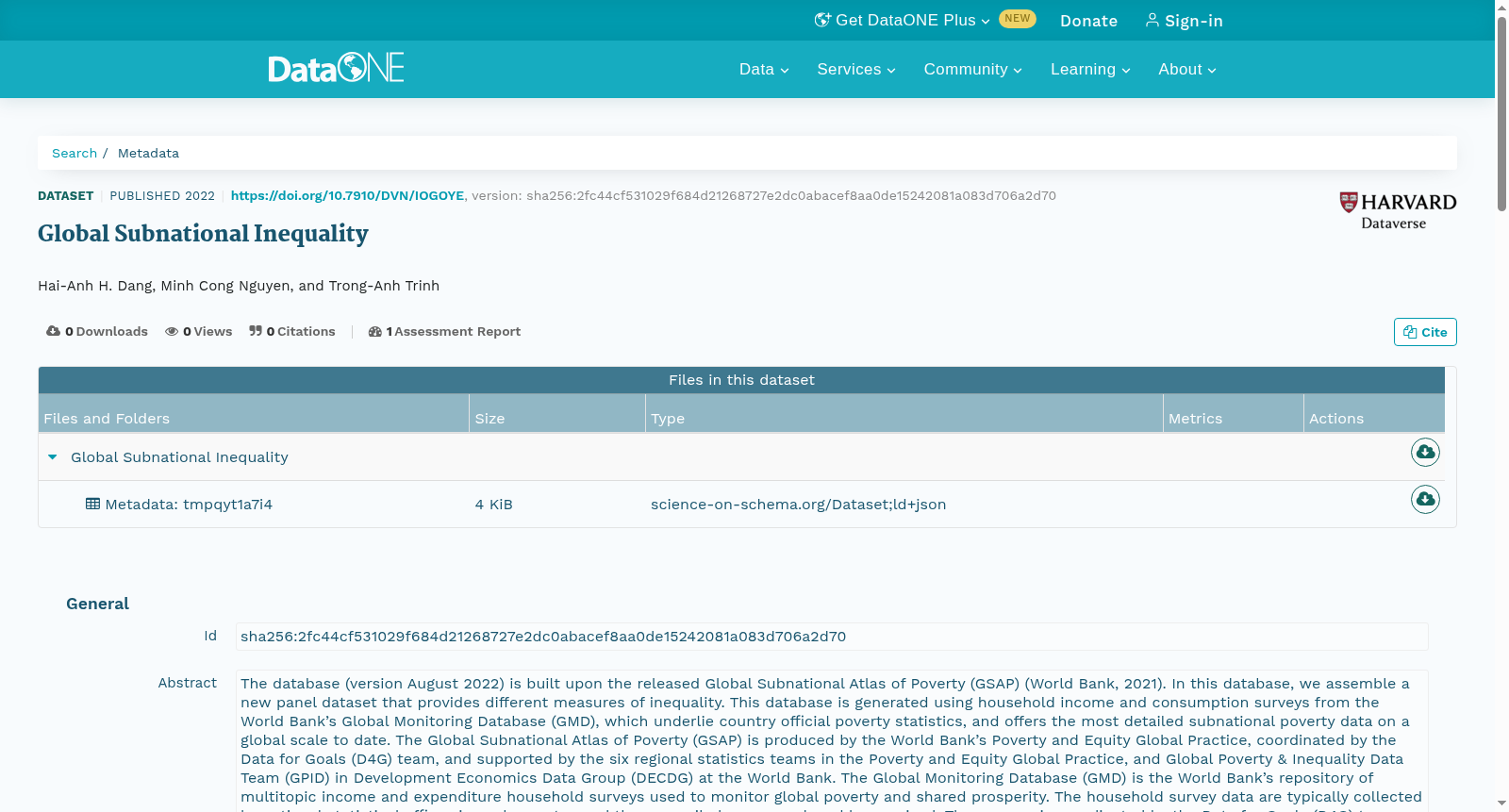
Global Subnational Inequality
收藏DataONE2022-11-05 更新2024-06-08 收录
下载链接:
https://search.dataone.org/view/sha256:2fc44cf531029f684d21268727e2dc0abacef8aa0de15242081a083d706a2d70
下载链接
链接失效反馈官方服务:
资源简介:
The database (version August 2022) is built upon the released Global Subnational Atlas of Poverty (GSAP) (World Bank, 2021). In this database, we assemble a new panel dataset that provides different measures of inequality. This database is generated using household income and consumption surveys from the World Bank’s Global Monitoring Database (GMD), which underlie country official poverty statistics, and offers the most detailed subnational poverty data on a global scale to date. The Global Subnational Atlas of Poverty (GSAP) is produced by the World Bank’s Poverty and Equity Global Practice, coordinated by the Data for Goals (D4G) team, and supported by the six regional statistics teams in the Poverty and Equity Global Practice, and Global Poverty & Inequality Data Team (GPID) in Development Economics Data Group (DECDG) at the World Bank. The Global Monitoring Database (GMD) is the World Bank’s repository of multitopic income and expenditure household surveys used to monitor global poverty and shared prosperity. The household survey data are typically collected by national statistical offices in each country, and then compiled, processed, and harmonized. The process is coordinated by the Data for Goals (D4G) team and supported by the six regional statistics teams in the Poverty and Equity Global Practice. Global Poverty & Inequality Data Team (GPID) in Development Economics Data Group (DECDG) also contributed historical data from before 1990, and recent survey data from Luxemburg Income Studies (LIS). Selected variables have been harmonized to the extent possible such that levels and trends in poverty and other key sociodemographic attributes can be reasonably compared across and within countries over time. The GMD’s harmonized microdata are currently used in Poverty and Inequality Platform (PIP), World Bank’s Multidimensional Poverty Measures (WB MPM), the Global Database of Shared Prosperity (GDSP), and Poverty and Shared Prosperity Reports. Reference: World Bank. (2021). World Bank estimates based on data from the Global Subnational Atlas of Poverty, Global Monitoring Database. World Bank: Washington. https://datacatalog.worldbank.org/search/dataset/0042041
本数据库(2022年8月版)基于已发布的全球次国家贫困地图集(Global Subnational Atlas of Poverty, GSAP)(世界银行,2021)构建。在此数据库中,我们整合了一套全新的面板数据集,可提供多种不平等衡量指标。本数据库依托世界银行全球监测数据库(Global Monitoring Database, GMD)中的家庭收入与消费调查数据搭建,此类数据是各国官方贫困统计的核心基础,也是目前全球范围内最详尽的国家以下层级贫困数据集。
全球次国家贫困地图集(GSAP)由世界银行贫困与公平全球实践部编制,由数据促目标(Data for Goals, D4G)团队统筹,并得到贫困与公平全球实践部下属六个区域统计团队,以及世界银行发展经济数据组(Development Economics Data Group, DECDG)下属全球贫困与不平等数据团队(Global Poverty & Inequality Data Team, GPID)的支持。
全球监测数据库(GMD)是世界银行用于监测全球贫困与共享繁荣的多主题家庭收入与支出调查资料库。此类家庭调查数据通常由各国国家统计局采集,随后由数据促目标(D4G)团队统筹完成汇编、处理与标准化协调工作,并得到贫困与公平全球实践部六个区域统计团队的支持。世界银行发展经济数据组(DECDG)的全球贫困与不平等数据团队(GPID)还补充了1990年之前的历史调查数据,以及卢森堡收入研究(Luxemburg Income Studies, LIS)的近期调查数据。
研究团队已对选定变量开展尽可能全面的标准化工作,以使贫困及其他关键社会人口特征的水平与变化趋势,能够在不同国家间、同一国家内部以及不同时期之间进行合理比较。
全球监测数据库(GMD)的标准化微观数据目前已应用于贫困与不平等平台(Poverty and Inequality Platform, PIP)、世界银行多维贫困测度(World Bank’s Multidimensional Poverty Measures, WB MPM)、全球共享繁荣数据库(Global Database of Shared Prosperity, GDSP)以及《贫困与共享繁荣》报告。
参考文献:世界银行. (2021). 基于全球次国家贫困地图集、全球监测数据库数据的世界银行估算. 华盛顿:世界银行. https://datacatalog.worldbank.org/search/dataset/0042041
创建时间:
2023-11-08
搜集汇总
数据集介绍
以上内容由遇见数据集搜集并总结生成


