AlexandriaX_Subtask_3_Test
收藏资源简介:
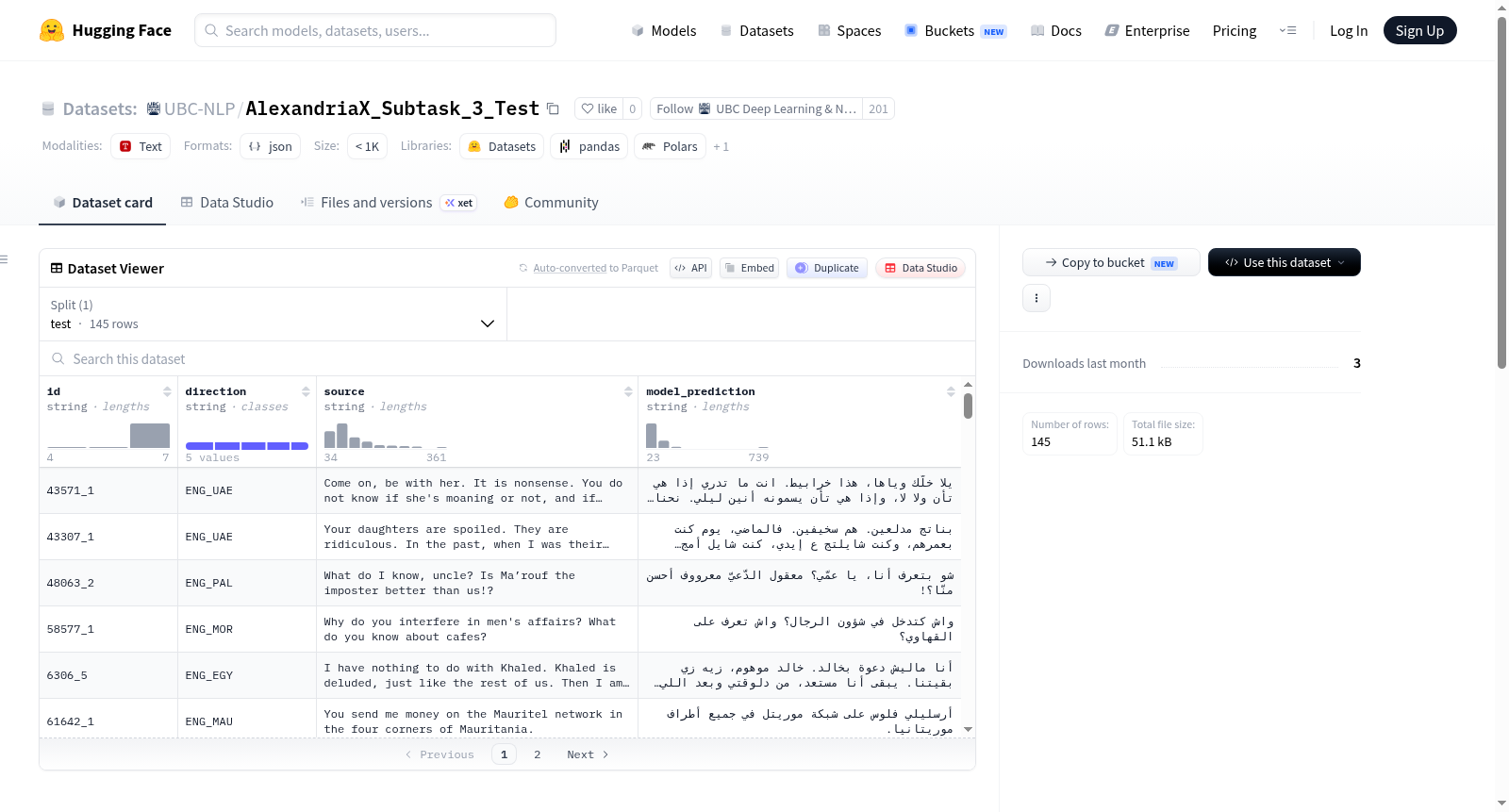
该数据集是AlexandriaX Subtask 3的测试集,专门用于方言阿拉伯语机器翻译评估任务。其目的是支持参与者基于机器翻译输出和源信息,检测和分类翻译错误,并采用LQM启发的注释方法。数据集包含四个字段:id(唯一标识符)、direction(翻译方向,如ENG_UAE,表示从英语到阿拉伯语)、source(源语言文本,通常为英语句子)和model_prediction(机器翻译生成的阿拉伯语文本)。数据规模未明确指定,但结构为JSONL格式,每行代表一个测试样本。该数据集适用于机器翻译质量评估、错误检测和分类等自然语言处理任务,特别是针对方言阿拉伯语的翻译场景。
This dataset is the test set for AlexandriaX Subtask 3, specifically designed for the dialectal Arabic machine translation evaluation task. Its purpose is to support participants in detecting and classifying translation errors based on machine translation outputs and source information, adopting an LQM-inspired annotation methodology. The dataset contains four fields: id (unique identifier), direction (translation direction, e.g., ENG_UAE, which indicates translation from English to Arabic), source (source language text, usually English sentences), and model_prediction (Arabic text generated by machine translation). The scale of the dataset is not explicitly specified, but it follows the JSONL format, with each line representing a test sample. This dataset is applicable to natural language processing tasks such as machine translation quality evaluation, error detection and classification, especially for dialectal Arabic translation scenarios.
数据集概述
数据集名称:UBC-NLP/AlexandriaX_Subtask_3_Test
用途:该数据集是 AlexandriaX 子任务3的测试集,用于方言阿拉伯语机器翻译(MT)评估任务。参与者需根据提供的机器翻译输出及源信息,利用基于 LQM(Likert Quality Metric)的标注来检测和分类翻译错误。
数据格式:数据集以 JSON Lines 格式存储,每条记录包含以下字段:
- id(字符串):唯一标识符。
- direction(字符串):翻译方向(例如
ENG_UAE表示英语到阿联酋方言)。 - source(字符串):源语言文本(原文)。
- model_prediction(字符串):机器翻译模型输出的目标语言文本。
示例数据: json { "id": "43571_1", "direction": "ENG_UAE", "source": "Come on, be with her. It is nonsense. You do not know if shes moaning or not, and if shes moaning, its called nocturnal moaning. We still too early.", "model_prediction": "يلا خلّك وياها، هذا خرابيط. انت ما تدري إذا هي تأن ولا لا، وإذا هي تأن يسمونه أنين ليلي. نحنا بعدنا وايد بدري." }
加载方式:可通过 Hugging Face datasets 库加载,参考代码如下:
python
from datasets import load_dataset
dataset = load_dataset("json", data_files={"test": "test.jsonl"})
print(dataset["test"][0])