
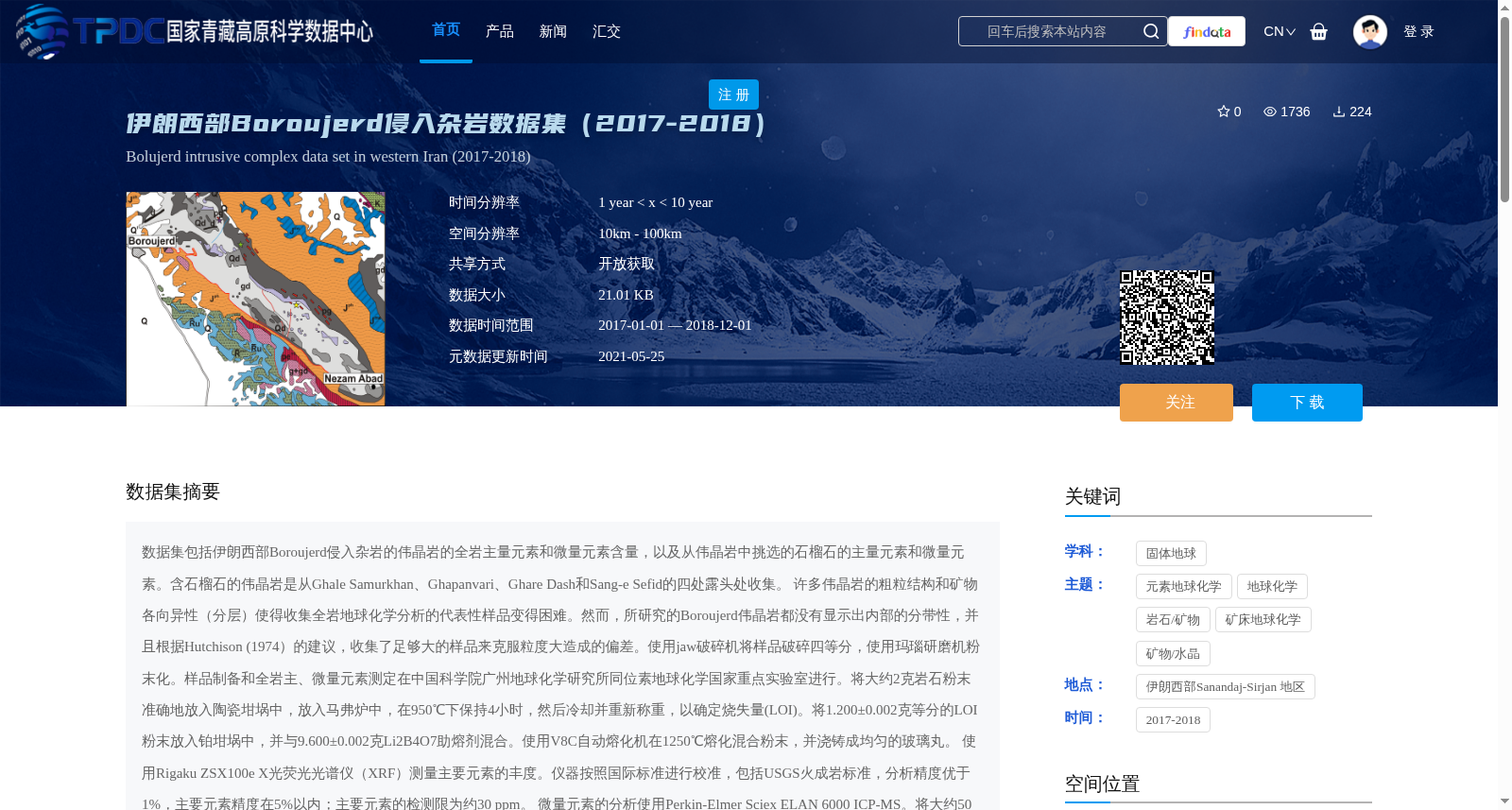
伊朗西部Boroujerd侵入杂岩数据集(2017-2018)
收藏国家青藏高原科学数据中心2021-05-25 更新2024-03-06 收录
下载链接:
https://data.tpdc.ac.cn/zh-hans/data/11ab0b1d-17c9-4962-bbcc-c19f0eaf849e
下载链接
链接失效反馈官方服务:
资源简介:
数据集包括伊朗西部Boroujerd侵入杂岩的伟晶岩的全岩主量元素和微量元素含量,以及从伟晶岩中挑选的石榴石的主量元素和微量元素。含石榴石的伟晶岩是从Ghale Samurkhan、Ghapanvari、Ghare Dash和Sang-e Sefid的四处露头处收集。
许多伟晶岩的粗粒结构和矿物各向异性(分层)使得收集全岩地球化学分析的代表性样品变得困难。然而,所研究的Boroujerd伟晶岩都没有显示出内部的分带性,并且根据Hutchison (1974)的建议,收集了足够大的样品来克服粒度大造成的偏差。使用jaw破碎机将样品破碎四等分,使用玛瑙研磨机粉末化。样品制备和全岩主、微量元素测定在中国科学院广州地球化学研究所同位素地球化学国家重点实验室进行。将大约2克岩石粉末准确地放入陶瓷坩埚中,放入马弗炉中,在950℃下保持4小时,然后冷却并重新称重,以确定烧失量(LOI)。将1.200±0.002克等分的LOI粉末放入铂坩埚中,并与9.600±0.002克Li2B4O7助熔剂混合。使用V8C自动熔化机在1250℃熔化混合粉末,并浇铸成均匀的玻璃丸。
使用Rigaku ZSX100e X光荧光光谱仪(XRF)测量主要元素的丰度。仪器按照国际标准进行校准,包括USGS火成岩标准,分析精度优于1%,主要元素精度在5%以内;主要元素的检测限为约30 ppm。
微量元素的分析使用Perkin-Elmer Sciex ELAN 6000 ICP-MS。将大约50毫克样品粉末准确称量到聚四氟乙烯胶囊(Teflon capsules)中,加入HF-HNO3溶液,密封胶囊并将其置于高压不锈钢容器中。将容器放入马弗炉中,在250℃下加热24小时,然后淬火,回收聚四氟乙烯胶囊,松开盖子,在加热板上将内容物干燥。向聚四氟乙烯胶囊中加入一份新的HF-HNO3溶液,并重复溶解和干燥程序。将沉淀物溶解在含5 ppb Rh和5 ppb Re的3% HNO 3溶液中,该溶液用作内部标准,以监控分析过程中的信号漂移。中国国家岩石标准GSR-1和GSR-3以及美国地质勘探局标准AGV-1、W-2、G-2和GSP-1用于校准测量样品的元素浓度。分析精度一般优于5%。
使用国家海洋局第二海洋研究所(中国杭州)的JEOL JXA 8100电子探针微区分析仪(EPMA)和四个波长色散光谱仪收集石榴石的背散射电子图像和主要元素组成。使用的操作条件:15千伏的加速电压、20 nA的束流、5μm的束直径、峰值10秒和每个背景10秒的采集时间。美国标准物质公司和中国标准物质公司提供的天然硅酸盐和纯氧化物用于校准电子探针。使用的标准和检测晶体包括铁铝石榴石(Si和Al;TAP晶体)、金红石(Ti;PET晶体),赤铁矿(Fe;LIF晶体),透辉石(Mg;TAP晶体),磷灰石(Ca;PET晶体),钠长石(Na;TAP晶体),钾长石(K;PET晶体),红柱石(Mn;LIF晶体),铬铁矿(Cr;LIF晶体)。使用JEOL所属软件对数据进行了简化,该软件应用了ZAF型矩阵校正,石榴石的化学计量是通过标准化的12个氧原子成分分析中得出的。分析元素的计算检出限优于100 ppm。单个元素的分析误差取决于绝对丰度;对于丰度在0.5至1wt%之间的元素,相对1σ精度优于10%,对于丰度在1至10wt%之间的元素,相对1σ精度优于5%,对于丰度大于10wt%的元素,相对1σ精度优于1%。
中国科学院广州地球化学研究所中国科学院矿物学与成矿学重点实验室利用LA-ICP-MS测定了石榴石的微量元素组成。LA-ICP-MS仪器由Agilent 7900 ICP-MS与ReSouncials RESOlution 193nm激光器、S-155双体积样品池(旨在避免交叉污染并减少背景冲洗时间)、Squid平滑装置(用于改善激光消融脉冲诱导的消融材料的混合和均质流速)和计算机控制的高精度X-Y平台 组成。烧蚀后的样品气溶胶与氩+氮气混合,以提高分析灵敏度,并在氦载气中传输至等离子体炬。激光器在80 mJ的动态能量下工作,衰减器值为25%,激光频率为8 Hz,光斑直径为74 μm。每次分析包括25秒的背景采集(气体空白),随后从样品中采集40秒的样品数据采集。ICP-MS对微量元素的检出限大多优于10 ppb,不确定度为5-10%。每个分析批次包括在开始和结束时对NIST612标准的两次剥蚀,和其间的五个矿物样品剥蚀。NIST612标准玻璃用作外部校准标准,而NIST610则作为监测标准进行分析,以评估仪器的精度和准确度。由电子探针测定的石榴石SiO2含量是从紧邻每个激光烧蚀坑的点收集的,用作计算元素丰度的内标。背景和分析信号的离线分析和整合,以及时间漂移校正和定量校准使用ICPMSDataCal软件。
该数据集可以用于解密伟晶岩岩浆起源。伟晶岩的矿物学和地球化学特征表明,伟晶岩为过铝至偏铝质的I型花岗岩。根据矿物组合和全岩地球化学,伟晶岩被划分为白云母型伟晶岩。电子探针分析显示,石榴石具有同心的成分分带,并且是铁-锰-铝石榴石固溶体,具有较少的镁铝榴石、钙铝榴石和钙铁榴石成分。石榴石中主要元素的同心分带归因于熔体中岩浆的生长。在MnO + CaO/ FeO + MgO (wt%)图中,石榴石的成分与熔体从弱到中度结晶一致。Boroujerd伟晶岩中的石榴石的特征是从中心到边缘,钇、铪、钛、锆、铌、钽、铪和铀的含量逐渐降低。石榴石还具有高的球粒陨石标准化的重稀土含量,具有几乎平坦的模式(Ybn/Smn = 0–508),较低的轻稀土元素含量,以及负铕异常(Eu/Eu* < 0.3)。这些元素从核心到边缘的变化归因于岩浆分馏的增加。Boroujerd伟晶岩石榴石中的成分、主量和微量元素分带模式与岩浆起源和不同分馏I型岩浆结晶相一致,表明石榴石晶体化学是解密伟晶岩岩浆起源的重要工具。
This dataset includes whole-rock major and trace element concentrations of pegmatites from the Boroujerd Intrusive Complex in western Iran, as well as major and trace element data for garnets separated from these pegmatites. Garnet-bearing pegmatites were collected from four outcrops: Ghale Samurkhan, Ghapanvari, Ghare Dash, and Sang-e Sefid.
The coarse-grained texture and mineral anisotropy (layering) of many pegmatites make it challenging to collect representative samples for whole-rock geochemical analysis. However, the Boroujerd pegmatites studied here show no internal zoning, and sufficiently large samples were collected to overcome biases caused by large grain sizes, following the recommendations of Hutchison (1974). Samples were crushed and quartered using a jaw crusher, then powdered with an agate grinder. Sample preparation and whole-rock major and trace element determinations were carried out at the State Key Laboratory of Isotope Geochemistry, Guangzhou Institute of Geochemistry, Chinese Academy of Sciences.
Approximately 2 g of rock powder was accurately weighed into a ceramic crucible, placed in a muffle furnace, held at 950°C for 4 hours, then cooled and reweighed to determine loss on ignition (LOI). An aliquot of 1.200 ± 0.002 g of the LOI-treated powder was placed in a platinum crucible and mixed with 9.600 ± 0.002 g of Li2B4O7 flux. The mixed powder was melted at 1250°C using a V8C automatic fusion machine and cast into homogeneous glass beads.
Major element abundances were measured using a Rigaku ZSX100e X-ray fluorescence spectrometer (XRF). The instrument was calibrated against international standards, including USGS igneous rock standards, with analytical precision better than 1%, and major element precision within 5%; the detection limit for major elements is approximately 30 ppm.
Trace element analysis was performed using a Perkin-Elmer Sciex ELAN 6000 ICP-MS. Approximately 50 mg of sample powder was accurately weighed into polytetrafluoroethylene (Teflon) capsules, to which HF-HNO3 solution was added. The capsules were sealed and placed in high-pressure stainless steel vessels, which were then heated in a muffle furnace at 250°C for 24 hours before being quenched. The PTFE capsules were recovered, their lids loosened, and the contents dried on a hotplate. A fresh aliquot of HF-HNO3 solution was added to the PTFE capsules, and the dissolution and drying procedures were repeated. The precipitates were dissolved in 3% HNO3 solution containing 5 ppb Rh and 5 ppb Re, which served as an internal standard to monitor signal drift during analysis. Chinese national rock standards GSR-1 and GSR-3, as well as US Geological Survey standards AGV-1, W-2, G-2, and GSP-1, were used to calibrate element concentrations in the measured samples. Analytical precision is generally better than 5%.
Backscattered electron (BSE) images and major element compositions of garnets were collected using a JEOL JXA 8100 electron probe microanalyzer (EPMA) equipped with four wavelength-dispersive spectrometers at the Second Institute of Oceanography, Ministry of Natural Resources of China (Hangzhou, China). The operating conditions were as follows: accelerating voltage of 15 kV, beam current of 20 nA, beam diameter of 5 μm, acquisition time of 10 seconds for peak counts and 10 seconds for each background count. Natural silicates and pure oxides provided by American and Chinese certified reference material (CRM) manufacturers were used to calibrate the EPMA. The standards and detection crystals used include almandine (Si and Al; TAP crystal), rutile (Ti; PET crystal), hematite (Fe; LIF crystal), diopside (Mg; TAP crystal), apatite (Ca; PET crystal), albite (Na; TAP crystal), K-feldspar (K; PET crystal), andalusite (Mn; LIF crystal), and chromite (Cr; LIF crystal). Data were reduced using JEOL’s proprietary software, which applies ZAF-type matrix correction. The stoichiometry of garnets was calculated based on analyses normalized to 12 oxygen atoms per formula unit. The calculated detection limits for analyzed elements are better than 100 ppm. The analytical error for individual elements depends on their absolute abundance: relative 1σ precision is better than 10% for elements with abundances between 0.5 and 1 wt%, better than 5% for elements with abundances between 1 and 10 wt%, and better than 1% for elements with abundances greater than 10 wt%.
Trace element compositions of garnets were determined by LA-ICP-MS at the Key Laboratory of Mineralogy and Metallogeny, Chinese Academy of Sciences, Guangzhou Institute of Geochemistry, Chinese Academy of Sciences. The LA-ICP-MS instrument consists of an Agilent 7900 ICP-MS coupled with a ReSouncials RESOlution 193 nm laser, an S-155 dual-volume sample cell (designed to avoid cross-contamination and reduce background washout time), a Squid smoothing device (to improve mixing and homogeneous flow of ablated material induced by laser ablation pulses), and a computer-controlled high-precision X-Y stage. Ablated sample aerosols were mixed with argon + nitrogen to improve analytical sensitivity, and transported to the plasma torch in a helium carrier gas. The laser operated at a dynamic energy of 80 mJ, with an attenuator setting of 25%, laser repetition rate of 8 Hz, and spot diameter of 74 μm. Each analysis included 25 seconds of background acquisition (gas blank), followed by 40 seconds of sample data acquisition from the specimen. Detection limits for trace elements by ICP-MS are mostly better than 10 ppb, with uncertainties of 5–10%. Each analytical batch included two ablations of NIST 612 standard at the start and end of the batch, and five mineral sample ablations in between. NIST 612 standard glass was used as the external calibration standard, while NIST 610 was analyzed as a monitoring standard to evaluate instrument precision and accuracy. Garnet SiO2 contents measured by EPMA at points immediately adjacent to each laser ablation pit were used as an internal standard for calculating element abundances. Off-line analysis and integration of background and analytical signals, time drift correction, and quantitative calibration were performed using ICPMSDataCal software.
This dataset can be used to unravel the petrogenesis of pegmatite magmas. The mineralogical and geochemical characteristics of the pegmatites indicate that they are peraluminous to metaluminous I-type granites. Based on mineral assemblages and whole-rock geochemistry, the pegmatites are classified as muscovite-type pegmatites. EPMA analysis reveals that garnets exhibit concentric compositional zoning and belong to the Fe-Mn-Al garnet solid solution series, with minor pyrope, grossular, and andradite components. The concentric major element zoning in garnets is attributed to magma growth in the melt. In the plot of MnO + CaO vs. FeO + MgO (wt%), garnet compositions are consistent with weak to moderate crystallization of the melt. Garnets from the Boroujerd pegmatites are characterized by gradual decreases in Y, Hf, Ti, Zr, Nb, Ta, Hf, and U contents from core to rim. Garnets also show high chondrite-normalized heavy rare earth element (HREE) abundances with nearly flat patterns (Ybn/Smn = 0–508), low light rare earth element (LREE) contents, and negative Eu anomalies (Eu/Eu* < 0.3). The variations of these elements from core to rim are attributed to increased magmatic fractionation. The compositional, major, and trace element zoning patterns of garnets from the Boroujerd pegmatites are consistent with magmatic petrogenesis and crystallization of differentially fractionated I-type magmas, indicating that garnet crystal chemistry is an important tool for unraveling the petrogenesis of pegmatite magmas.
提供机构:
丁兴
创建时间:
2021-05-14
搜集汇总
数据集介绍
背景与挑战
背景概述
该数据集包含2017-2018年伊朗西部Boroujerd侵入杂岩中伟晶岩的全岩主微量元素及石榴石主微量元素数据,采样自四个露头点,数据通过XRF、ICP-MS、EPMA和LA-ICP-MS等精密方法在中国科学院相关实验室分析获得。数据集旨在通过石榴石晶体化学特征解密伟晶岩的岩浆起源,显示其为过铝至偏铝质I型花岗岩,具有同心成分分带,可用于研究岩浆分馏过程。
以上内容由遇见数据集搜集并总结生成


