
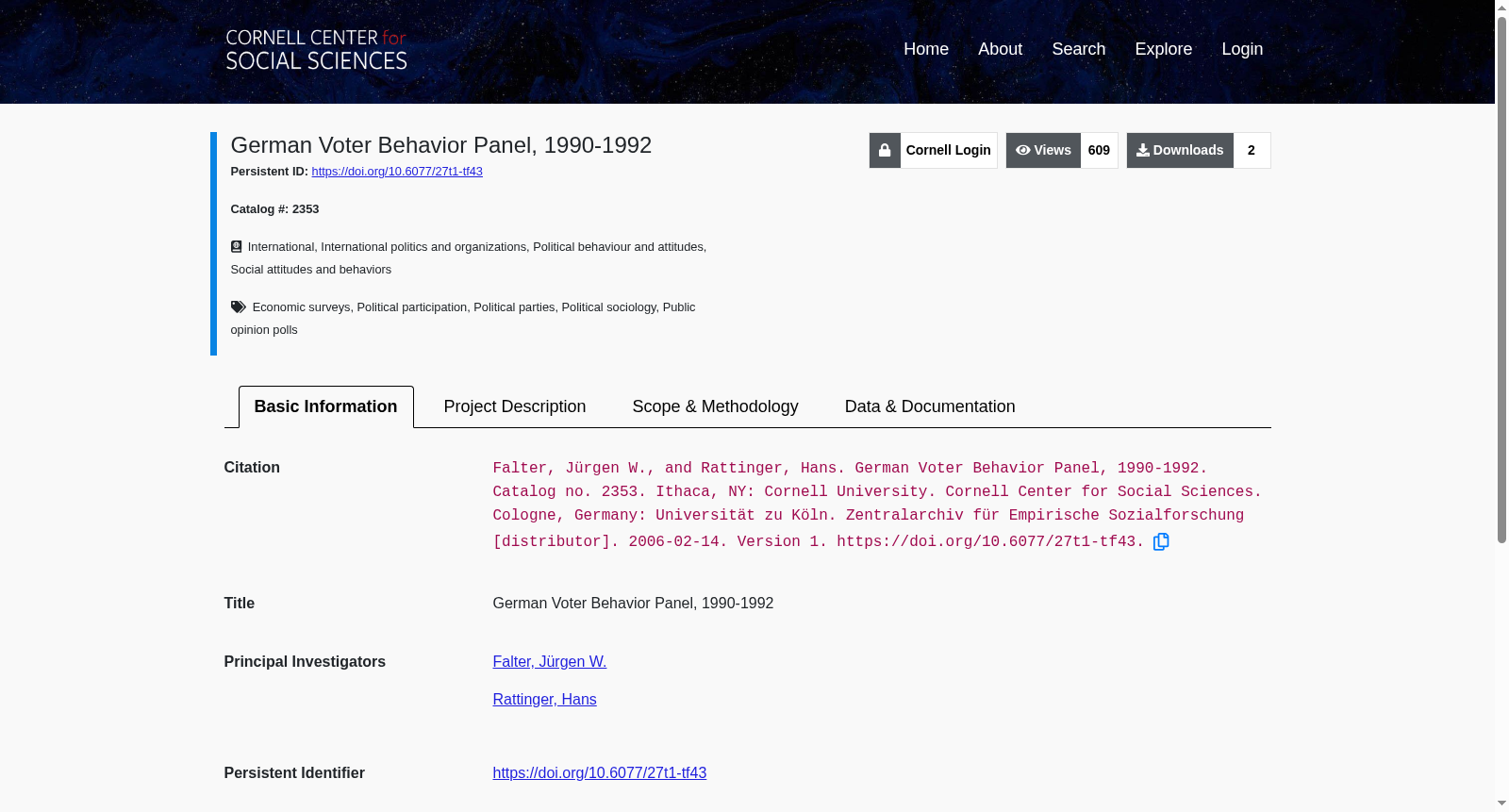
German Voter Behavior Panel, 1990-1992
收藏DataCite Commons2026-02-05 更新2025-04-09 收录
下载链接:
https://data.socialsciences.cornell.edu/citation?persistentId=doi:10.6077/27T1-TF43
下载链接
链接失效反馈官方服务:
资源简介:
<p>Multi-wave follow-up survey on judgement on parties and politicians. Attitude to current political and social questions. Topics: In all three waves (in the east as in the west) the following questions were posed: interest in politics; judgement on the general as well as personal economic situation and expected future economic development; party preference (Sunday question, second vote); interest in a nation-wide eligiblity for the CSU; parties one cannot vote for; frequency of reading the political part of daily newspapers and of weekly political magazines; frequency of watching news and political broadcasts; sympathy scale for selected top politicians and the parties; issue relevance and issue ability of the parties; perceived changes in selected political areas such as unemployment, drugs, equal rights, security of pensions, social justice, environmental protection and housing supply of the population; personal position and assumed position of the parties regarding selected political questions such as reduction in working hours or increase in income and making abortion easier; sympathy scale for the parties, for the trade unions and employers; anomy scale; self-classification as well as classification of the parties on a left-right continuum; complexity of politics; perceived personal powerlessness and assumed disinterest of politicians in ordinary people; general judgement on the economic system, the system of social security and the political system; trust in institutions such as the Federal Government, the Federal Parliament, the Federal German Armed Forces, the judiciary, the political parties, the police and the Federal Constitutional Court; forms of political participation; ASKO scale; classification of the parties on the ASKO scale; party identification; intensity and length of party inclination; parties as representatives of the interests of selected groups; knowledge about the significance of first and second votes; postmaterialism; religiousness; union membership; characterization of social surroundings as persons with similar political views; party currently most favored by mood. Interviewer rating: length of interview; presence of other persons during interview. Also encoded was: length of interview; identification of interviewer. The following questions were posed in at least one survey wave and one part of the state: changes in general as well as personal economic situation; most important reasons for one's own voting decision; attitude to selected peoples and religious groups such as Americans, applicants for political asylum, Buddhists, citizens of the GDR, French, Jews, Moslems, East Germans, Russians, Swiss and Turks; election participation and behavior at the polls in the last Federal Parliament election; personality profiles of the two candidates for chancellor Kohl and Lafontaine in comparison; personal position and assumed position of the parties regarding reduction in government social expenditures, West German participation in military actions of the United Nations, restriction of automobile traffic, possible unification of the two German nations, necessity of military intervention in Irak, reasonableness of financial sacrifice for unification and immigration restrictions for foreigners; positive and negative feelings regarding selected terms such as harshness, obedience, uncompromising stand, strictness, leadership personality, self-discipline and discipline; classification of the candidates for chancellor Lafontaine and Kohl on a left-right continuum; most important communication partner of respondent for political conversations; assumed party preference of this conversation partner; political knowledge such as e.g. knowledge of the name of the CDU secretary-general as well as the Federal Parliament President; knowledge of the year of construction of the wall and the proportion of Russians among the citizens of the Soviet Union; employment in the civil service; company size; most important characteristics of work; place of work at place of residence; characterization of circle of friends regarding religiousness and proportion of trade union members; status of father, mother as well as respondent as refugee, exiled from home, emigrant from East Germany or ethnic German from Eastern Europe; residential status; city size. Interviewer rating: description of place of residence; number of residential units in building; reliability of respondent. The following additional questions were posed in the east in at least one wave: change of general as well as personal economic situation since introduction of the DM as currency; attitude to Russians, Vietnamese and West Germans; filing claim to possession of the residential building of respondent by earlier owners; concern for future claims to possession; personal attitude and assumed position of the parties regarding criminal prosecution of former SED functionaries and STASI employees.</p>
本数据集为针对政党与政客评价的多波次追踪调查,核心内容为受访者对当前政治与社会议题的态度。
调研主题分为三部分:
1. 全波次通用问题(覆盖东、西德全部三个波次):
包括政治兴趣程度;对宏观经济与个人经济状况的评价、未来经济发展预期;政党偏好(周日调查问题、第二选票);对基督教社会联盟(CSU,Christlich-Soziale Union)全国参选资格的态度;不可投票支持的政党;阅读日报政治版面与周度政治杂志的频率;收看新闻及政治类节目的频率;对选定顶尖政客与政党的好感度评分;政党的议题相关性与议题履职能力;民众对失业、毒品治理、平等权利、养老金保障、社会公平、环境保护与住房供应等政治领域变化的感知;个人在缩短工时、提高收入、放宽堕胎限制等选定政治议题上的立场,以及对政党在该类议题上立场的推测;对政党、工会与雇主的好感度评分;失范感量表(anomy scale)作答;自我与政党在左右连续谱上的定位;对政治复杂性的感知;个人无力感与政客漠视普通民众程度的感知;对经济体系、社会保障体系与政治体系的整体评价;对联邦政府、联邦议院、德国联邦国防军、司法机构、政党、警察与联邦宪法法院等公共机构的信任度;政治参与形式;ASKO量表作答;政党在ASKO量表上的定位;政党认同;政党倾向的强度与持续时长;政党作为特定群体利益代表的角色认知;对第一、第二选票意义的了解程度;后物质主义价值观;宗教虔诚度;工会会员身份;以政治观点相似性对社交圈进行分类;当前民意最青睐的政党。
访员需记录的评分项包括访谈时长、访谈过程中在场的其他人员;同时纳入编码的变量还包括访谈时长、访员身份标识。
2. 部分波次/地区问题(至少在一个调查波次与一个州份中设置):
包括宏观与个人经济状况的变化;自身投票决策的最主要动因;对美国人、政治避难申请者、佛教徒、民主德国公民、法国人、犹太人、穆斯林、东德民众、俄罗斯人、瑞士人、土耳其人等选定族群与宗教群体的态度;上届联邦议院选举的参选情况与投票行为;科尔与拉方丹两位总理候选人的人格特质对比;个人在削减政府社会支出、西德参与联合国军事行动、限制机动车通行、两德统一可能性、对伊拉克军事干预的必要性、为统一付出财政牺牲的合理性、对外国人的移民限制等选定政治议题上的立场,以及对政党在该类议题上立场的推测;对严苛、服从、不妥协立场、严格、领袖气质、自律与纪律等选定词汇的正负向情感评分;总理候选人拉方丹与科尔在左右连续谱上的定位;受访者进行政治对话时的最主要沟通对象;该对话对象的推定政党偏好;政治知识考核:例如知晓基督教民主联盟(CDU,Christlich-Demokratische Union Deutschlands)秘书长与联邦议院议长的姓名、柏林墙建造年份、苏联公民中俄罗斯裔的占比;公务员身份;企业规模;工作的最主要特征;工作地点与居住地点是否一致;以宗教虔诚度与工会会员占比对朋友圈进行特征描述;父亲、母亲与受访者本人的身份背景:难民、流亡者、东德移民或来自东欧的族裔德国人;居住状况;城市规模。
该部分的访员评分项包括居住地点描述、建筑内住宅单元数量、受访者回答可靠性。
3. 东德地区附加问题(仅在东德地区至少一个波次中设置):
包括自德国马克(DM,Deutsche Mark)作为流通货币引入以来宏观与个人经济状况的变化;对俄罗斯人、越南人与西德民众的态度;受访者居住楼宇被原业主主张所有权的情况;对未来所有权主张的担忧;个人在追究前德国统一社会党(SED,Sozialistische Einheitspartei Deutschlands)公职人员与斯塔西(STASI,Staatssicherheitsdienst)雇员刑事责任问题上的立场,以及对政党在该议题上立场的推测。
提供机构:
CCSS Data Repository
创建时间:
2019-06-28
搜集汇总
数据集介绍
背景与挑战
背景概述
该数据集记录了1990年至1992年德国选民行为的面板数据,涵盖政治行为、社会态度及经济调查等多个方面。由Jürgen W. Falter和Hans Rattinger主导,Cornell大学和科隆大学的社会科学研究机构分发,适用于研究政治社会学和公共舆论等领域。
以上内容由遇见数据集搜集并总结生成



