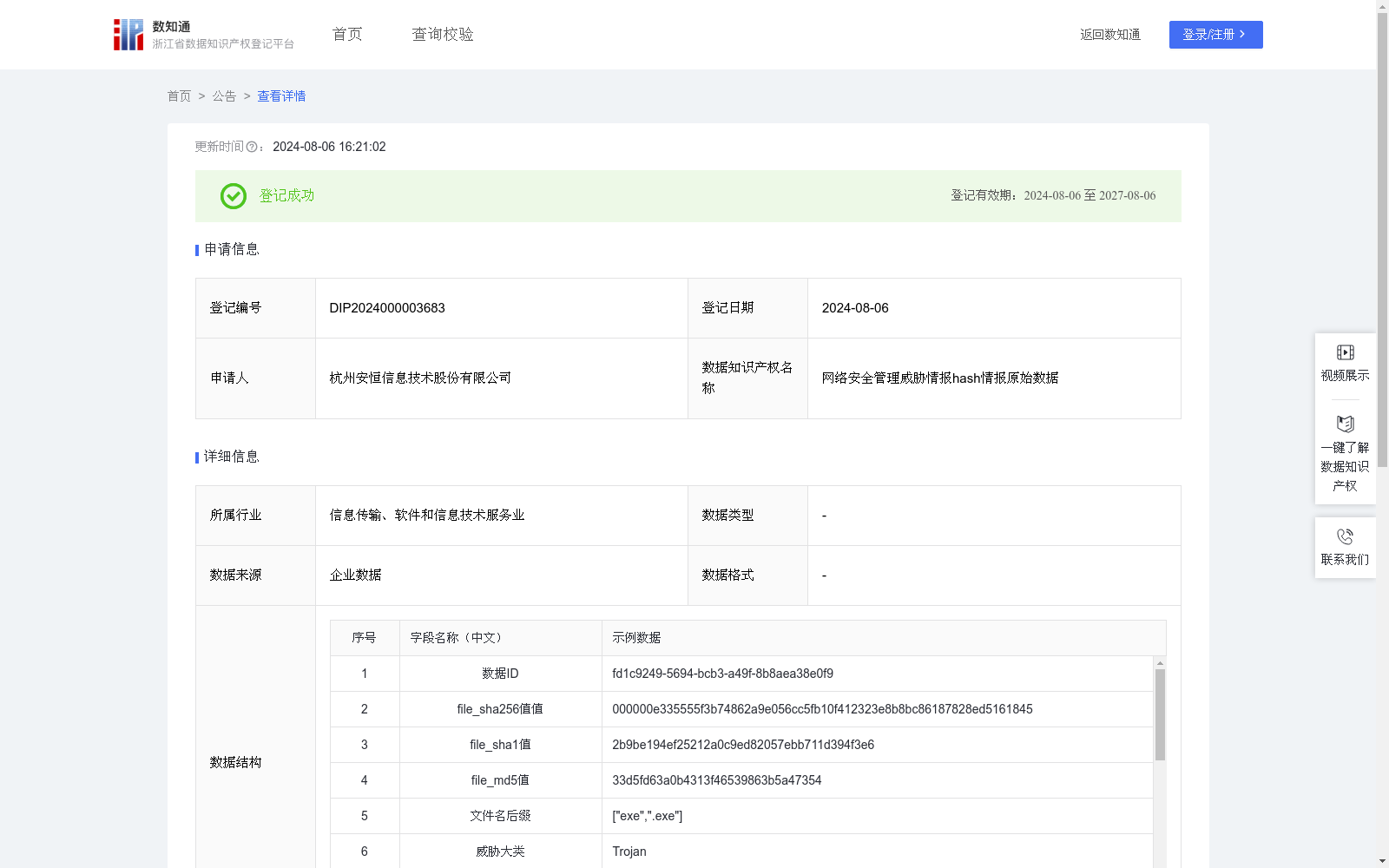
网络安全管理威胁情报hash情报原始数据
收藏资源简介:
安全解决方案-安全运营/MDR/MSS:安全服务提供商利用hash情报原始数据,为客户提供实时的威胁监测、分析和响应服务,提升客户的安全防护水平。工控安全:工控安全管理平台:将hash情报集成到工控安全管理平台中,对工控网络中的流量和文件活动进行监控,防止恶意软件对工控系统的攻击。工控安全审计:利用hash情报对工控系统中的文件进行审计,确保系统的完整性和安全性。安全管理:安全管理平台/态势感知:安全管理平台通过整合hash情报原始数据,构建全面的威胁态势感知图,为安全决策提供有力支持。安全基线与配置管理:根据hash情报揭示的威胁趋势,动态调整安全基线和配置管理策略,提升系统安全性。威胁情报(TI):hash情报是威胁情报的重要组成部分,为安全团队提供实时的、具体的威胁信息。志分析与审计:通过比对日志中的文件hash值与已知的恶意hash,快速定位并处理安全事件。云安全-微隔离:在云环境中,利用hash情报对云资源之间的流量进行微隔离控制,防止恶意软件在云内扩散。物联网安全-车联网安全:将hash情报应用于车联网安全领域,对车载终端和车辆网络中的流量进行监控,防止恶意软件通过车载系统1.哈希值计算规则 file_sha256值:使用SHA-256算法计算文件的哈希值。 file_sha1值:使用SHA-1算法计算文件的哈希值。 file_md5值:使用MD5算法计算文件的哈希值。 这些哈希值用于唯一标识文件,即使文件很小的变化也能被检测出来。 2. 文件元数据处理 包含可能的文件类型/文件名后缀:通过文件签名或后缀分析确定文件类型。 文件大小:记录文件的字节大小,用于数据分析和过滤。 3. 威胁分类与评分 威胁大类/小类:根据情报说明自动或人工分类。 威胁等级:基于威胁的潜在影响和可能性,用数值表示。 可信度:依据情报源的可靠性及验证情况,给出0-10的评分。 公开程度:衡量情报的公开范围,从完全保密到完全公开。 4. 数据安全与隐私保护 对于敏感信息,如情报来源、相关组织等,应用加密或哈希技术以保护隐私。 使用安全的存储和传输协议,确保数据不被未授权访问。
Security Solutions - Security Operations / MDR / MSS: Security service providers leverage raw hash intelligence data to provide customers with real-time threat monitoring, analysis and response services, thereby enhancing customers' security protection capabilities. Industrial Control Security: Industrial Control Security Management Platform: Integrate hash intelligence into the industrial control security management platform to monitor traffic and file activities in the industrial control network, preventing malicious software from attacking industrial control systems. Industrial Control Security Audit: Use hash intelligence to audit files in industrial control systems, ensuring the integrity and security of the system. Security Management: Security Management Platform / Threat Situational Awareness: The security management platform integrates raw hash intelligence data to build a comprehensive threat situational awareness map, providing robust support for security decision-making. Security Baseline and Configuration Management: Dynamically adjust security baseline and configuration management strategies based on threat trends revealed by hash intelligence, improving system security. Threat Intelligence (TI): Hash intelligence is a critical component of threat intelligence, providing security teams with real-time and specific threat information. Log Analysis and Audit: Quickly locate and handle security incidents by comparing file hashes in logs with known malicious hashes. Cloud Security - Microsegmentation: In cloud environments, use hash intelligence to implement microsegmentation control over traffic between cloud resources, preventing the spread of malicious software within the cloud. Internet of Things Security - Internet of Vehicles Security: Apply hash intelligence to the field of Internet of Vehicles security, monitoring traffic in on-board terminals and vehicle networks, preventing malicious software from spreading through on-board systems. 1. Hash Value Calculation Rules file_sha256 value: Calculate the hash value of a file using the SHA-256 algorithm. file_sha1 value: Calculate the hash value of a file using the SHA-1 algorithm. file_md5 value: Calculate the hash value of a file using the MD5 algorithm. These hash values are used to uniquely identify files, enabling detection of even minor changes to files. 2. File Metadata Processing Supported File Types/File Name Extensions: Determine the file type through file signature or suffix analysis. File Size: Record the byte size of the file for data analysis and filtering purposes. 3. Threat Classification and Scoring Threat Major Category / Subcategory: Automatically or manually classify based on intelligence descriptions. Threat Level: Expressed as a numerical value based on the potential impact and likelihood of the threat. Credibility: A score ranging from 0 to 10, assigned based on the reliability and verification status of the intelligence source. Public Disclosure Level: Measure the public scope of the intelligence, ranging from fully confidential to fully public. 4. Data Security and Privacy Protection For sensitive information such as intelligence sources and related organizations, apply encryption or hashing technologies to protect privacy. Use secure storage and transmission protocols to ensure that data is not accessed by unauthorized parties.