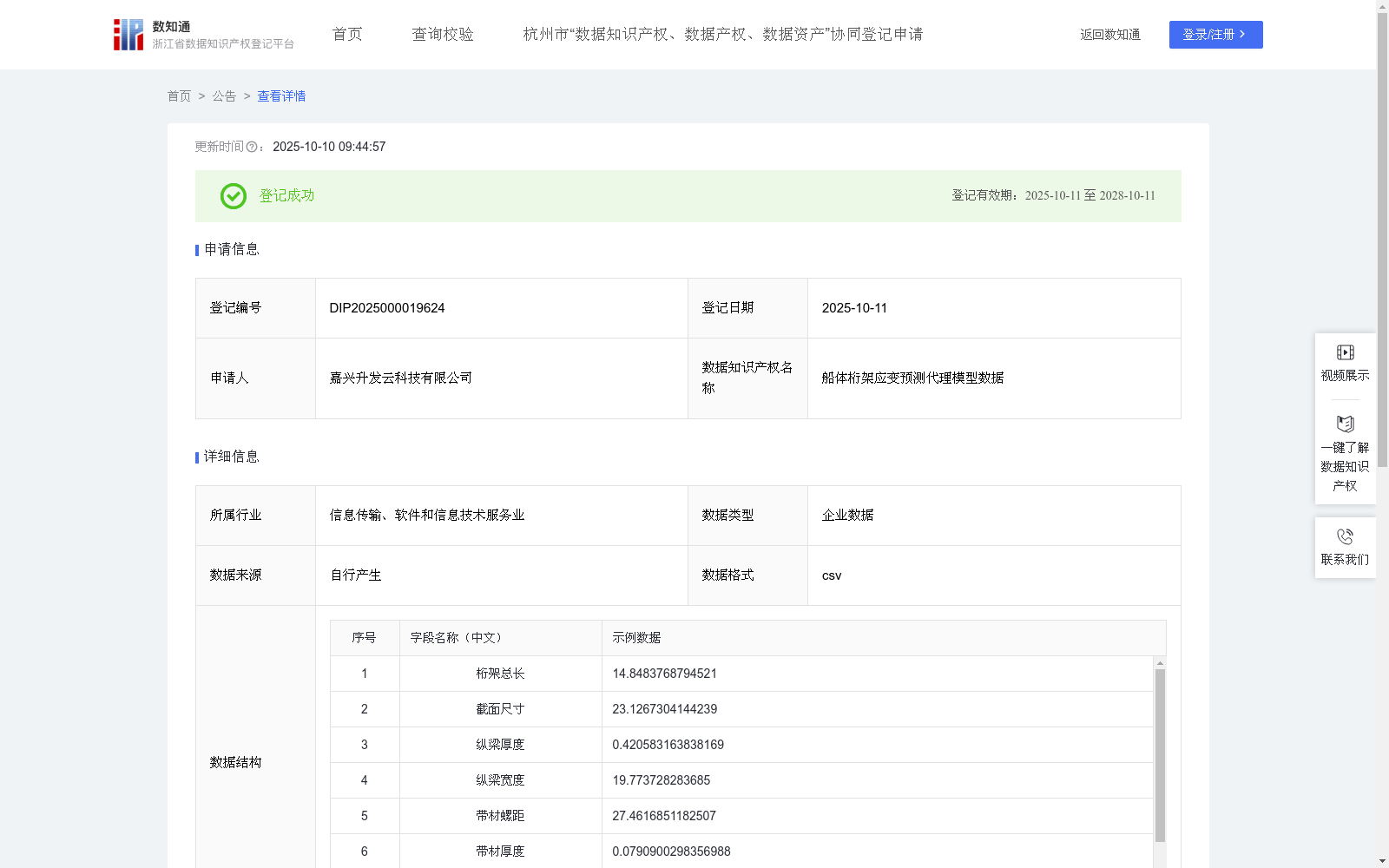
船体桁架应变预测代理模型数据
收藏资源简介:
船体桁架应变预测代理模型数据集,其核心价值在于能够高效且低成本地解决对船体结构在各种工况下力学响应的快速洞察问题。具体而言,该数据集能够直接用于评估结构安全裕度,帮助探索极端海况下的载荷极限;支持设计方案的快速对比与优化迭代,缩短研发周期;作为虚拟传感器网络,为数字孪生系统提供全船实时应变数据,弥补物理监测的不足;并能为船员操作与航线规划提供决策依据,通过模拟不同航向与航速下的结构负荷,选择对船体最安全的航行策略。最终,该数据集为解决船舶结构的状态评估、风险控制和生命周期管理等核心工程应用问题提供了高效的数据基础。1.数据收集:根据仿真模拟系统的捕捉功能,我们获得了仿真船体的结构变量(衍架总长计量单位为m,其余计量单位为mm);紧接着我们通过仿真测试得到了桁架应变的值(计量单位为ε)2.构建高斯过程:构建代理模型对结构性能评估本质是一个回归问题的模型。将船体结构方案的设计参数作为高斯过程的输入参数,结构性能指标作为高斯过程的输出参数。通过仿真数据的训练,可得到仿真船体的代理模型3.模型预测:通过代理模型数据的估计,我们可以得到预测模型,多项式核函数是高斯过程中常用的核函数之一,可以用来建模输入变量与输出变量之间的非线性关系,当输入新型船体的结构变量时,我们就可以快速得到他的应变的数量预测值。其形式为:K(x,y)=(σ^2*<x,y>+c)^d,其中x和y是输入向量,<x,y>表示它们的内积,d是多项式的次数,σ是一个比例因子,c是一个常数项。模型训练前首先准备数据集,共有100个样本,输入变量为二维,输出变量为一维,使用随机划分的方法将数据集划分为训练集和测试集,其中,80%用于训练,剩余20%数据用于测试。经过模型训练,将测试集应用于高斯过程模型进行测试,使用MAE、MAPE、MSE、RMSE四个参考值对模型的准确性进行评估。
Hull Truss Strain Prediction Surrogate Model Dataset. Its core value lies in efficiently and cost-effectively enabling rapid insight into the mechanical responses of hull structures under various operating conditions. Specifically, this dataset can be directly used to evaluate structural safety margins, assist in exploring load limits under extreme sea conditions; support rapid comparison and iterative optimization of design schemes to shorten R&D cycles; serve as a virtual sensor network to provide real-time strain data of the entire ship for digital twin systems, compensating for the shortcomings of physical monitoring; and provide decision-making basis for crew operations and route planning, by simulating structural loads under different headings and speeds to select the safest navigation strategy for the hull. Ultimately, this dataset provides an efficient data foundation for addressing core engineering application issues such as ship structure condition assessment, risk control, and lifecycle management. 1. Data Collection: Based on the capture function of the simulation system, we obtained the structural variables of the simulated hull (the total length unit of the truss is m, and the rest units are mm); subsequently, we obtained the truss strain values (unit: ε) through simulation tests. 2. Gaussian Process Construction: Constructing a surrogate model for structural performance evaluation is essentially a regression model. The design parameters of the hull structure scheme are taken as the input parameters of the Gaussian process, and the structural performance indicators are taken as the output parameters of the Gaussian process. Through training with simulation data, a surrogate model for the simulated hull can be obtained. 3. Model Prediction: Through the estimation of surrogate model data, we can obtain a prediction model. The polynomial kernel function is one of the commonly used kernel functions in Gaussian processes, which can be used to model the nonlinear relationship between input and output variables. When inputting the structural variables of a new hull, we can quickly obtain the predicted strain values. Its form is: $K(x,y)=(sigma^2cdot<x,y>+c)^d$, where $x$ and $y$ are input vectors, $<x,y>$ represents their inner product, $d$ is the degree of the polynomial, $sigma$ is a scaling factor, and $c$ is a constant term. Before model training, the dataset is prepared, which has a total of 100 samples, with two-dimensional input variables and one-dimensional output variables. The dataset is divided into training set and test set using random partitioning, where 80% is used for training and the remaining 20% is used for testing. After model training, the test set is applied to the Gaussian process model for testing, and four reference indicators including MAE, MAPE, MSE, and RMSE are used to evaluate the accuracy of the model.