
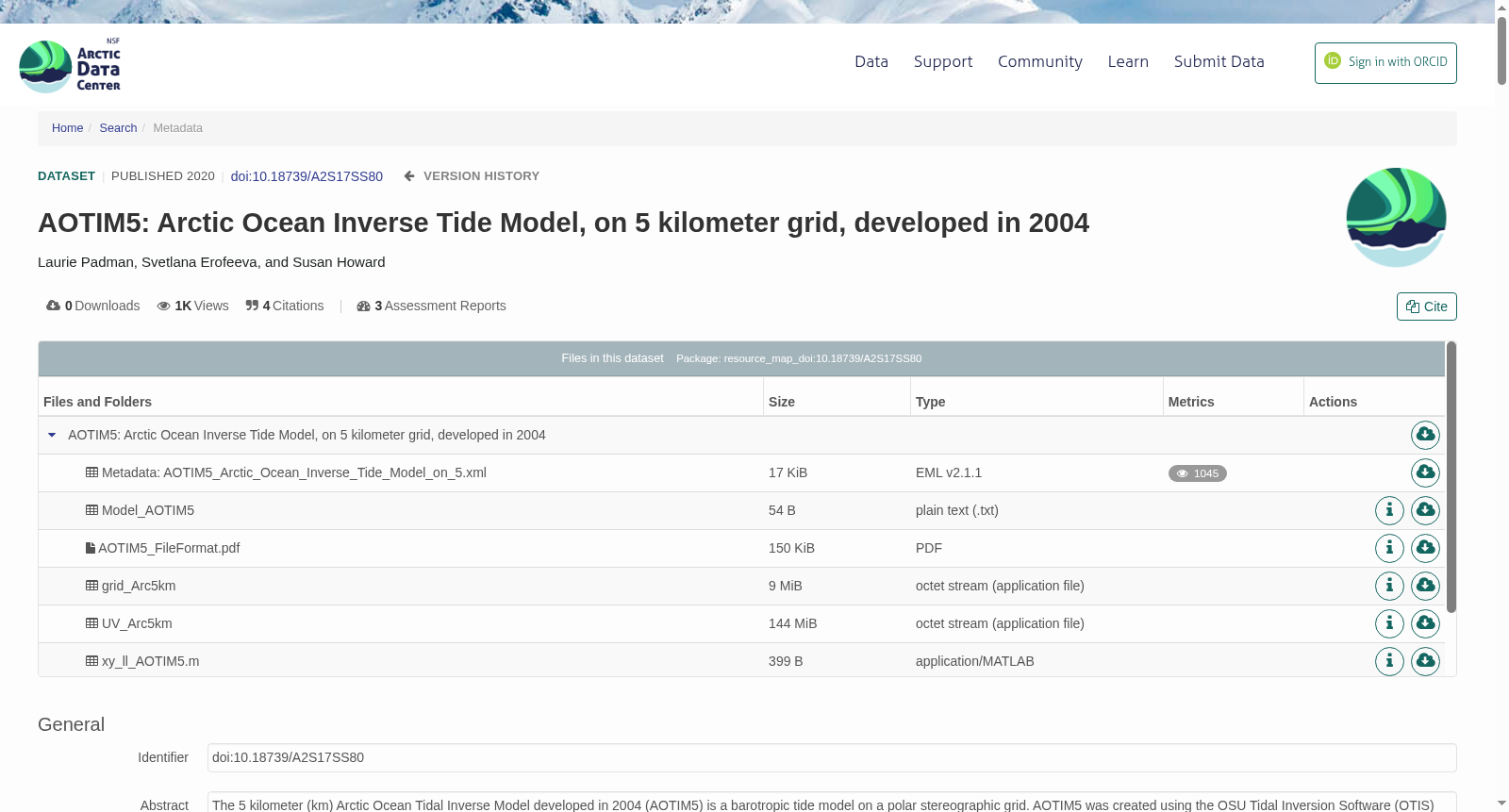
AOTIM5: Arctic Ocean Inverse Tide Model, on 5 kilometer grid, developed in 2004
收藏DataCite Commons2025-02-07 更新2025-04-16 收录
下载链接:
https://arcticdata.io/catalog/view/doi:10.18739/A2S17SS80
下载链接
链接失效反馈官方服务:
资源简介:
The 5 kilometer (km) Arctic Ocean Tidal Inverse Model developed in 2004 (AOTIM5) is a barotropic tide model on a polar stereographic grid. AOTIM5 was created using the OSU Tidal Inversion Software (OTIS) package (https://www.tpxo.net/). Model development is described by Padman and Erofeeva (2004) (https://doi.org/10.1029/2003GL019003). The bathymetry grid is based on the original International Bathymetric Chart of the Arctic Ocean (IBCAO) bathymetry (Jakobsson et al., 2000; https://doi.org/10.1029/00EO00059). AOTIM5 consists of grids of sea surface height and depth-integrated currents (“volume transports”) for each of 8 tidal constituents; 4 semidiurnal (M2, S2, K2, N2) and 4 diurnal (K1, O1, P1, Q1). The first step in building AOTIM5 was development of the Arctic Ocean Dynamics-based Tide Model (AODTM5), which is also available at the Arctic Data Center (https://arcticdata.io/catalog/view/doi:10.18739/A2901ZG3N). That model was forced at open ocean boundaries by the TOPEX/Poseidon global barotropic tidal solution version 6.2 (TPXO.6.2), and by local astronomical forcing (“potential tides”). Each constituent in AODTM5 was tuned, separately, to Arctic tide height data by optimizing the linear drag coefficient. AOTIM5 used AODTM5 as a “prior” model, then assimilated coastal and benthic tide gauges, and TOPEX/Poseidon and ERS satellite radar altimetry, to improve the 4 largest-amplitude constituents, M2, S2, K1 and O1.
An updated version of this model created in 2018, Arc5km2018, is also available at the Arctic Data Center. The newer model uses updated open boundary conditions, and a wider range of assimilated data including much longer satellite altimetry records. We recommend that users compare results from AOTIM5 and Arc5km2018 before deciding which to use for a specific application. Please also check the ESR Polar Tide Model webpage (https://www.esr.org/research/polar-tide-models/) for more recent Arctic barotropic tide models.
Padman, L., and S. Erofeeva (2004), A barotropic inverse tidal model for the Arctic Ocean, Geophysical Research Letters, 31(2), L02303, doi:10.1029/2003GL019003.
2004年开发的5千米(km)分辨率北极海洋潮汐反演模型(AOTIM5)是一种采用极射赤平投影网格的正压潮汐模型。AOTIM5基于俄亥俄州立大学潮汐反演软件包(OSU Tidal Inversion Software, OTIS)构建,相关资源可访问https://www.tpxo.net/获取。该模型的开发细节由Padman与Erofeeva于2004年发表(https://doi.org/10.1029/2003GL019003)。
其水深网格基于原始《北极海洋国际水深图》(International Bathymetric Chart of the Arctic Ocean, IBCAO)的水深数据(Jakobsson等,2000;https://doi.org/10.1029/00EO00059)。AOTIM5包含8个潮汐分潮的海面高度与垂向积分海流("体积输运量")网格,其中4个为半日分潮(M2、S2、K2、N2),4个为全日分潮(K1、O1、P1、Q1)。
开发AOTIM5的第一步是构建基于北极海洋动力学的潮汐模型(AODTM5),该模型同样可在北极数据中心获取(https://arcticdata.io/catalog/view/doi:10.18739/A2901ZG3N)。AODTM5的开边界条件采用TOPEX/Poseidon全球正压潮汐解第6.2版(TPXO.6.2),并叠加局地天文强迫("势能潮汐")。通过优化线性拖曳系数,AODTM5的每个分潮均单独针对北极潮汐观测数据进行了调谐。AOTIM5以AODTM5作为"先验"模型,随后同化了沿岸与底床潮汐计数据,以及TOPEX/Poseidon和欧洲遥感卫星(ERS)的卫星雷达测高数据,以优化4个振幅最大的分潮:M2、S2、K1与O1。
2018年开发的该模型更新版本Arc5km2018同样可在北极数据中心获取。新版本采用了更新后的开边界条件,并同化了更多类型的观测数据,包括更长时间序列的卫星测高记录。我们建议用户在选择特定应用所需的模型前,先对比AOTIM5与Arc5km2018的计算结果。此外,请访问ESR极地潮汐模型网页(https://www.esr.org/research/polar-tide-models/)以获取更多近期北极正压潮汐模型资源。
Padman, L.与S. Erofeeva(2004):《北极海洋正压反演潮汐模型》,《地球物理研究快报》,31(2),L02303,doi:10.1029/2003GL019003。
提供机构:
NSF Arctic Data Center
创建时间:
2020-05-06
搜集汇总
数据集介绍
以上内容由遇见数据集搜集并总结生成


