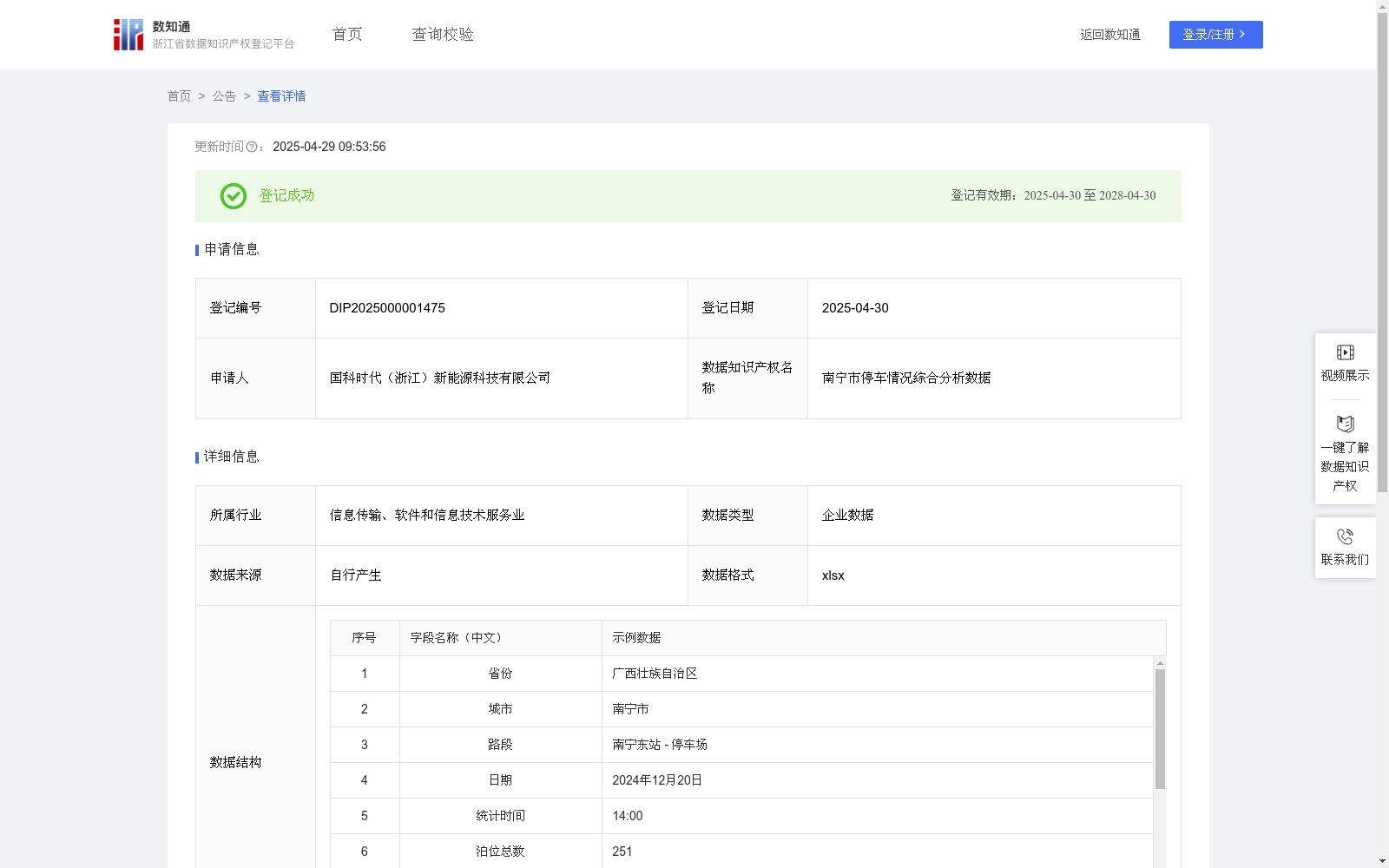
南宁市停车情况综合分析数据
收藏资源简介:
通过对南宁市道路停车清洗加工统计,分析道路停车的各路段泊位周转率、日平均停车时长分布等数据: 为研究院对静态交通研究提供城市车辆动静态数据支持。 为主管部门提供路面流动及车辆管理提供数据支持。 为静态交通研究室私有知识库提供数据支持 为管理平台及城市规划停车设施建设提供数据支持。当车辆驶入或驶出停车位时系统实时上传, 平台解析数据并根据数据库中存储的车位设备关系表,找到对应所属的车位编号以及路段信息。平台每小时按照省份、城市、路段的层次从数据库检索,并按照如下规则做数据统计:统计最近一小时内,该路段下所有泊位地磁上报的有车总数据条数作为【停车次数】;统计当前时刻该路段下有车的泊位数量,作为【占用泊位】数量;统计当前时刻该路段下无车的泊位数量,作为【空闲泊位】数量;空闲泊位+占用泊位作为【泊位总数】;占用泊位/泊位总数作为【泊位占用率】;停车次数/泊位总数作为【周转率】;每个泊位停车时长总和作为【总停车时长】;总停车时长/停车次数 作为【平均停车时长】; 最后将省份、城市、路段、日期、统计时间、泊位总数、空闲泊位、占用泊位、泊位占用率、停车次数、周转率、总停车时长(分钟)、平均停车时长(分钟)存储到数据库中供后续查询。
This dataset is developed based on the cleaned, processed and statistically analyzed road parking data of Nanning, and analyzes indicators such as the berth turnover rate and daily average parking duration distribution of each road section. It serves the following scenarios: 1. Providing urban vehicle dynamic and static data support for the research institute's static traffic research; 2. Providing data support for competent authorities to manage road traffic flow and vehicle operations; 3. Providing data support for the private knowledge base of the Static Traffic Research Laboratory; 4. Providing data support for management platforms and urban planning of parking facility construction. When a vehicle enters or exits a parking berth, the system uploads relevant data in real time. The platform parses the received data and identifies the corresponding berth number and road section information by referring to the berth-device relationship table stored in the database. On an hourly basis, the platform retrieves data from the database following the hierarchy of province, city and road section, and conducts data statistics according to the following rules: - Count the total number of reported data entries of occupied vehicles from all berth magnetometers under this road section in the latest hour as **parking times**; - Count the number of berths occupied by vehicles at the current moment as **occupied berths**; - Count the number of berths without vehicles at the current moment as **idle berths**; - The sum of idle berths and occupied berths is defined as **total berths**; - Calculate **berth occupancy rate** as occupied berths divided by total berths; - Calculate **berth turnover rate** as parking times divided by total berths; - Sum the parking durations of all berths to get **total parking duration**; - Calculate **average parking duration** as total parking duration divided by parking times; Finally, store the collected data including province, city, road section, date, statistics timestamp, total berths, idle berths, occupied berths, berth occupancy rate, parking times, turnover rate, total parking duration (in minutes), and average parking duration (in minutes) into the database for subsequent query and analysis.