
Carbohydrate Structure Database
收藏re3data.org2024-05-31 收录
下载链接:
https://www.re3data.org/repository/r3d100012862
下载链接
链接失效反馈资源简介:
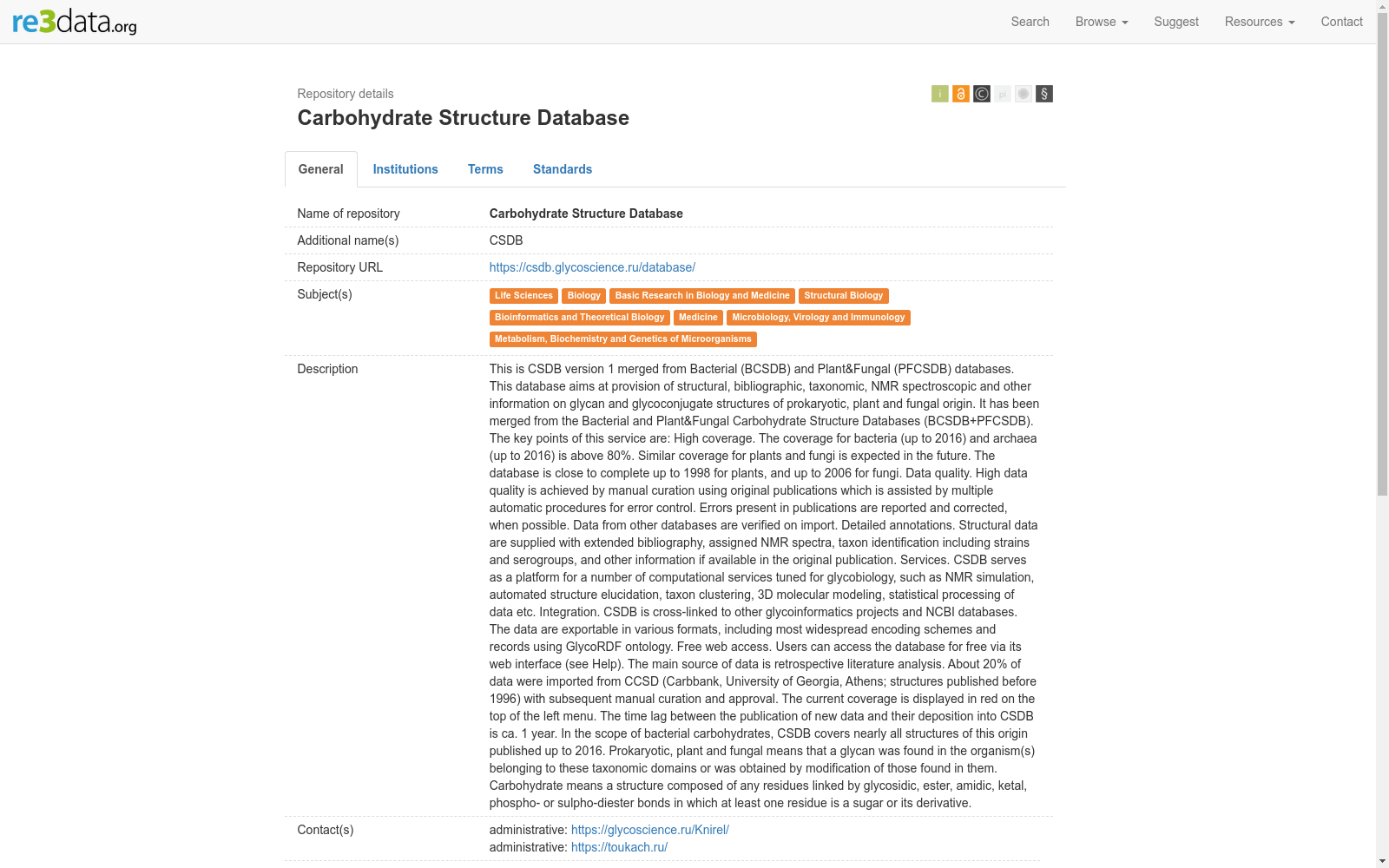
This is CSDB version 1 merged from Bacterial (BCSDB) and Plant&Fungal (PFCSDB) databases. This database aims at provision of structural, bibliographic, taxonomic, NMR spectroscopic and other information on glycan and glycoconjugate structures of prokaryotic, plant and fungal origin. It has been merged from the Bacterial and Plant&Fungal Carbohydrate Structure Databases (BCSDB+PFCSDB). The key points of this service are: High coverage. The coverage for bacteria (up to 2016) and archaea (up to 2016) is above 80%. Similar coverage for plants and fungi is expected in the future. The database is close to complete up to 1998 for plants, and up to 2006 for fungi. Data quality. High data quality is achieved by manual curation using original publications which is assisted by multiple automatic procedures for error control. Errors present in publications are reported and corrected, when possible. Data from other databases are verified on import. Detailed annotations. Structural data are supplied with extended bibliography, assigned NMR spectra, taxon identification including strains and serogroups, and other information if available in the original publication. Services. CSDB serves as a platform for a number of computational services tuned for glycobiology, such as NMR simulation, automated structure elucidation, taxon clustering, 3D molecular modeling, statistical processing of data etc. Integration. CSDB is cross-linked to other glycoinformatics projects and NCBI databases. The data are exportable in various formats, including most widespread encoding schemes and records using GlycoRDF ontology. Free web access. Users can access the database for free via its web interface (see Help). The main source of data is retrospective literature analysis. About 20% of data were imported from CCSD (Carbbank, University of Georgia, Athens; structures published before 1996) with subsequent manual curation and approval. The current coverage is displayed in red on the top of the left menu. The time lag between the publication of new data and their deposition into CSDB is ca. 1 year. In the scope of bacterial carbohydrates, CSDB covers nearly all structures of this origin published up to 2016. Prokaryotic, plant and fungal means that a glycan was found in the organism(s) belonging to these taxonomic domains or was obtained by modification of those found in them. Carbohydrate means a structure composed of any residues linked by glycosidic, ester, amidic, ketal, phospho- or sulpho-diester bonds in which at least one residue is a sugar or its derivative.
本CSDB版本1由细菌(BCSDB)和植物真菌(PFCSDB)数据库合并而成。该数据库旨在提供有关原核生物、植物和真菌来源的糖苷和糖苷化合物的结构、书目、分类、核磁共振光谱及其他相关信息。它由细菌和植物真菌碳水化合物结构数据库(BCSDB+PFCSDB)合并而来。本服务的关键点如下:
- 高度覆盖:对于细菌(截至2016年)和古菌(截至2016年)的覆盖率达到80%以上。预计未来植物和真菌的覆盖率也将相似。数据库中,植物的数据截止至1998年,真菌的数据截止至2006年已基本完整。
- 数据质量:通过使用原始出版物进行人工整理,辅以多种自动错误控制程序,实现了高质量的数据。出版物中存在的错误被报告并尽可能纠正。导入的数据来自其他数据库时,均经过验证。
- 详细注释:结构数据附带扩展的参考文献、指定的核磁共振光谱、物种鉴定(包括菌株和血清群)以及原始出版物中可用的其他信息。
- 服务:CSDB作为一个平台,提供了一系列针对糖生物学的计算服务,如核磁共振模拟、自动化结构解析、物种聚类、3D分子建模、数据统计分析等。
- 集成:CSDB与其他糖信息学项目和NCBI数据库相互链接。数据可导出为多种格式,包括最广泛使用的编码方案和采用GlycoRDF本体的记录。
- 免费网络访问:用户可以通过其网络界面免费访问数据库(见帮助)。数据的主要来源是对回顾性文献的分析。约20%的数据来自CCSD(Carbbank,乔治亚大学,亚特兰大;1996年之前发表的化合物结构)的导入,随后经过人工整理和批准。当前覆盖范围在左侧菜单顶部以红色显示。新数据从出版到存入CSDB的时间滞后约为1年。在细菌碳水化合物范围内,CSDB涵盖了截至2016年发表的几乎所有此类来源的结构。原核生物、植物和真菌指的是在属于这些分类域的有机体中发现的糖苷,或通过对其发现的糖苷进行修饰而获得的糖苷。碳水化合物是指由糖苷键、酯键、酰胺键、缩醛键、磷酸二酯键或磺酸二酯键连接的任何残基组成的结构,其中至少有一个残基是糖或其衍生物。
提供机构:
CSDB
搜集汇总
数据集介绍
背景与挑战
背景概述
Carbohydrate Structure Database(CSDB)是一个专注于原核生物、植物和真菌来源的碳水化合物结构数据库,合并了细菌和植物/真菌子库,提供结构、文献、分类和NMR光谱等详细信息。其特点包括高覆盖率(截至2016年细菌和古菌超过80%)、通过手动管理和自动程序确保数据质量,并集成了NMR模拟、3D建模等计算服务,支持免费开放访问和跨数据库链接。
以上内容由遇见数据集搜集并总结生成



