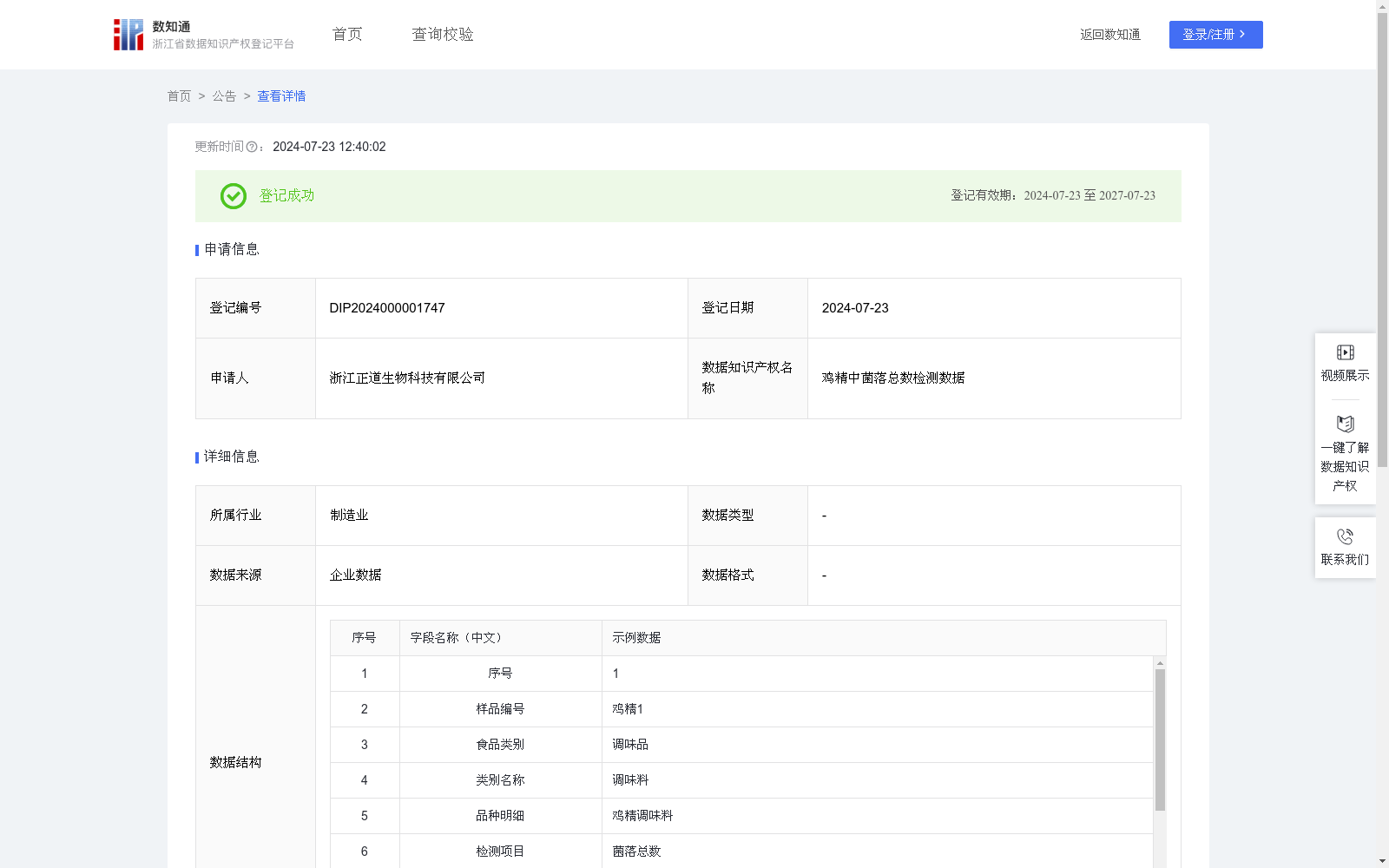
鸡精中菌落总数检测数据
收藏资源简介:
菌落总数可以反映食品在生产过程中是否符合卫生要求。因此对于鸡精中菌落总数进行检测,对判断产品中菌落总数含量是否超标具有重要意义,有利于保证食品安全。1、数据采集:样品编号、食品类别、检测项目、检测值等项目;2、数据处理:1)若只有一个稀释度平板上的菌落数在适宜计数范围内,计算两个平板菌落数的平均值,再将平均值乘以相应稀释倍数;2)若有两个连续稀释度的平板菌落数在适宜计数范围内时,平板(含适宜范围菌落数的平板)菌落数之和/【(第一稀释度(低稀释倍数)平板个数)+0.1第二稀释度(高稀释倍数)平板个数*稀释因子(第一稀释度)】;3)若所有稀释度的平板上菌落数均大于 300 CFU,则对稀释度最高的平板进行计数,其他平板可记录为多不可计,结果按平均菌落数乘以最高稀释倍数计算;4)若所有稀释度的平板菌落数均小于30 CFU,则应按稀释度最低的平均菌落数乘以稀释倍数计算;5)若所有稀释度(包括液体样品原液)平板均无菌落生长,则以小于1乘以最低稀释倍数计算;6)若所有稀释度的平板菌落数均不在 30CFU~300CFU之间,其中一部分小于30CFU或大于300CFU时,则以最接近30 CFU或300CFU的平均菌落数乘以稀释倍数计算。3、数据应用:菌落总数含量超标问题项检测结果可以作为判断食品安全性评价依据,为监管部门靶向监管提供技术支撑。
Total Aerobic Plate Count (APC) can reflect whether food meets hygiene requirements during production. Therefore, detecting the APC in chicken essence is of great significance for judging whether the APC content in the product exceeds the standard, which is conducive to ensuring food safety. 1. Data Collection: Includes sample number, food category, detection items, detection values and other related items; 2. Data Processing: 1) If the colony count on only one dilution plate falls within the appropriate counting range, calculate the average value of the colony counts from the two plates, then multiply the average value by the corresponding dilution factor; 2) If the colony counts on two consecutive dilution plates fall within the appropriate counting range, use the formula: (sum of colony counts from plates with colony counts within the appropriate range) / [(number of plates in the first dilution [lower dilution multiple] × 1) + 0.1 × number of plates in the second dilution [higher dilution multiple] × dilution factor of the first dilution]; 3) If the colony counts on all dilution plates are greater than 300 CFU, count the plate with the highest dilution, record the other plates as too numerous to count (TNTC), and calculate the result by multiplying the average colony count by the highest dilution factor; 4) If the colony counts on all dilution plates are less than 30 CFU, calculate the result by multiplying the average colony count of the lowest dilution by the dilution factor; 5) If no colonies grow on all dilution plates (including undiluted liquid samples), calculate the result as less than 1 multiplied by the lowest dilution factor; 6) If the colony counts on all dilution plates are not between 30 CFU and 300 CFU, and some are less than 30 CFU or greater than 300 CFU, calculate the result by multiplying the average colony count closest to 30 CFU or 300 CFU by the dilution factor; 3. Data Application: The detection results of items with excessive APC content can be used as a basis for food safety evaluation, and provide technical support for targeted supervision by regulatory authorities.