Design of a cryogenic photocathode gun with a novel TM02 mode coupler for low emittance
收藏资源简介:
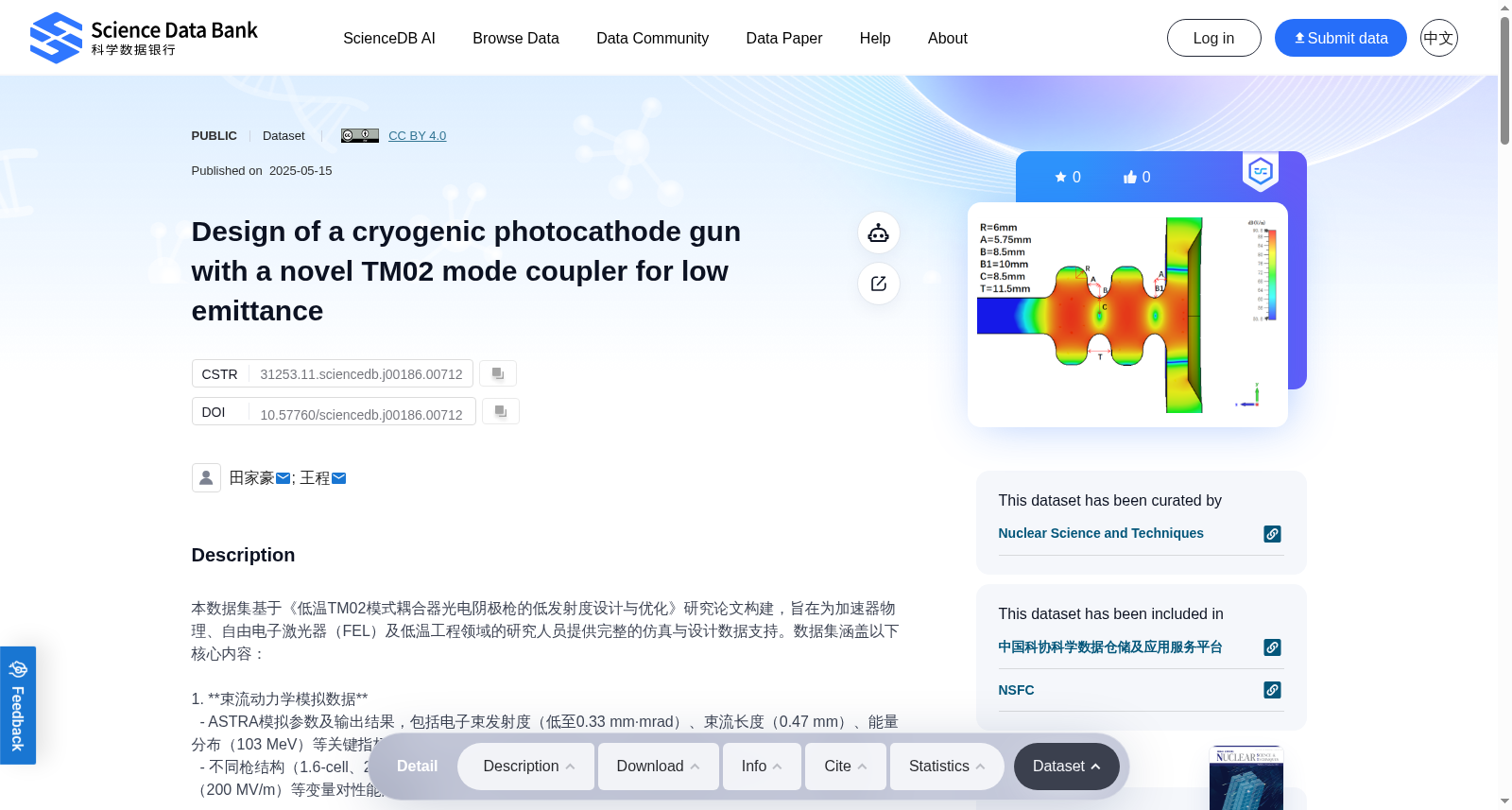
本数据集基于《低温TM02模式耦合器光电阴极枪的低发射度设计与优化》研究论文构建,旨在为加速器物理、自由电子激光器(FEL)及低温工程领域的研究人员提供完整的仿真与设计数据支持。数据集涵盖以下核心内容: 1. **束流动力学模拟数据** - ASTRA模拟参数及输出结果,包括电子束发射度(低至0.33 mm·mrad)、束流长度(0.47 mm)、能量分布(103 MeV)等关键指标。 - 不同枪结构(1.6-cell、2.6-cell、3.6-cell)的优化对比数据,含激光脉冲宽度(5-10 ps)、阴极梯度(200 MV/m)等变量对性能的影响。 2. **射频设计与低温性能数据** - CST Microwave Studio与SUPERFISH的仿真结果,包括腔体结构参数(椭圆轮廓比、倒角半径)、表面电场分布、品质因子(Q₀)及模式分离度。 - 低温状态下(40 K)材料性能参数,如铜的残余电阻比(RRR=300)、热膨胀系数、电导率变化及频率偏移(18.1 MHz)等。 3. **耦合器设计与多极场抑制数据** - J型与T型波导耦合器的S参数(S₁₁=-35 dB,S₂₁=-3 dB)、电场分布及多极场强度(低至0.01%)。 - 基于Panofsky-Wenzel定理的横向动量计算数据,量化多极场对发射度的影响(0.5 mm·mrad)。 4. **工程与低温系统数据** - 2.6-cell枪的工程图纸、低温恒温器设计图及真空参数(1e-7 Pa)。 - 射频脉冲加热温度(19.98 K@室温,4.85 K@低温)及峰值功率需求(3.761 MW)。 **数据格式与结构** - 数据以仿真配置文件(ASTRA/CST脚本)、图像(腔体结构图、电场分布图)及技术文档(参数说明、公式推导)形式组织。 - 元数据标注清晰,包含变量定义、单位及实验条件描述。 **应用价值** 本数据集为高亮度电子源设计提供基准参考,适用于新型加速器开发、低温射频系统优化及多物理场耦合研究,尤其支持上海软X射线自由电子激光(SXFEL)升级等重大科学工程。数据首次公开了TM02模式阴极枪的完整设计流程,为后续实验验证与工程实现奠定理论基础。 **访问方式** 数据集通过开放科学平台发布(如Zenodo或Figshare),遵循CC BY 4.0协议,允许非商业性使用与衍生开发。用户可通过论文附录或项目主页获取下载链接及详细文档。
This dataset is constructed based on the research paper *Low Emittance Design and Optimization of a Cryogenic TM02-mode Coupler Photocathode Gun*, aiming to provide comprehensive simulation and design data support for researchers in the fields of accelerator physics, free-electron lasers (FEL), and cryogenic engineering. The dataset covers the following core contents: 1. **Beam Dynamics Simulation Data** - ASTRA simulation parameters and output results, including key metrics such as electron beam emittance (as low as 0.33 mm·mrad), bunch length (0.47 mm), and energy spread (103 MeV). - Optimized comparative data for different gun structures (1.6-cell, 2.6-cell, 3.6-cell), including the effects of variables such as laser pulse width (5–10 ps) and cathode gradient (200 MV/m) on performance. 2. **RF Design and Cryogenic Performance Data** - Simulation results from CST Microwave Studio and SUPERFISH, including cavity structural parameters (elliptical aspect ratio, chamfer radius), surface electric field distribution, quality factor (Q₀), and mode separation. - Material performance parameters under cryogenic conditions (40 K), such as residual resistivity ratio (RRR=300) of copper, thermal expansion coefficient, electrical conductivity variation, and frequency shift (18.1 MHz). 3. **Coupler Design and Multipole Field Suppression Data** - S-parameters (S₁₁ = -35 dB, S₂₁ = -3 dB), electric field distribution, and multipole field strength (as low as 0.01%) for J-type and T-type waveguide couplers. - Transverse momentum calculation data based on the Panofsky-Wenzel Theorem, quantifying the impact of multipole fields on emittance (0.5 mm·mrad). 4. **Engineering and Cryogenic System Data** - Engineering drawings of the 2.6-cell gun, design drawings of the cryostat, and vacuum parameters (1e-7 Pa). - RF pulse heating temperatures (19.98 K at room temperature, 4.85 K at cryogenic temperature) and peak power requirement (3.761 MW). **Data Format and Structure** - Data is organized in the form of simulation configuration files (ASTRA/CST scripts), images (cavity structure diagrams, electric field distribution diagrams), and technical documents (parameter descriptions, formula derivations). - Metadata is clearly annotated, including variable definitions, units, and descriptions of experimental conditions. **Application Value** This dataset provides a benchmark reference for high-brightness electron source design, applicable to novel accelerator development, cryogenic RF system optimization, and multi-physics coupling research, particularly supporting major scientific projects such as the upgrade of the Shanghai Soft X-ray Free-Electron Laser (SXFEL). For the first time, this dataset publicly releases the complete design workflow of a TM02-mode photocathode gun, laying a theoretical foundation for subsequent experimental verification and engineering implementation. **Access Method** The dataset is released via open science platforms (e.g., Zenodo or Figshare) under the CC BY 4.0 license, allowing non-commercial use and derivative development. Users can obtain download links and detailed documentation through the paper's appendix or the project homepage.