wjiaqi/evo
收藏资源简介:
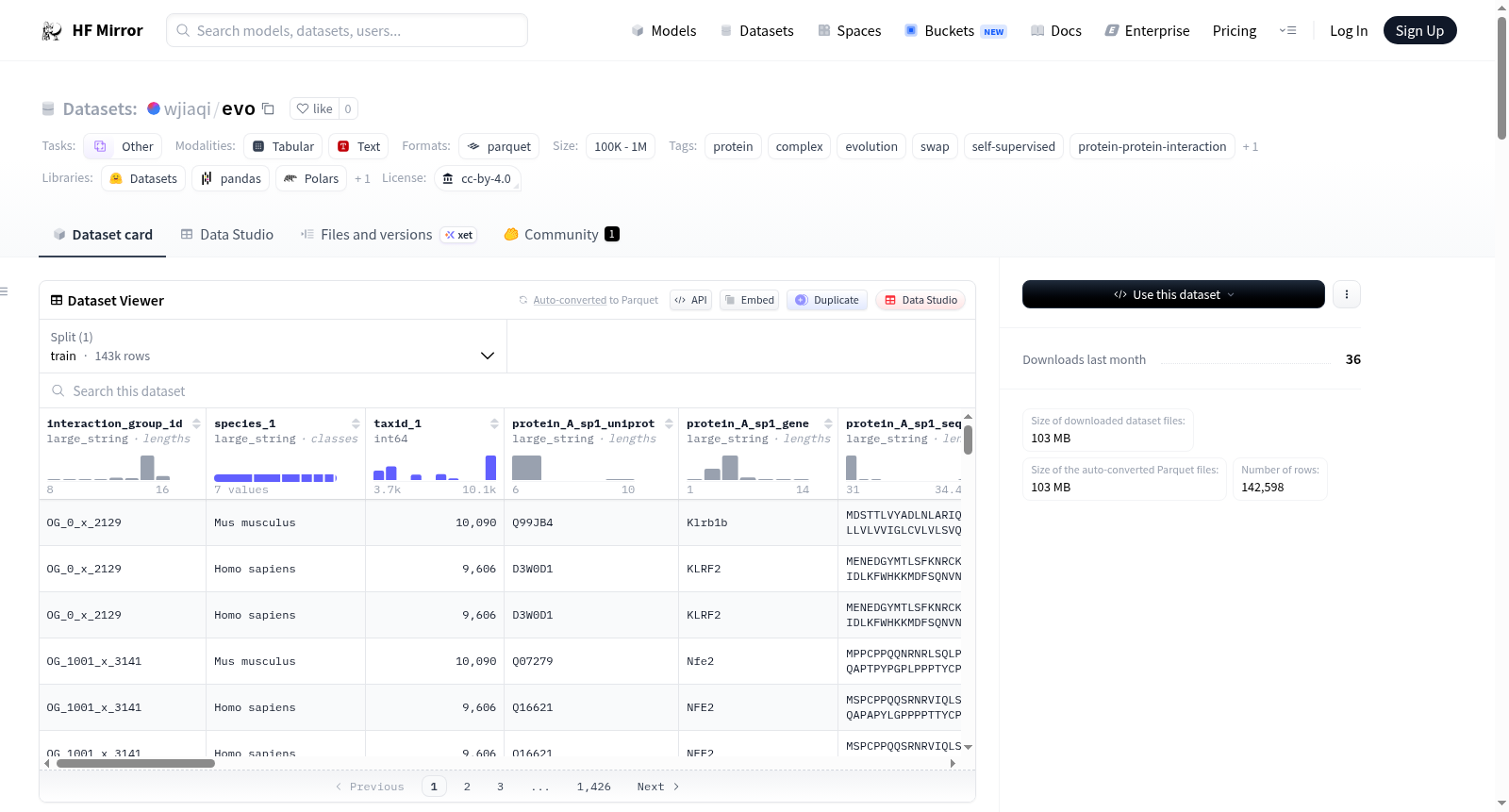
--- configs: - config_name: default data_files: "data/swap_complexes.parquet" default: true license: cc-by-4.0 task_categories: - other tags: - protein - complex - evolution - swap - self-supervised - protein-protein-interaction - ortholog size_categories: - 100K<n<1M --- # Protein Complex Swap Dataset A dataset of cross-species protein-protein interaction comparisons for self-supervised training of protein complex models. ## Overview Each row contains **two native protein complexes from different species** that share the same conserved interaction (via orthology). From each row, a model can construct: - **Native complex 1**: (A_sp1_seq, B_sp1_seq) — correct interaction in species 1 - **Native complex 2**: (A_sp2_seq, B_sp2_seq) — correct interaction in species 2 - **Swap complex 1**: (A_sp1_seq, B_sp2_seq) — cross-species partner swap - **Swap complex 2**: (A_sp2_seq, B_sp1_seq) — symmetric swap All **4 protein sequences** are included inline in each row, along with two quantitative distance measures. ## Dataset Statistics | Metric | Value | |--------|-------| | Total rows | 142,598 | | Unique interaction groups | 40,973 | | Unique proteins | 26,775 | | Species covered | 9 model organisms | ## Distance Measures Each row contains two quantitative measures of "how different" the swap is: 1. **`seq_identity_A`**: Pairwise sequence identity between protein A in species 1 and protein A in species 2 (0.0–1.0) 2. **`seq_identity_B`**: Pairwise sequence identity between protein B in species 1 and protein B in species 2 (0.0–1.0) 3. **`taxonomic_distance`**: NCBI taxonomy tree distance between the two species (integer, higher = more distant) ## Species Coverage | Species 1 | Species 2 | Rows | |-----------|-----------|------| | Homo sapiens | Mus musculus | 34,514 | | Saccharomyces cerevisiae | Homo sapiens | 12,309 | | Mus musculus | Rattus norvegicus | 12,061 | | Homo sapiens | Rattus norvegicus | 11,202 | | Saccharomyces cerevisiae | Mus musculus | 8,692 | | Drosophila melanogaster | Homo sapiens | 5,553 | | Arabidopsis thaliana | Homo sapiens | 5,492 | | Drosophila melanogaster | Mus musculus | 5,117 | | Arabidopsis thaliana | Mus musculus | 4,911 | | Arabidopsis thaliana | Saccharomyces cerevisiae | 4,402 | | Saccharomyces cerevisiae | Rattus norvegicus | 4,101 | | Caenorhabditis elegans | Homo sapiens | 4,013 | | Caenorhabditis elegans | Mus musculus | 3,733 | | Saccharomyces cerevisiae | Drosophila melanogaster | 3,481 | | Saccharomyces cerevisiae | Caenorhabditis elegans | 2,985 | | Drosophila melanogaster | Rattus norvegicus | 2,691 | | Arabidopsis thaliana | Rattus norvegicus | 2,570 | | Arabidopsis thaliana | Drosophila melanogaster | 2,389 | | Caenorhabditis elegans | Drosophila melanogaster | 2,251 | | Caenorhabditis elegans | Rattus norvegicus | 2,154 | | Arabidopsis thaliana | Caenorhabditis elegans | 2,023 | | Danio rerio | Homo sapiens | 1,579 | | Danio rerio | Mus musculus | 1,472 | | Drosophila melanogaster | Danio rerio | 718 | | Saccharomyces cerevisiae | Danio rerio | 611 | | Danio rerio | Rattus norvegicus | 599 | | Caenorhabditis elegans | Danio rerio | 542 | | Arabidopsis thaliana | Danio rerio | 433 | ## Column Schema | Column | Type | Description | |--------|------|-------------| | `interaction_group_id` | str | Groups rows from the same conserved interaction | | `species_1` | str | Species of complex 1 | | `taxid_1` | int | NCBI taxonomy ID of species 1 | | `protein_A_sp1_uniprot` | str | UniProt accession of protein A in species 1 | | `protein_A_sp1_gene` | str | Gene name of protein A in species 1 | | `protein_A_sp1_seq` | str | Full amino acid sequence of protein A in species 1 | | `protein_A_sp1_len` | int | Sequence length | | `protein_B_sp1_uniprot` | str | UniProt accession of protein B in species 1 | | `protein_B_sp1_gene` | str | Gene name of protein B in species 1 | | `protein_B_sp1_seq` | str | Full amino acid sequence of protein B in species 1 | | `protein_B_sp1_len` | int | Sequence length | | `string_score_sp1` | int | STRING confidence score for (A, B) in species 1 | | `species_2` | str | Species of complex 2 | | `taxid_2` | int | NCBI taxonomy ID of species 2 | | `protein_A_sp2_uniprot` | str | UniProt accession of protein A in species 2 | | `protein_A_sp2_gene` | str | Gene name | | `protein_A_sp2_seq` | str | Full amino acid sequence ← model input | | `protein_A_sp2_len` | int | Sequence length | | `protein_B_sp2_uniprot` | str | UniProt accession of protein B in species 2 | | `protein_B_sp2_gene` | str | Gene name | | `protein_B_sp2_seq` | str | Full amino acid sequence ← model input | | `protein_B_sp2_len` | int | Sequence length | | `string_score_sp2` | int | STRING confidence score for (A, B) in species 2 | | `seq_identity_A` | float | Sequence identity between A_sp1 and A_sp2 (0.0–1.0) | | `seq_identity_B` | float | Sequence identity between B_sp1 and B_sp2 (0.0–1.0) | | `taxonomic_distance` | float | NCBI taxonomy tree distance between species 1 and 2 | | `role_key_A` | str | Ortholog group ID for protein A family | | `role_key_B` | str | Ortholog group ID for protein B family | ## Construction Method 1. **Protein-protein interactions**: STRING v12.0 physical interactions (score ≥ 700) for 9 model organisms 2. **Ortholog mapping**: STRING best-hit homology to identify same proteins across species 3. **Interaction groups**: Interactions where both partners have orthologs in ≥2 species 4. **Sequences**: UniProt REST API batch retrieval 5. **Taxonomic distance**: NCBI taxonomy tree edge distance 6. **Sequence identity**: Pairwise sequence alignment ## Intended Use Self-supervised training for protein complex preference models. The model learns to distinguish native complexes from cross-species swaps at varying evolutionary distances. ## Citation If you use this dataset, please cite: - STRING database: Szklarczyk et al., "The STRING database in 2023", Nucleic Acids Research (2023) - UniProt: UniProt Consortium, "UniProt: the Universal Protein Knowledgebase in 2025", Nucleic Acids Research (2025)
配置项: - 配置名称:default(默认配置) 数据文件:"data/swap_complexes.parquet" 默认启用:是 许可证:CC BY 4.0 任务类别: - 其他 标签: - 蛋白质(protein) - 复合物(complex) - 进化(evolution) - 交换(swap) - 自监督(self-supervised) - 蛋白质-蛋白质相互作用(protein-protein-interaction) - 同源基因(ortholog) 样本规模区间: - 10万 < 样本数量 < 100万 --- # 蛋白质复合物交换数据集 本数据集用于跨物种蛋白质-蛋白质相互作用对比研究,旨在支撑蛋白质复合物模型的自监督训练。 ## 概述 每一行数据包含**两个来自不同物种的天然蛋白质复合物**,二者通过同源基因(ortholog)共享同一保守的相互作用。模型可从每一行数据中构建以下四类复合物: - **天然复合物1**:(A_sp1序列, B_sp1序列) — 物种1中的正确相互作用复合物 - **天然复合物2**:(A_sp2序列, B_sp2序列) — 物种2中的正确相互作用复合物 - **交换复合物1**:(A_sp1序列, B_sp2序列) — 跨物种伴侣交换复合物 - **交换复合物2**:(A_sp2序列, B_sp1序列) — 对称交换复合物 每一行数据中还内嵌了全部**4条蛋白质序列**,以及两项定量距离度量指标。 ## 数据集统计 | 指标 | 数值 | |------|------| | 总样本数 | 142,598 | | 唯一相互作用组数量 | 40,973 | | 唯一蛋白质数量 | 26,775 | | 覆盖物种数 | 9种模式生物 | ## 距离度量指标 每一行数据包含两项用于量化“交换复合物与天然复合物差异程度”的定量指标: 1. **`seq_identity_A`**:物种1与物种2中A蛋白的两两序列一致性(取值范围0.0~1.0) 2. **`seq_identity_B`**:物种1与物种2中B蛋白的两两序列一致性(取值范围0.0~1.0) 3. **`taxonomic_distance`**:两个物种间的NCBI分类树距离(整数,数值越高代表亲缘关系越远) ## 物种覆盖情况 | 物种1 | 物种2 | 样本数 | |------|------|--------| | 智人(Homo sapiens) | 小家鼠(Mus musculus) | 34,514 | | 酿酒酵母(Saccharomyces cerevisiae) | 智人(Homo sapiens) | 12,309 | | 小家鼠(Mus musculus) | 褐家鼠(Rattus norvegicus) | 12,061 | | 智人(Homo sapiens) | 褐家鼠(Rattus norvegicus) | 11,202 | | 酿酒酵母(Saccharomyces cerevisiae) | 小家鼠(Mus musculus) | 8,692 | | 黑腹果蝇(Drosophila melanogaster) | 智人(Homo sapiens) | 5,553 | | 拟南芥(Arabidopsis thaliana) | 智人(Homo sapiens) | 5,492 | | 黑腹果蝇(Drosophila melanogaster) | 小家鼠(Mus musculus) | 5,117 | | 拟南芥(Arabidopsis thaliana) | 小家鼠(Mus musculus) | 4,911 | | 拟南芥(Arabidopsis thaliana) | 酿酒酵母(Saccharomyces cerevisiae) | 4,402 | | 酿酒酵母(Saccharomyces cerevisiae) | 褐家鼠(Rattus norvegicus) | 4,101 | | 秀丽隐杆线虫(Caenorhabditis elegans) | 智人(Homo sapiens) | 4,013 | | 秀丽隐杆线虫(Caenorhabditis elegans) | 小家鼠(Mus musculus) | 3,733 | | 酿酒酵母(Saccharomyces cerevisiae) | 黑腹果蝇(Drosophila melanogaster) | 3,481 | | 酿酒酵母(Saccharomyces cerevisiae) | 秀丽隐杆线虫(Caenorhabditis elegans) | 2,985 | | 黑腹果蝇(Drosophila melanogaster) | 褐家鼠(Rattus norvegicus) | 2,691 | | 拟南芥(Arabidopsis thaliana) | 褐家鼠(Rattus norvegicus) | 2,570 | | 拟南芥(Arabidopsis thaliana) | 黑腹果蝇(Drosophila melanogaster) | 2,389 | | 秀丽隐杆线虫(Caenorhabditis elegans) | 黑腹果蝇(Drosophila melanogaster) | 2,251 | | 秀丽隐杆线虫(Caenorhabditis elegans) | 褐家鼠(Rattus norvegicus) | 2,154 | | 拟南芥(Arabidopsis thaliana) | 秀丽隐杆线虫(Caenorhabditis elegans) | 2,023 | | 斑马鱼(Danio rerio) | 智人(Homo sapiens) | 1,579 | | 斑马鱼(Danio rerio) | 小家鼠(Mus musculus) | 1,472 | | 黑腹果蝇(Drosophila melanogaster) | 斑马鱼(Danio rerio) | 718 | | 酿酒酵母(Saccharomyces cerevisiae) | 斑马鱼(Danio rerio) | 611 | | 斑马鱼(Danio rerio) | 褐家鼠(Rattus norvegicus) | 599 | | 秀丽隐杆线虫(Caenorhabditis elegans) | 斑马鱼(Danio rerio) | 542 | | 拟南芥(Arabidopsis thaliana) | 斑马鱼(Danio rerio) | 433 | ## 列结构说明 | 列名 | 数据类型 | 描述 | |------|----------|------| | `interaction_group_id` | 字符串 | 同一保守相互作用对应的行分组标识 | | `species_1` | 字符串 | 复合物1的所属物种 | | `taxid_1` | 整数 | 物种1的NCBI分类学ID | | `protein_A_sp1_uniprot` | 字符串 | 物种1中A蛋白的UniProt登录号 | | `protein_A_sp1_gene` | 字符串 | 物种1中A蛋白的基因名称 | | `protein_A_sp1_seq` | 字符串 | 物种1中A蛋白的完整氨基酸序列 | | `protein_A_sp1_len` | 整数 | 氨基酸序列长度 | | `protein_B_sp1_uniprot` | 字符串 | 物种1中B蛋白的UniProt登录号 | | `protein_B_sp1_gene` | 字符串 | 物种1中B蛋白的基因名称 | | `protein_B_sp1_seq` | 字符串 | 物种1中B蛋白的完整氨基酸序列 | | `protein_B_sp1_len` | 整数 | 氨基酸序列长度 | | `string_score_sp1` | 整数 | 物种1中(A,B)蛋白对的STRING数据库置信评分 | | `species_2` | 字符串 | 复合物2的所属物种 | | `taxid_2` | 整数 | 物种2的NCBI分类学ID | | `protein_A_sp2_uniprot` | 字符串 | 物种2中A蛋白的UniProt登录号 | | `protein_A_sp2_gene` | 字符串 | 物种2中A蛋白的基因名称 | | `protein_A_sp2_seq` | 字符串 | 物种2中A蛋白的完整氨基酸序列 — 模型输入项 | | `protein_A_sp2_len` | 整数 | 氨基酸序列长度 | | `protein_B_sp2_uniprot` | 字符串 | 物种2中B蛋白的UniProt登录号 | | `protein_B_sp2_gene` | 字符串 | 物种2中B蛋白的基因名称 | | `protein_B_sp2_seq` | 字符串 | 物种2中B蛋白的完整氨基酸序列 — 模型输入项 | | `protein_B_sp2_len` | 整数 | 氨基酸序列长度 | | `string_score_sp2` | 整数 | 物种2中(A,B)蛋白对的STRING数据库置信评分 | | `seq_identity_A` | 浮点数 | 物种1与物种2中A蛋白的序列一致性(0.0~1.0) | | `seq_identity_B` | 浮点数 | 物种1与物种2中B蛋白的序列一致性(0.0~1.0) | | `taxonomic_distance` | 浮点数 | 物种1与物种2间的NCBI分类树距离 | | `role_key_A` | 字符串 | A蛋白家族的同源群ID | | `role_key_B` | 字符串 | B蛋白家族的同源群ID | ## 数据集构建方法 1. **蛋白质-蛋白质相互作用数据**:采用STRING v12.0数据库的物理相互作用数据(评分≥700),覆盖9种模式生物 2. **同源基因映射**:通过STRING最佳比对同源性来识别跨物种的同源蛋白质 3. **相互作用组筛选**:筛选出两个相互作用伙伴均在至少2个物种中存在同源基因的相互作用 4. **序列获取**:通过UniProt REST API批量检索蛋白质序列 5. **分类学距离计算**:基于NCBI分类树的边距离计算物种间亲缘距离 6. **序列一致性计算**:通过两两序列比对计算序列一致性 ## 预期用途 本数据集适用于蛋白质复合物偏好模型的自监督训练,使模型能够在不同进化距离下区分天然复合物与跨物种交换复合物。 ## 引用说明 若使用本数据集,请引用以下文献: - STRING数据库:Szklarczyk 等, 《2023年STRING数据库》, 《核酸研究》(2023) - UniProt:UniProt 联盟, 《2025年通用蛋白质知识库UniProt》, 《核酸研究》(2025)