
SAMPLE Skill Taxonomy Data | 37,000+ Skills Mapped to 70,000+ Normalized Job Titles | Enriched ...
收藏Databricks2026-01-19 收录
下载链接:
https://marketplace.databricks.com/details/0f983883-6d85-4620-a7f9-1741c2734201/Canaria-Inc-_SAMPLE-Skill-Taxonomy-Data-37,000+-Skills-Mapped-to-70,000+-Normalized-Job-Titles-Enriched-
下载链接
链接失效反馈官方服务:
资源简介:
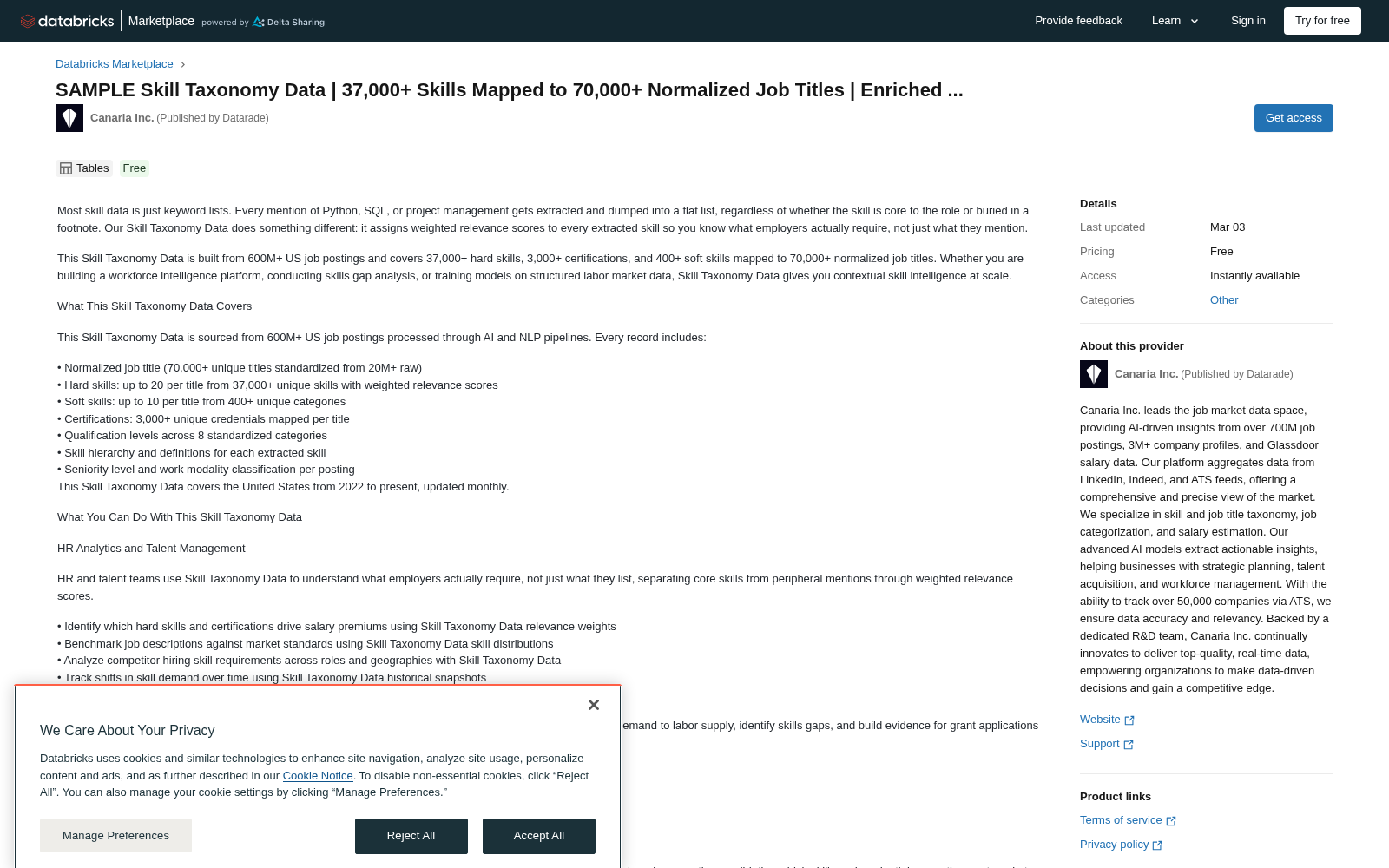
Most skill data is just keyword lists. Every mention of Python, SQL, or project management gets extracted and dumped into a flat list, regardless of whether the skill is core to the role or buried in a footnote. Our Skill Taxonomy Data does something different: it assigns weighted relevance scores to every extracted skill so you know what employers actually require, not just what they mention.
This Skill Taxonomy Data is built from 600M+ US job postings and covers 37,000+ hard skills, 3,000+ certifications, and 400+ soft skills mapped to 70,000+ normalized job titles. Whether you are building a workforce intelligence platform, conducting skills gap analysis, or training models on structured labor market data, Skill Taxonomy Data gives you contextual skill intelligence at scale.
What This Skill Taxonomy Data Covers
This Skill Taxonomy Data is sourced from 600M+ US job postings processed through AI and NLP pipelines. Every record includes:
• Normalized job title (70,000+ unique titles standardized from 20M+ raw)
• Hard skills: up to 20 per title from 37,000+ unique skills with weighted relevance scores
• Soft skills: up to 10 per title from 400+ unique categories
• Certifications: 3,000+ unique credentials mapped per title
• Qualification levels across 8 standardized categories
• Skill hierarchy and definitions for each extracted skill
• Seniority level and work modality classification per posting
This Skill Taxonomy Data covers the United States from 2022 to present, updated monthly.
What You Can Do With This Skill Taxonomy Data
HR Analytics and Talent Management
HR and talent teams use Skill Taxonomy Data to understand what employers actually require, not just what they list, separating core skills from peripheral mentions through weighted relevance scores.
• Identify which hard skills and certifications drive salary premiums using Skill Taxonomy Data relevance weights
• Benchmark job descriptions against market standards using Skill Taxonomy Data skill distributions
• Analyze competitor hiring skill requirements across roles and geographies with Skill Taxonomy Data
• Track shifts in skill demand over time using Skill Taxonomy Data historical snapshots
Skills Gap Analysis and Workforce Planning
Workforce planning teams and economic development organizations use Skill Taxonomy Data to map employer demand to labor supply, identify skills gaps, and build evidence for grant applications and regional economic strategy.
• Identify in-demand skills and emerging occupations across regions using Skill Taxonomy Data records
• Map skill gaps between employer demand and labor supply with Skill Taxonomy Data
• Build evidence for workforce grant applications backed by Skill Taxonomy Data employer demand signals
• Inform sector partnership strategies by mapping skill requirements to key industries using Skill Taxonomy Data
Learning and Development
L&D teams use Skill Taxonomy Data to design training programs aligned with real employer demand rather than internal assumptions, validating which skills and credentials carry the most market weight.
• Design training curricula aligned with Skill Taxonomy Data employer skill demand signals
• Prioritize certification programs by identifying the highest-weighted Skill Taxonomy Data credentials
• Validate internal L&D investments against external Skill Taxonomy Data skill frequency benchmarks
• Identify skills with the fastest growth trajectories using Skill Taxonomy Data trend data
Career Pathing and Recruiting Intelligence
Recruiting teams use Skill Taxonomy Data to map career progressions, build role-to-skill frameworks, and identify skills that differentiate senior from junior candidates across 70,000+ normalized titles.
• Map skill adjacencies and career progression paths using Skill Taxonomy Data normalized titles
• Distinguish core skills from peripheral skills in candidate evaluation using Skill Taxonomy Data weights
• Build role-to-skill frameworks for structured interviewing using Skill Taxonomy Data field definitions
• Power ATS and talent intelligence tools with structured Skill Taxonomy Data skill and certification fields
Data Science and AI Applications
Data science and ML teams use Skill Taxonomy Data as structured training input for NLP models, job matching systems, and labor market research.
• Train NLP models on skill relationships and job-to-candidate matching using Skill Taxonomy Data
• Fine-tune classification models using Skill Taxonomy Data relevance weights as a supervised signal
• Conduct longitudinal labor market research with Skill Taxonomy Data historical snapshots
How We Build This Skill Taxonomy Data
The skill taxonomy model is the core extraction engine for this Skill Taxonomy Data. It uses Aho-Corasick extraction with NLP-based relevance filtering to remove false positives, then assigns weighted relevance scores based on frequency, uniqueness, and role context. This makes Skill Taxonomy Data a contextual skill map, not a flat keyword dump. The model produces 37,000+ distinct hard skills, 3,000+ certifications, and 400+ soft skills across all records.
The title taxonomy model normalizes every Skill Taxonomy Data job title into 50,000+ standardized categories from 20M+ raw titles, stripping location noise, qualifiers, and formatting variations for consistent cross-company analysis.
Job category models classify each Skill Taxonomy Data record by seniority (Entry, Mid, Senior, Lead, Executive) and work modality (Remote, Hybrid, Onsite) using LLM-based analysis of the full job description.
Our annotation team validates every Skill Taxonomy Data model output before delivery.
What Makes This Skill Taxonomy Data Different
• Weighted relevance scores: Skill Taxonomy Data distinguishes core skills from peripheral mentions, giving you a true signal of employer demand
• Contextual extraction: Skill Taxonomy Data uses NLP filtering, not plain keyword matching, to remove false positives and irrelevant terms
• Scale: Skill Taxonomy Data maps 37,000+ hard skills, 3,000+ certifications, and 400+ soft skills across 70,000+ normalized titles
• Skill hierarchy: Skill Taxonomy Data includes definitions, groupings, and categories for every extracted skill
• Matchable: Skill Taxonomy Data joins directly with job postings, company profiles, and salary records for multi-dimensional analysis
• Monthly updates: Skill Taxonomy Data refreshes monthly so skill demand signals reflect current employer activity
Who Uses This Skill Taxonomy Data
• HR and Talent Acquisition Teams use Skill Taxonomy Data to benchmark job requirements, analyze competitor hiring, and build sharper candidate evaluation frameworks
• People Analytics Teams use Skill Taxonomy Data to track skill demand trends and build workforce planning and compensation models
• Learning and Development Teams use Skill Taxonomy Data to design training programs and validate certification priorities against real employer demand
• Workforce Development Organizations use Skill Taxonomy Data to map in-demand skills, support grant applications, and inform regional economic strategy
• Recruiting and Staffing Agencies use Skill Taxonomy Data to understand role requirements and build structured candidate sourcing pipelines
• Data Science and ML Teams use Skill Taxonomy Data as structured training input for NLP models, job matching systems, and skill classification applications
• HR Tech Companies and B2B Platforms use Skill Taxonomy Data to power skills intelligence APIs, candidate matching tools, and workforce analytics products
Delivery and Format
Skill Taxonomy Data is delivered in CSV, JSON, or Parquet via AWS S3 or Google Cloud Storage. Custom filters by geography, industry, seniority, job title, skill category, and certification type. Compatible with Snowflake, Databricks, Power BI, Tableau, Salesforce, and most BI platforms.
提供机构:
Canaria Inc.
搜集汇总
数据集介绍
背景与挑战
背景概述
该数据集基于6亿+美国招聘信息,涵盖37,000+硬技能、3,000+认证和400+软技能,映射到70,000+标准化职位名称,每月更新,适用于人力资源分析、技能差距分析等场景。
以上内容由遇见数据集搜集并总结生成



