
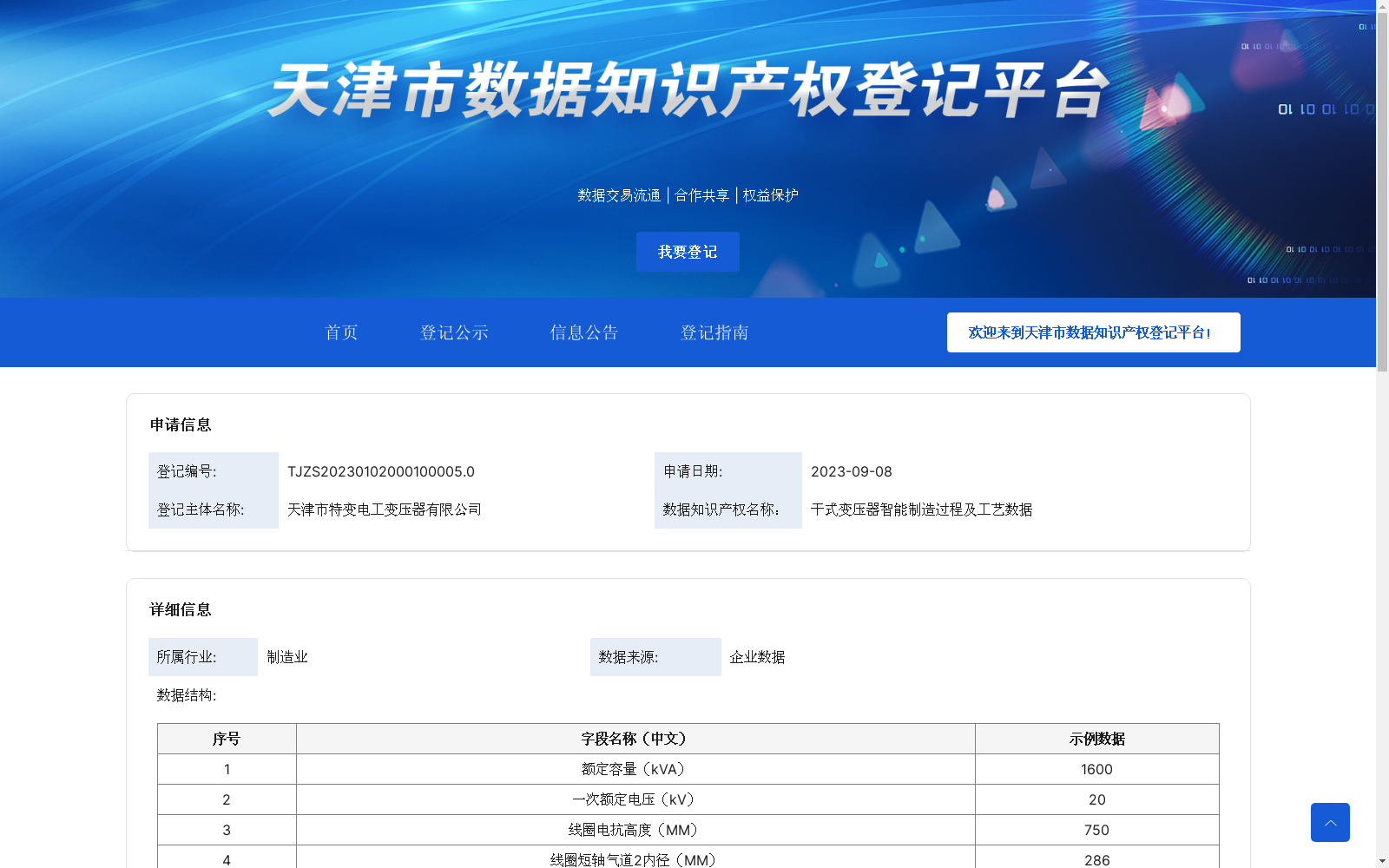
干式变压器智能制造过程及工艺数据
收藏天津市数据知识产权登记平台2024-01-04 更新2024-05-10 收录
下载链接:
https://dengji.tjippc.cn/xxgg_nr?id=069cf3ab-4bdf-4faa-95ac-93820c81c813
下载链接
链接失效反馈官方服务:
资源简介:
通过ERP、PLM、MES、SCADA等系统联通,基于工业互联网平台,通过SCADA将设备工业数据实时进行采集并存储到时序数据库,在通过工业物联网平台的数据订阅功能,将时序库中的数据进行筛选和清理并存入数据中台设备主题数据库中,打通端到端数据流,实现干式变压器智能制造过程及工艺数据的精准控制,通过实时下发与采集提升产品质量的 致性和稳定性。在数据处理过程中,应用到的算法规则主要有数据清洗、数转换、数据过滤、数据聚合、数据匹配、数据决策等。
干式变压器智能制造过程涉及的工艺数据算法规则主要包括以下几个方面:
(1)负载分析算法:通过对干式变压器的负载数据进行分析,可以识别出负载特征和负载模式。基于负载数据的统计分析和机器学习算法,可以预测未来的负载情况,帮助调整变压器的运行参数,提高能效和稳定性。
(2)温度控制算法:干式变压器的温度是一个重要的指标,直接关系到设备的安全和可靠性。通过对温度数据的实时监测和分析,结合温度传感器的反馈,可以实现温度的精确控制例如,通过PID控制算法来调整冷却系统的运行状态,保持温度在安全范围内。
(3)故障检测算法:通过对干式变压器的时序数据进行故障检测,可以识别出异常模式和故障特征。基千机器学习算法和故障诊断模型,可以实现对设备故障的早期预警和诊断。例如,使用支持向量机(SVM)或神经网络等算法,对数据进行分类和异常检测,以判断设备是否存在故障风险。
(4)能效优化算法:干式变压器的能效是制造过程中需要重点关注的指标之一。通过对能耗数据的分析和建模,可以找出能源浪费的原因,并提出相应的优化方案。例如,使用回归分析和优化算法,找到影响能效的关键因素,并调整工艺参数或改进设备设计,提高能效水平。
这些算法规则的应用可以通过数据采集和实时监测系统与MES和SCADA数据库的对接实现。 通过对工艺数据的分析和挖掘,可以实现对干式变压器智能制造过程的精确控制和优化,提高生产效率和质量,降低成本和风险, 增强企业的竞争力和市场份额。
Connected via systems including ERP, PLM, MES, and SCADA, this dataset is constructed on an industrial internet platform. SCADA is employed to collect real-time industrial equipment data and store it in a time-series database. Subsequently, through the data subscription function of the Industrial Internet of Things (IIoT) platform, the data in the time-series database is screened, cleaned, and stored into the equipment-themed database of the data middle platform. This establishes an end-to-end data flow, realizing precise control over the entire smart manufacturing process and process data of dry-type transformers. By enabling real-time distribution and acquisition, the consistency and stability of product quality are improved.
During the data processing phase, the applied algorithm rules mainly include data cleaning, data conversion, data filtering, data aggregation, data matching, and data decision-making.
The process data algorithm rules involved in the smart manufacturing process of dry-type transformers mainly cover the following aspects:
(1) Load analysis algorithm: By analyzing the load data of dry-type transformers, load characteristics and load patterns can be identified. Based on statistical analysis of load data and machine learning algorithms, future load conditions can be predicted, which helps adjust the operating parameters of transformers and improve energy efficiency and stability.
(2) Temperature control algorithm: The temperature of dry-type transformers is a critical indicator directly related to the safety and reliability of the equipment. Through real-time monitoring and analysis of temperature data combined with feedback from temperature sensors, precise temperature control can be achieved. For example, the PID control algorithm is used to adjust the operating state of the cooling system, keeping the temperature within a safe range.
(3) Fault detection algorithm: By conducting fault detection on the time-series data of dry-type transformers, abnormal patterns and fault features can be identified. Based on machine learning algorithms and fault diagnosis models, early warning and diagnosis of equipment faults can be realized. For instance, algorithms such as Support Vector Machine (SVM) or neural networks are used to classify data and perform anomaly detection to determine whether the equipment has a fault risk.
(4) Energy efficiency optimization algorithm: The energy efficiency of dry-type transformers is one of the key indicators that require focus during the manufacturing process. By analyzing and modeling energy consumption data, the causes of energy waste can be identified, and corresponding optimization schemes can be proposed. For example, regression analysis and optimization algorithms are used to identify key factors affecting energy efficiency, and adjust process parameters or improve equipment design to enhance energy efficiency levels.
The application of these algorithm rules can be realized by docking data acquisition and real-time monitoring systems with MES and SCADA databases. Through the analysis and mining of process data, precise control and optimization of the smart manufacturing process of dry-type transformers can be achieved, improving production efficiency and product quality, reducing costs and risks, and enhancing the competitiveness and market share of enterprises.
提供机构:
天津市特变电工变压器有限公司
创建时间:
2024-01-02
搜集汇总
数据集介绍
特点
该数据集包含干式变压器智能制造过程及工艺数据,规模为102602条,适用于干式变压器智能制造的过程及工艺控制。数据应用能解决的主要问题包括效率优化、质量控制、故障预测和数据可视化,通过算法规则如负载分析、温度控制、故障检测和能效优化等实现精确控制和优化。
以上内容由遇见数据集搜集并总结生成


