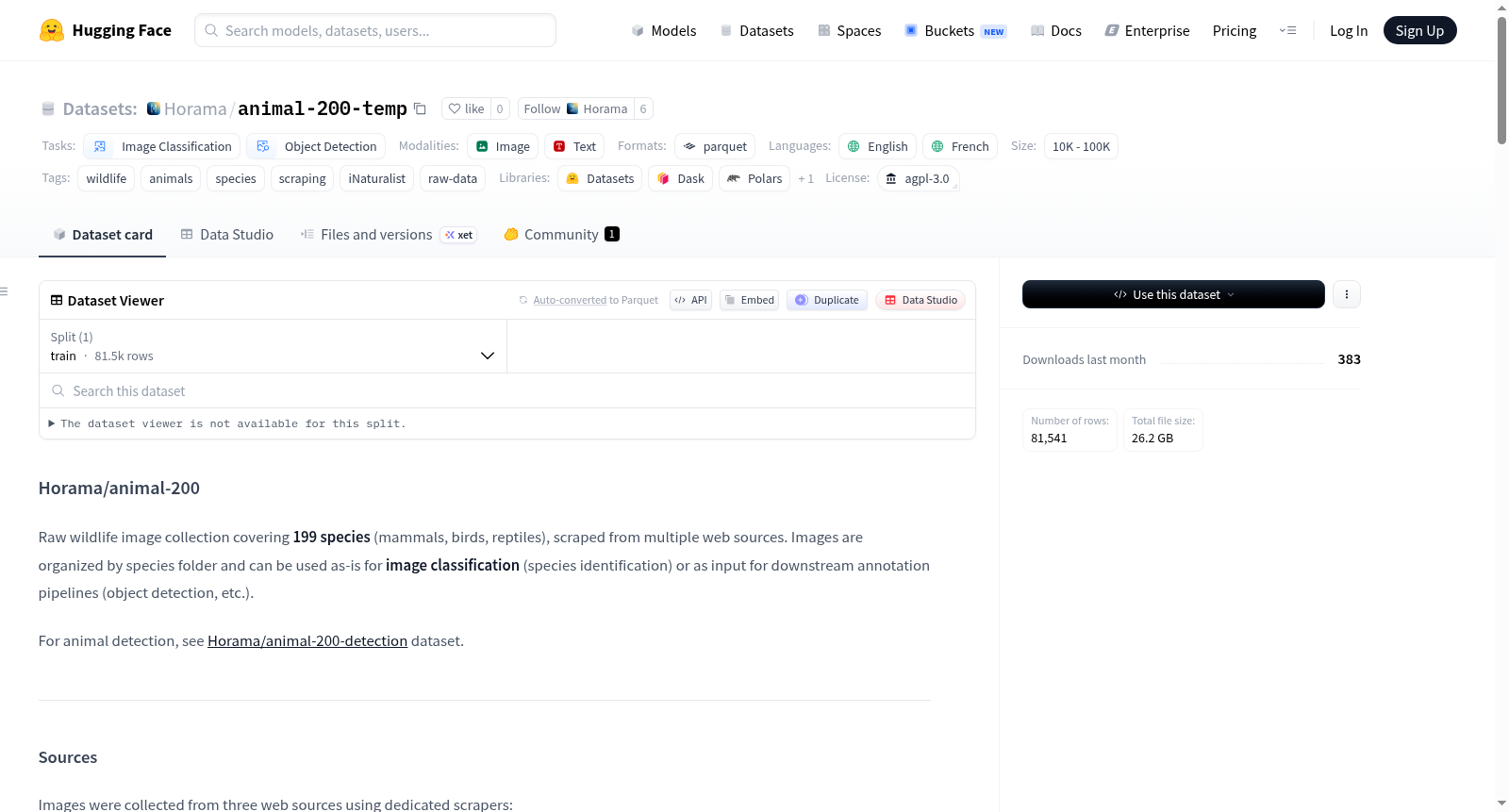
animal-200-temp
收藏资源简介:
Animal Scrapped 是一个野生动物图像原始数据集,包含约 200 个物种(哺乳动物、鸟类、爬行动物)的 JPEG/PNG 图像。数据通过专用爬虫从 DuckDuckGo Images、Wikimedia Commons、Wikipedia 和 iNaturalist 四个网络来源收集,并按物种科学名称组织为文件夹结构(如 Diceros_bicornis_images/)。每个物种文件夹包含来自不同来源的原始图像文件(前缀标明来源)。数据集还提供 CLIP 模型的预分类结果(image_classification.csv),包含三个质量维度:1) alive(是否为活体动物);2) distance(拍摄距离:特写/中景/远景);3) watermark(是否存在干扰性水印)。该数据集适用于物种图像分类任务,也可作为下游标注流程(如目标检测)的输入数据。需注意这是未经人工筛选的原始数据,可能存在物种错误、标本、绘图或水印图片等情况。数据集规模在 1万-10万张图像之间,采用 AGPL-3.0 许可。
Animal Scrapped is a raw wildlife image dataset containing JPEG/PNG format images of approximately 200 species, including mammals, birds, and reptiles. The data was collected via a dedicated crawler from four web sources: DuckDuckGo Images, Wikimedia Commons, Wikipedia, and iNaturalist, and organized into a folder structure based on the scientific names of the species (e.g., Diceros_bicornis_images/). Each species folder contains raw image files from different sources, with the source indicated by the filename prefix. The dataset also provides pre-classification results from the CLIP model in image_classification.csv, which covers three quality dimensions: 1) alive (whether the subject is a living animal); 2) distance (shooting distance: close-up, medium shot, or long shot); 3) watermark (whether interfering watermarks are present). This dataset is suitable for species image classification tasks, and can also serve as input data for downstream annotation workflows such as object detection. Please note that this is raw data without manual filtering, and may contain mislabeled species, specimens, illustrations, or watermarked images, among other issues. The dataset has a scale of between 10,000 and 100,000 images, and is licensed under AGPL-3.0.
数据集概述:Horama/animal-200-temp
基本信息
- 数据集名称:Animal Scrapped – Wildlife Image Collection (~200 species)
- 创建者/发布者:Horama
- 许可协议:AGPL-3.0
- 任务类别:图像分类、目标检测
- 语言:英语、法语
- 标签:野生动物、动物、物种、网络爬取、iNaturalist、原始数据
- 数据规模:10K < n < 100K
数据集描述
这是一个按物种文件夹组织的原始野生动物图像集合。数据集包含从多个网络来源爬取的JPEG/PNG图像,不包含标注,仅有图像。
数据来源
图像从以下四个网络来源收集:
- DuckDuckGo Images:通过学名搜索获取。
- Wikimedia Commons:通过MediaWiki API查询获取。
- Wikipedia:通过文章图像提取获取。
- iNaturalist:通过
inat_downloader工具(MIT许可)查询iNaturalist API获取,遵守速率限制。
数据结构
数据集采用以下目录结构:
Horama/animal_scrapped/ ├── <物种学名>_images/ (每个物种一个文件夹,包含原始图像) └── image_classification.csv (CLIP分类元数据文件)
每个物种文件夹以<Scientific_name>_images/格式命名(空格替换为下划线)。图像文件名以其来源为前缀(duckduckgo_、wikimedia_、wikipedia_、inat_)。
数据特征
- image:原始的JPEG/PNG图像文件。
- species:物种学名(从文件夹名称派生)。
CLIP预分类
每个图像都使用CLIP模型(openai/clip-vit-large-patch14)沿三个维度进行了分类,结果存储在image_classification.csv文件中:
- alive:布尔值,表示CLIP是否将图像分类为活体动物。
- distance:字符串,表示拍摄距离(特写、中景、远景)。
- watermark:布尔值,表示CLIP是否检测到侵入性水印。
物种覆盖
数据集涵盖199个物种,包括哺乳动物、鸟类和爬行动物。完整物种列表包含学名、英文名和法文名。
主要用途
- 图像分类:可直接用于物种识别,因为每个文件夹对应一个单一物种。
- 下游处理:可作为输入用于下游标注流程(如目标检测),特别是为Horama/animal-200-detection数据集提供源数据。
使用工具
scraping/:用于DuckDuckGo、Wikimedia Commons和Wikipedia的爬取工具(AGPL-3.0许可)。inat_downloader/:用于iNaturalist API的工具(MIT许可,版权所有 (c) 2023 Cyprien Amigon)。
局限性
- 此为原始爬取数据,未经人工筛选。可能存在噪声:错误物种、绘画、标本、带水印的库存照片、重复图像。
- 199个物种间的图像数量不完全平衡;稀有物种可能图像较少。
- CLIP分类CSV提供了质量信号,但其本身是零样本分类,并不完美。
引用方式
bibtex @misc{horama_animal200_2026, title = {Animal-200: Wildlife Image Collection (200 Species)}, author = {Horama}, year = {2026}, url = {https://huggingface.co/datasets/Horama/animal-200}, note = {Raw scraped wildlife images from DuckDuckGo, Wikimedia, Wikipedia and iNaturalist, with CLIP pre-classification} }