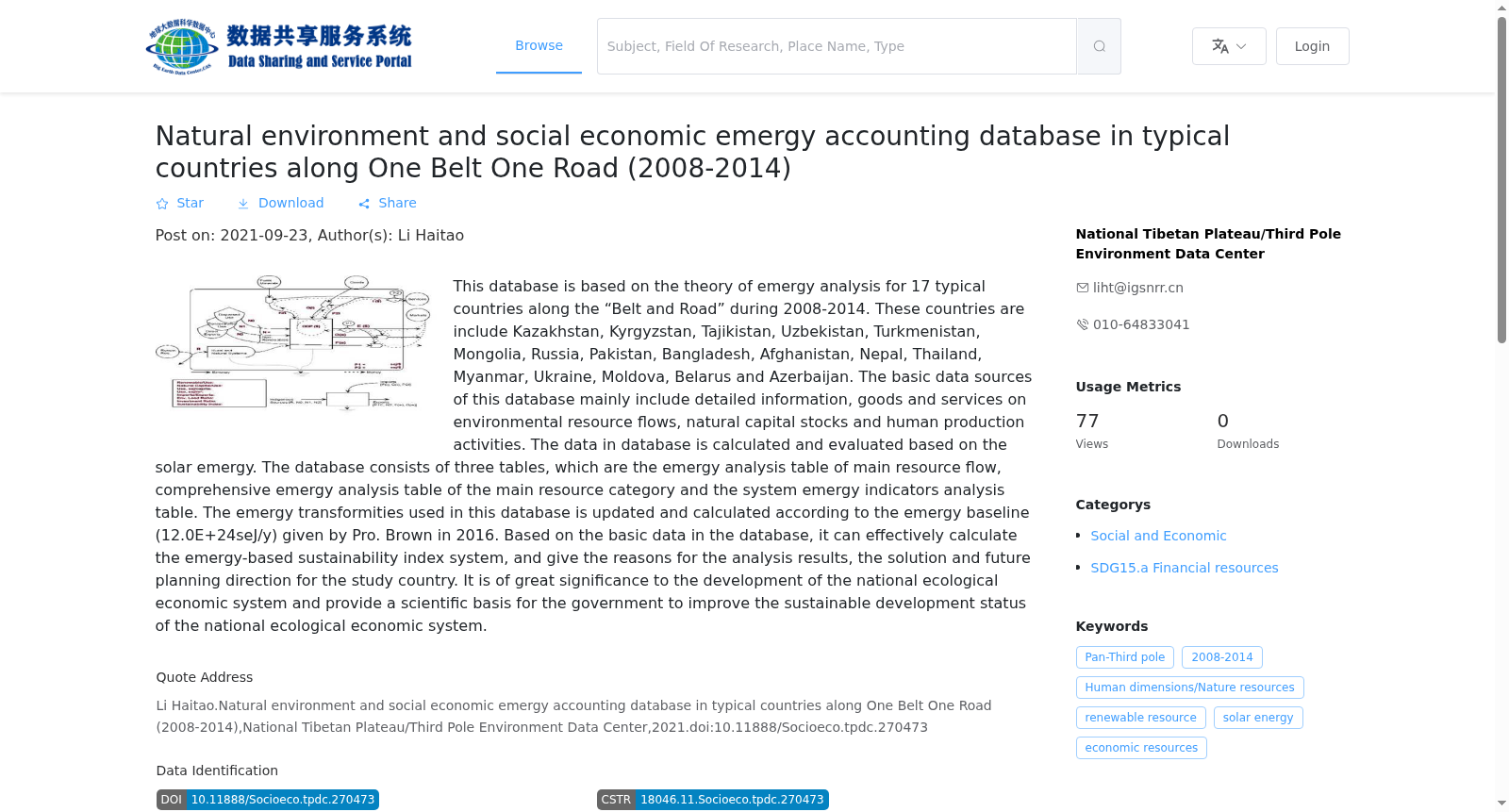
“一带一路”沿线国家典型地区自然环境及社会经济能值核算数据库(2008-2014)
收藏资源简介:
本数据库依据能值理论分析对2008-2014年17个“一带一路”沿线典型国家(哈萨克斯坦、吉尔吉斯斯坦、塔吉克斯坦、乌兹别克斯坦、土库曼斯坦、蒙古、俄罗斯、巴基斯坦、孟加拉国、阿富汗、尼泊尔、泰国、缅甸、乌克兰、摩尔多瓦、白俄罗斯、阿塞拜疆)包括环境资源流量、自然资本存量、人类生产活动在内的各种生态经济资源的详细信息、商品和服务数据以太阳能值为基准进行计算、评估。数据库由3个表格构成,分别为主要资源能值分析表、主要资源类别综合能值流分析表和系统能值指标分析表。主要资源能值分析表中所有的能值转换率都根据GEB2016进行了更新。以数据库中的基础数据为依据,能有效计算包括基于能值的可持续性指数(Emergy-based sustainability index, ESI)在内的能值指标体系,并有根据性的给出分析结果产生的原因、解决方案及未来规划方向,对国家生态经济系统的发展具有重要意义,并为政府完善生态经济系统可持续发展决策提供科学依据。
This database conducts calculations and assessments based on emergy theory, taking solar emergy as the benchmark, for detailed eco-economic resource data and commodity and service data of 17 typical countries along the Belt and Road Initiative (BRI) from 2008 to 2014. The 17 countries include Kazakhstan, Kyrgyzstan, Tajikistan, Uzbekistan, Turkmenistan, Mongolia, Russia, Pakistan, Bangladesh, Afghanistan, Nepal, Thailand, Myanmar, Ukraine, Moldova, Belarus, and Azerbaijan, with the data covering environmental resource flows, natural capital stocks, and human production activities. The database consists of three tables, namely the Main Resource Emergy Analysis Table, the Comprehensive Emergy Flow Analysis Table for Major Resource Categories, and the System Emergy Index Analysis Table. All emergy conversion rates in the Main Resource Emergy Analysis Table have been updated in accordance with GEB2016. Based on the basic data in the database, the emergy indicator system including the Emergy-based Sustainability Index (ESI) can be effectively calculated. Moreover, targeted analyses of the causes of the analytical results, corresponding solutions and future planning directions can be provided, which is of great significance to the development of national eco-economic systems and provides scientific evidence for governments to improve their decision-making on sustainable development of eco-economic systems.