
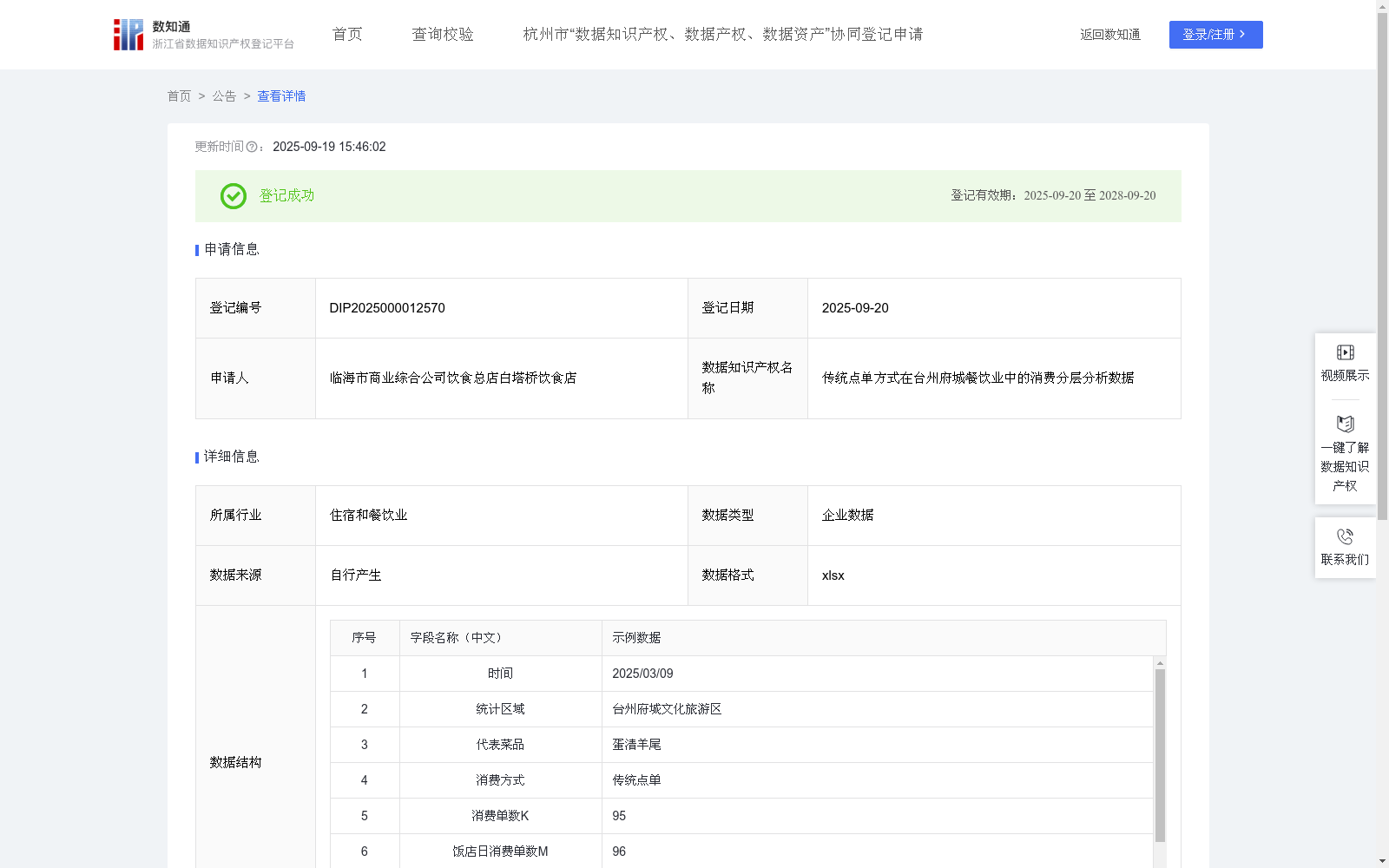
传统点单方式在台州府城餐饮业中的消费分层分析数据
收藏浙江省数据知识产权登记平台2025-09-19 更新2025-09-20 收录
下载链接:
https://www.zjip.org.cn/home/announce/trends/183141
下载链接
链接失效反馈官方服务:
资源简介:
本项数据分析基于台州府城的相关传统美食的营业数据,分析传统点单方式在客户群体中的消费占比情况,运用大数据平台收集不同点单方式的销售数据,运用算法进行加工处理后,得到不同点单方式的消费系数,再对计算所得的消费系数进行分级评价。本项数据分析能够有效分析文旅景区中餐饮业到店点单的客流量,以便文旅主管部门针对该数据,制定合理的营销推广方案,通过增加实际到店通过传统点餐方式的游客的数量,以餐饮撬动人流,带动文旅景区其他业态的人流基数。本项数据分析旨在提升老字号餐饮企业的经营管理能力,在业内具有广泛的借鉴推广价值,有效助力传统老字号餐饮经营的数字化改革。1.数据采集:消费单数K;消费黏性指数N;饭店日消费单数M。
2.算法公式:消费系数P=消费黏性指数N×消费单数K÷饭店日消费单数M。其中消费黏性指数N由系统统计该点单方式在台州府城景区内所有点单方式累计消费次数得出。将客户点单方式的消费系数P按照表格层次进行划分,得出对应点单方式对应的层级。
3.数据分析:根据消费系数P的值对客户的点单方式数据进行分层评级,当P≥1.5时,评为“A类消费”;当0.8≤P<1.5时,评为“B类消费”;当0.3≤P<0.8时,评为“C类消费”;当P<0.3,评为“D类消费”。
This data analysis is grounded in the operational data of traditional catering establishments within Taizhou Prefecture Scenic Area, with the core objective of analyzing the consumption share of traditional in-store ordering methods among customer groups. Big data platforms are employed to collect sales data across various ordering modalities. After algorithmic processing, consumption coefficients for each ordering method are derived, followed by hierarchical evaluation of the calculated coefficients.
This analysis can effectively quantify the in-store ordering passenger flow of catering businesses in cultural and tourism scenic spots, enabling cultural and tourism administrative departments to formulate targeted marketing and promotion plans based on these findings. By increasing the number of on-site tourists opting for traditional ordering methods, the catering sector can serve as a catalyst to drive overall passenger flow and expand the customer base for other business formats within the scenic area.
This study aims to enhance the operational and management capabilities of time-honored catering enterprises, holds broad reference and promotion value within the industry, and effectively supports the digital transformation of traditional time-honored catering businesses.
1. Data Collection: Number of consumer orders (K); Consumer stickiness index (N); Daily consumer orders per restaurant (M).
2. Algorithmic Formula: Consumption coefficient P = Consumer stickiness index N × Number of consumer orders K ÷ Daily consumer orders per restaurant M. The consumer stickiness index N is statistically calculated by the system as the cumulative number of consumption transactions of a given ordering method across all ordering modalities within Taizhou Prefecture Scenic Area. All ordering methods are classified into corresponding tiers based on their consumption coefficient P in accordance with the tabular hierarchy.
3. Data Analysis: A hierarchical rating is applied to customer ordering method data based on the value of consumption coefficient P:
- "Class A Consumption" for P ≥ 1.5;
- "Class B Consumption" for 0.8 ≤ P < 1.5;
- "Class C Consumption" for 0.3 ≤ P < 0.8;
- "Class D Consumption" for P < 0.3.
提供机构:
临海市商业综合公司饮食总店白塔桥饮食店
创建时间:
2025-07-28
搜集汇总
数据集介绍
背景与挑战
背景概述
该数据集包含台州府城文化旅游区餐饮业的传统点单消费数据,通过消费系数算法对客户消费行为进行分层评级(如A类消费为P≥1.5),旨在分析传统点单方式的客流占比,支持文旅主管部门制定营销方案以提升老字号餐饮企业的经营效率和数字化水平。
以上内容由遇见数据集搜集并总结生成



