
黑水国汉墓动物遗存鉴定结果,动物骨胶原C、N稳定同位素以及测年数据集
收藏国家青藏高原科学数据中心2023-08-20 更新2024-03-01 收录
下载链接:
https://data.tpdc.ac.cn/zh-hans/data/9fe999d3-a73a-42b5-a8aa-cc1411736cdb
下载链接
链接失效反馈官方服务:
资源简介:
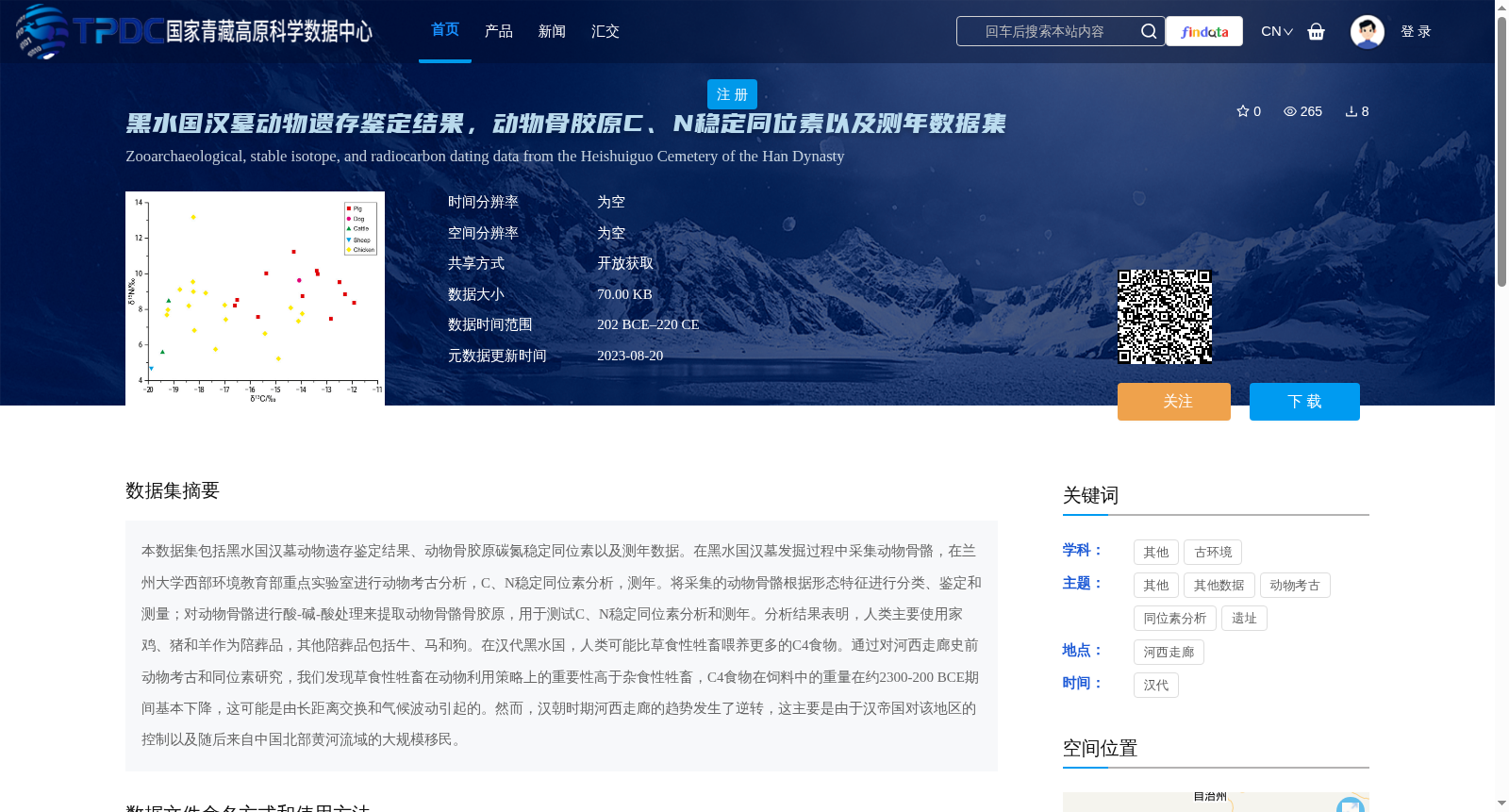
本数据集包括黑水国汉墓动物遗存鉴定结果、动物骨胶原碳氮稳定同位素以及测年数据。在黑水国汉墓发掘过程中采集动物骨骼,在兰州大学西部环境教育部重点实验室进行动物考古分析,C、N稳定同位素分析,测年。将采集的动物骨骼根据形态特征进行分类、鉴定和测量;对动物骨骼进行酸-碱-酸处理来提取动物骨骼骨胶原,用于测试C、N稳定同位素分析和测年。分析结果表明,人类主要使用家鸡、猪和羊作为陪葬品,其他陪葬品包括牛、马和狗。在汉代黑水国,人类可能比草食性牲畜喂养更多的C4食物。通过对河西走廊史前动物考古和同位素研究,我们发现草食性牲畜在动物利用策略上的重要性高于杂食性牲畜,C4食物在饲料中的重量在约2300-200 BCE期间基本下降,这可能是由长距离交换和气候波动引起的。然而,汉朝时期河西走廊的趋势发生了逆转,这主要是由于汉帝国对该地区的控制以及随后来自中国北部黄河流域的大规模移民。
This dataset encompasses the identification results of animal remains unearthed from Han Dynasty tombs at Heishuiguo, alongside carbon and nitrogen stable isotope data of animal bone collagen and radiocarbon dating results. Animal bones were collected during the excavation of these Han Dynasty tombs at Heishuiguo, and subsequent zooarchaeological analysis, carbon and nitrogen stable isotope analysis, and radiocarbon dating were performed at the Key Laboratory of Western China's Environmental Systems (Ministry of Education), Lanzhou University. The collected animal bones were classified, identified, and measured based on their morphological characteristics; bone collagen was extracted from the specimens via acid-alkali-acid treatment, which was then utilized for carbon and nitrogen stable isotope testing and radiocarbon dating. The analytical results reveal that domestic chickens, pigs, and sheep were the primary funerary offerings, with additional offerings including cattle, horses, and dogs. In Heishuiguo during the Han Dynasty, humans likely provisioned a greater quantity of C4 foods to their domestic livestock than herbivorous animals would naturally consume. Based on prehistoric zooarchaeological and isotopic research conducted in the Hexi Corridor, we determined that herbivorous livestock held greater importance in animal utilization strategies than omnivorous livestock. Additionally, the weight proportion of C4 foods in animal fodder generally declined during the period c. 2300–200 BCE, a trend likely driven by long-distance exchange and climatic fluctuations. However, this trend reversed in the Hexi Corridor during the Han Dynasty, primarily due to the Han Empire's control over the region and the subsequent large-scale immigration from the Yellow River Basin in northern China.
提供机构:
李昕
创建时间:
2023-08-12
搜集汇总
数据集介绍
背景与挑战
背景概述
该数据集提供了黑水国汉墓的动物遗存鉴定结果、动物骨胶原碳氮稳定同位素及测年数据,时间跨度为汉代(公元前202年至公元220年)。数据揭示了汉代人类主要使用家鸡、猪和羊作为陪葬品,并通过对动物骨胶原的分析,表明人类可能比草食性牲畜喂养更多C4食物,反映了汉代河西走廊地区动物利用策略和饲料变化的逆转趋势,可能与汉帝国控制和移民有关。
以上内容由遇见数据集搜集并总结生成


