
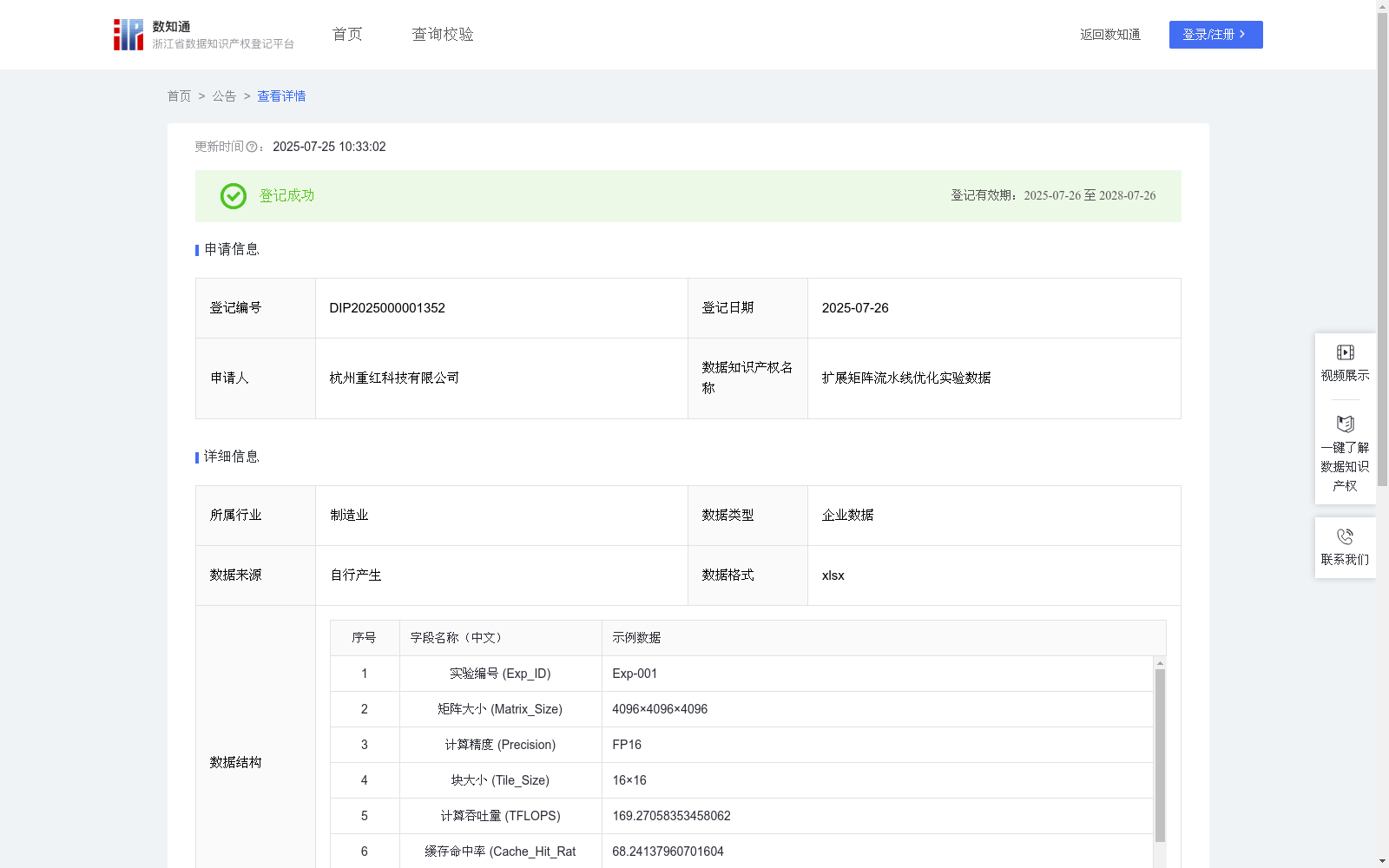
扩展矩阵流水线优化实验数据
收藏浙江省数据知识产权登记平台2025-07-25 更新2025-07-26 收录
下载链接:
https://www.zjip.org.cn/home/announce/trends/154629
下载链接
链接失效反馈官方服务:
资源简介:
本数据适用于人工智能(AI)计算、深度学习加速、高性能计算(HPC)等领域,涵盖深度学习训练与推理、科学计算、边缘 AI 低功耗优化等应用。其适用条件包括支持向量化计算(SIMD, Tensor Core, AVX512)的硬件环境(如 GPU、TPU、NPU、AI ASIC、FPGA),以及支持FP16/INT8 低精度计算和块矩阵优化(Tiling & Blocking)的算法框架(如 TensorFlow、PyTorch、TVM)。适用对象包括AI 硬件厂商(NVIDIA、Google TPU、华为 Ascend)、深度学习框架开发者、云计算服务商(AWS、Azure)、自动驾驶和机器人 AI 计算,可用于优化 AI 训练与推理吞吐量,降低计算延迟,提高能效比。本数据不适用于传统 CPU 计算优化、非矩阵计算任务(如事务处理、Web 服务器优化)、低功耗微控制器(MCU),也不适用于隐私计算或加密计算等特定安全领域。该数据及算法可有效解决深度学习计算优化、AI 训练加速、边缘 AI 低功耗推理、大规模 HPC 矩阵计算等问题,提高 AI 计算芯片的整体性能。能效比=计算吞吐量(TFLOPS)/功耗(W)*100
能效比衡量的是 每瓦功耗可以提供的计算能力,单位通常为 GFLOPS/W(每瓦特的十亿次浮点运算)
计算吞吐量 (TFLOPS):表示芯片在矩阵流水线计算中的实际浮点运算能力,单位是 TeraFLOPS(每秒万亿次浮点运算)。
功耗 (W):芯片运行时的实际功耗,单位是 瓦特 (W)。
由于不同的计算精度(FP32、FP16、INT8)对能效的影响较大,根据综合数据取均值可近似得出:FP32 功耗较高,基础功耗为 400W。FP16 计算相对节能,基础功耗为 300W。INT8 计算最节能,基础功耗为 200W。
This dataset is applicable to fields such as artificial intelligence (AI) computing, deep learning acceleration, and high-performance computing (HPC), covering applications including deep learning training and inference, scientific computing, and low-power optimization for edge AI.
Its applicable conditions include hardware environments supporting vectorized computing (SIMD, Tensor Core, AVX512), such as GPU, TPU, NPU, AI ASIC, FPGA, as well as algorithm frameworks supporting FP16/INT8 low-precision computing and block matrix optimization (Tiling & Blocking), such as TensorFlow, PyTorch, TVM.
Its target users include AI hardware vendors (NVIDIA, Google TPU, Huawei Ascend), deep learning framework developers, cloud computing service providers (AWS, Azure), and autonomous driving and robotic AI computing scenarios. It can be used to optimize the throughput of AI training and inference, reduce computational latency, and improve energy efficiency ratio.
This dataset is not applicable to traditional CPU computing optimization, non-matrix computing tasks such as transaction processing, web server optimization, low-power microcontrollers (MCU), as well as specific security fields such as privacy computing or encrypted computing.
This dataset and algorithm can effectively solve problems such as deep learning computing optimization, AI training acceleration, low-power inference for edge AI, and large-scale HPC matrix computing, improving the overall performance of AI computing chips.
Energy Efficiency Ratio (EER) = Computational Throughput (TFLOPS) / Power Consumption (W) * 100
Energy efficiency ratio measures the computing capability provided per watt of power consumption, and its common unit is GFLOPS/W (billion floating-point operations per watt).
Computational Throughput (TFLOPS): Refers to the actual floating-point operation capability of the chip in matrix pipeline computing, with the unit of TeraFLOPS (trillion floating-point operations per second).
Power Consumption (W): The actual power consumption of the chip during operation, with the unit of Watt (W).
Since different computing precisions (FP32, FP16, INT8) have a significant impact on energy efficiency, an approximate average can be obtained based on comprehensive data: FP32 has relatively high power consumption, with a baseline power of 400W; FP16 computing is relatively energy-saving, with a baseline power of 300W; INT8 computing is the most energy-saving, with a baseline power of 200W.
提供机构:
杭州重红科技有限公司
创建时间:
2025-03-18
搜集汇总
数据集介绍
背景与挑战
背景概述
该数据集包含785条制造业企业数据,记录扩展矩阵流水线优化实验的各项性能指标,适用于AI计算和HPC领域,但不适用于传统CPU优化或安全领域。
以上内容由遇见数据集搜集并总结生成



