jacob-valdez/synthux-economy-r5-w073
收藏资源简介:
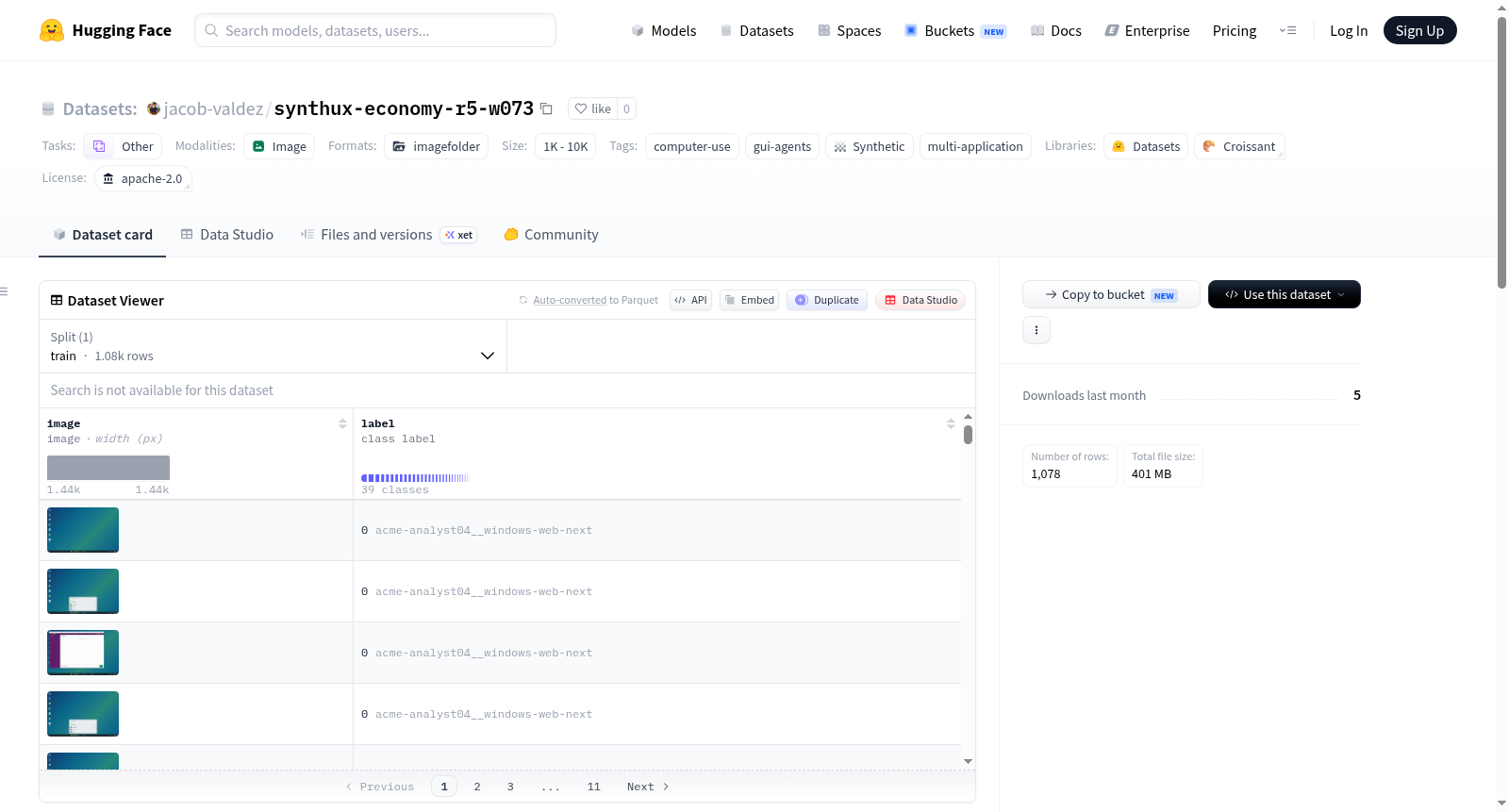
SynthUX Computer-Use数据集(economy sim r5)是一个基于视觉的计算机使用轨迹数据集,通过SynthUX生成。每个记录代表一个模拟公司内部员工的设备会话:目标扩展为节点树,终端节点通过低级别鼠标/键盘输入驱动真实桌面模拟器应用(如Terminal、Notes、VS Code、Browser、Slack/Teams、Mail、Sheets、Slides等),观察到的轨迹被记录为屏幕视频和每个节点的帧。数据集支持应用原生多应用程序执行(无工作台覆盖)、每个参与者内容的多样性、跨操作系统消息传递以及大型多公司经济模拟。每个经济模拟作为独立的数据集仓库发布。内容包括data.jsonl(每个渲染轨迹的记录)、screenshots目录(每个终端节点的帧)和videos目录(完整屏幕录制)。记录模式包括轨迹ID、参与者ID、公司、角色、环境、自然语言目标、节点树、输入事件、观察、对齐和媒体引用。该版本包含36个轨迹、969个帧、6家公司,分布在browser-os、macos-web-next和windows-web-next环境中。数据集由SynthUX工具生成,观察基于因果模拟(突变通道为低级别输入),捕获过程中未使用高级别应用突变。
SynthUX Computer-Use Dataset (economy sim r5) is a vision-based computer interaction trajectory dataset generated via SynthUX. Each record represents a device session simulating an internal employee workflow for a company: the target goal is expanded into a node tree, where terminal nodes drive real desktop simulator applications (including Terminal, Notes, VS Code, Browser, Slack/Teams, Mail, Sheets, Slides, etc.) through low-level mouse and keyboard inputs. Observed interaction trajectories are recorded as screen videos and frames corresponding to each terminal node. This dataset supports native multi-application execution (without workspace overlay), diverse content per participant, cross-operating system messaging, and large-scale multi-company economic simulations. Each economic simulation is released as an independent dataset repository. The dataset content includes: data.jsonl (records for each rendered trajectory), the screenshots directory (frames for each terminal node), and the videos directory (full screen recordings). The record schema covers trajectory ID, participant ID, company, role, environment, natural language goal, node tree, input events, observations, alignments, and media references. This version contains 36 trajectories, 969 frames, spanning 6 companies across three environments: browser-os, macos-web-next, and windows-web-next. The dataset is generated using the SynthUX tool, with observations derived from causal simulation (using low-level inputs as the mutation channel), and no high-level application mutations were utilized during the capture process.