
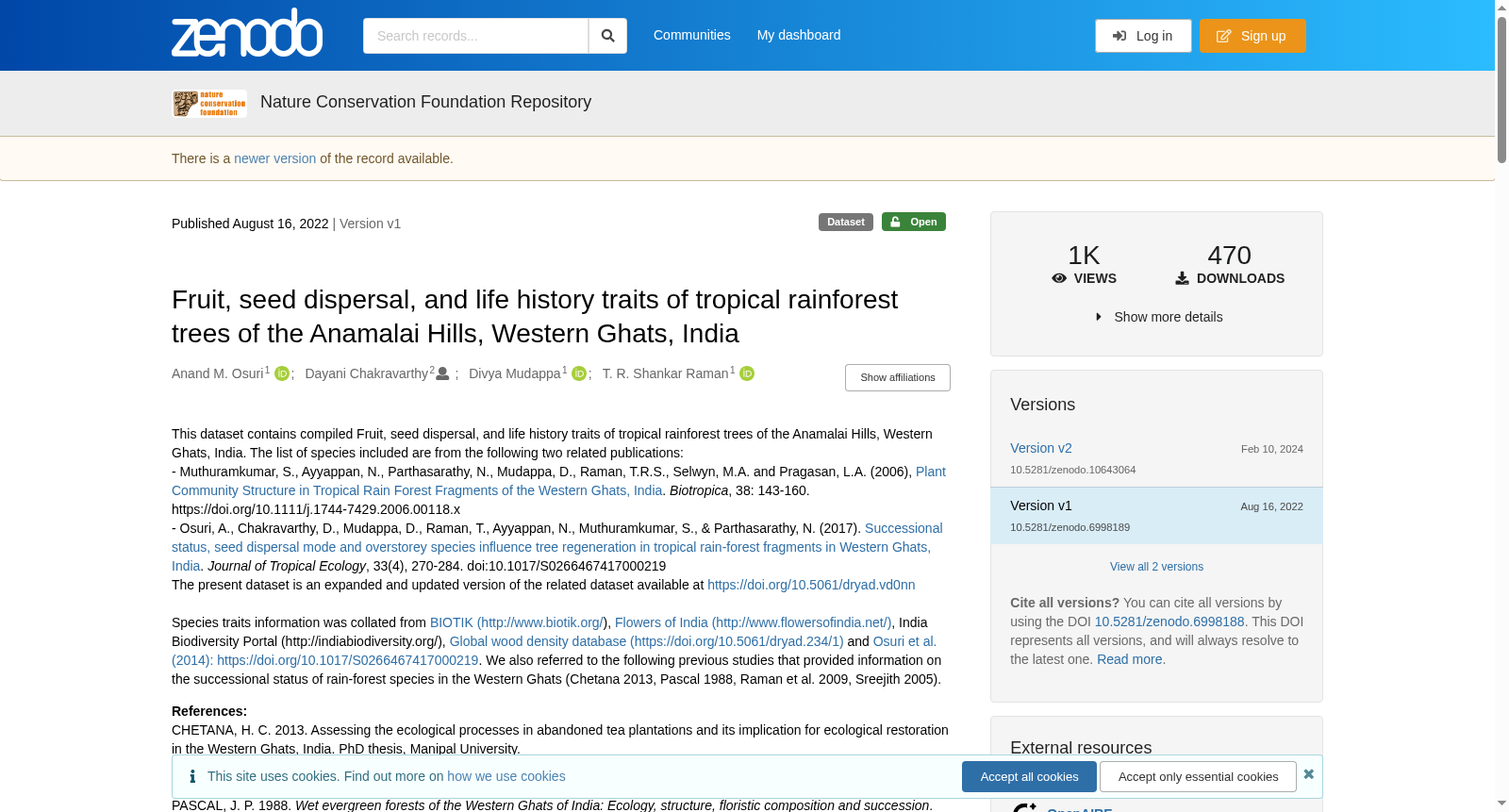
Fruit, seed dispersal, and life history traits of tropical rainforest trees of the Anamalai Hills, Western Ghats, India
收藏Mendeley Data2024-06-27 更新2024-06-27 收录
下载链接:
https://zenodo.org/record/6998189
下载链接
链接失效反馈官方服务:
资源简介:
This dataset contains compiled Fruit, seed dispersal, and life history traits of tropical rainforest trees of the Anamalai Hills, Western Ghats, India. The list of species included are from the following two related publications: - Muthuramkumar, S., Ayyappan, N., Parthasarathy, N., Mudappa, D., Raman, T.R.S., Selwyn, M.A. and Pragasan, L.A. (2006), Plant Community Structure in Tropical Rain Forest Fragments of the Western Ghats, India. Biotropica, 38: 143-160. https://doi.org/10.1111/j.1744-7429.2006.00118.x - Osuri, A., Chakravarthy, D., Mudappa, D., Raman, T., Ayyappan, N., Muthuramkumar, S., & Parthasarathy, N. (2017). Successional status, seed dispersal mode and overstorey species influence tree regeneration in tropical rain-forest fragments in Western Ghats, India. Journal of Tropical Ecology, 33(4), 270-284. doi:10.1017/S0266467417000219 The present dataset is an expanded and updated version of the related dataset available at https://doi.org/10.5061/dryad.vd0nn Species traits information was collated from BIOTIK (http://www.biotik.org/), Flowers of India (http://www.flowersofindia.net/), India Biodiversity Portal (http://indiabiodiversity.org/), Global wood density database (https://doi.org/10.5061/dryad.234/1) and Osuri et al. (2014): https://doi.org/10.1017/S0266467417000219. We also referred to the following previous studies that provided information on the successional status of rain-forest species in the Western Ghats (Chetana 2013, Pascal 1988, Raman et al. 2009, Sreejith 2005). References: CHETANA, H. C. 2013. Assessing the ecological processes in abandoned tea plantations and its implication for ecological restoration in the Western Ghats, India. PhD thesis, Manipal University. OSURI, A. M., KUMAR, V. S. & SANKARAN, M. 2014. Altered stand structure and tree allometry reduce carbon storage in evergreen forest fragments in India’s Western Ghats. Forest Ecology and Management 329: 375–383. PASCAL, J. P. 1988. Wet evergreen forests of the Western Ghats of India: Ecology, structure, floristic composition and succession. Institut Français de Pondichéry, Pondicherry. RAMAN, T. R. S., MUDAPPA, D. & KAPOOR, V. 2009. Restoring rainforest fragments: survival of mixed-native species seedlings under contrasting site conditions in the Western Ghats, India. Restoration Ecology 17:137–147. SREEJITH, K. A. 2005. Ecological and ecophysiological studies on the successional status of tree seedlings in tropical wet evergreen and semi-evergreen forests of Kerala. PhD thesis, Forest Research Institute, Dehradun. Geographic Coverage: 1. Location/Study Area: Valparai Plateau, Tamil Nadu, India; Anamalai Tiger Reserve, Tamil Nadu, India 2. GPS coordinates: Valparai Plateau (10°15'- 10°22'N, 76°52' - 76°59'E); Anamalai Tiger Reserve (10°12' - 10°35'N, 76°49' - 77°24'E) Temporal Coverage: 1. Begins: 2003-03-01 (Year, Month, Day) 2. Ends: 2022-08-16 (Year, Month, Day) Besides the README.txt file, the dataset includes two comma-delimited text (csv) files with the data in columns as explained below: Anamalai_tree_traits.csv gbif_namematch.csv Anamalai_tree_traits.csv old_code: Species codes used at the time of data collection (manuscript Muthuramkumar et al. 2006: https://doi.org/10.1111/j.1744-7429.2006.00118.x) osuri_code: Revised species codes if used in the Osuri et al. 2017 paper in Journal of Tropical Ecology 33:270-284 (https://doi.org/10.1017/S0266467417000219) and related dataset (https://doi.org/10.5061/dryad.vd0nn) or else indicated as NA current_code: Species codes used at present in relation to current taxonomy and name as in ‘species’ column old_speciesName: Species names used at the time of data collection (Muthuramkumar et al. 2006: https://doi.org/10.1111/j.1744-7429.2006.00118.x) verbatimScientificName: Revised species names used to match names to current taxonomy (next column) species: Accepted species scientific name at present as determined by running the name in the previous column through the Global Biodiversity Information Facility lookup tool (GBIF: https://www.gbif.org/tools/species-lookup) family: Plant Family that the taxon belongs to genus: Genus the taxon belongs to fruit_type: Type of fruit fleshy_dry: Whether fruit is a dry fruit or fleshy, with aril or other parts seed_size: Species seed size: L = Large (>3 cm); M = Medium (1-3 cm); S = Small (<1 cm) disperser: Categories indicating seed dispersal mode: Bird, mammal, bird and mammal (Mammal_bird), gravity, wind, or unknown new_disp: Composite category based on disperser and seed size (taking seed size as S and L) habitat: Habitat affinity category: EG_edg - evergreen forest edge; EG_for - evergreen forest; Dec_for - deciduous forest; Int – Introduced species; Unknown – Unknown habt_new: Habitat affinity new category: Mature – mature forest; Secondary – secondary forest, Int - Introduced species; Unknown – unknown ad_ht: Species maximum adult height (m) wden: Species wood density (g cm^-3); NA - not available; sourced from Global wood density database (https://doi.org/10.5061/dryad.234/1) remarks: Notes or remarks gbif_namematch.csv verbatimScientificName: Scientific name as used for the GBIF lookup scientificName: Name returned by GBIF species lookup tool (https://www.gbif.org/tools/species-lookup) key: GBIF key returned by the species lookup tool matchType: Match type returned by the species lookup tool confidence: Confidence returned by the species lookup tool status: Indicates whether the verbatimScientificName is an Accepted name or a Synonym rank: Indicates whether the taxon was identified to Family, Genus or species kingdom: Kingdom of taxon phylum: Phylum of taxon class: Class of taxon order: Order of taxon family: Family of taxon genus: Genus of taxon species: Species name (accepted and current species name) canonicalName: Canonical form of species name returned by species lookup tool authorship: Author of taxon
本数据集汇编了印度西高止山脉阿纳马莱丘陵热带雨林树木的果实、种子传播及生活史性状。收录物种列表源自以下两篇相关学术出版物:
- Muthuramkumar, S.、Ayyappan, N.、Parthasarathy, N.、Mudappa, D.、Raman, T.R.S.、Selwyn, M.A. 及 Pragasan, L.A.(2006):《印度西高止山脉热带雨林片段的植物群落结构》,刊载于《热带生物学报》(Biotropica),第38卷,第143-160页。https://doi.org/10.1111/j.1744-7429.2006.00118.x
- Osuri, A.、Chakravarthy, D.、Mudappa, D.、Raman, T.、Ayyappan, N.、Muthuramkumar, S. 及 Parthasarathy, N.(2017):《演替状态、种子传播模式与上层树种对印度西高止山脉热带雨林片段树木更新的影响》,刊载于《热带生态学杂志》(Journal of Tropical Ecology),第33卷第4期,第270-284页。doi:10.1017/S0266467417000219
本数据集为https://doi.org/10.5061/dryad.vd0nn 发布的相关数据集的扩展更新版本。
物种性状信息汇编自以下资源:BIOTIK(http://www.biotik.org/)、印度之花(Flowers of India,http://www.flowersofindia.net/)、印度生物多样性门户网站(India Biodiversity Portal,http://indiabiodiversity.org/)、全球木材密度数据库(Global wood density database,https://doi.org/10.5061/dryad.234/1)以及Osuri等(2014)的研究(https://doi.org/10.1017/S0266467417000219)。本研究还参考了以下提供西高止山脉雨林物种演替状态相关信息的既往研究:Chetana 2013、Pascal 1988、Raman等2009、Sreejith 2005。
参考文献:
CHETANA, H. C. 2013. 《评估印度西高止山脉废弃茶园的生态过程及其对生态修复的意义》,马尼帕尔大学博士学位论文。
OSURI, A. M.、KUMAR, V. S. 及 SANKARAN, M. 2014. 《印度西高止山脉常绿林片段的林分结构改变与树木异速生长降低碳储量》,刊载于《森林生态与管理》(Forest Ecology and Management),第329卷,第375-383页。
PASCAL, J. P. 1988. 《印度西高止山脉湿润常绿林:生态学、结构、区系组成与演替》,本地治里法国研究院(Institut Français de Pondichéry)。
RAMAN, T. R. S.、MUDAPPA, D. 及 KAPOOR, V. 2009. 《恢复热带雨林片段:印度西高止山脉不同立地条件下混合乡土树种幼苗的存活情况》,刊载于《恢复生态学》(Restoration Ecology),第17卷,第137-147页。
SREEJITH, K. A. 2005. 《喀拉拉邦热带湿润常绿林与半常绿林树木幼苗演替状态的生态学与生理生态学研究》,德拉敦森林研究所博士学位论文。
地理覆盖范围:
1. 研究区域:印度泰米尔纳德邦瓦尔帕莱高原、阿纳马莱老虎保护区
2. GPS坐标:瓦尔帕莱高原(10°15'~10°22'N,76°52'~76°59'E);阿纳马莱老虎保护区(10°12'~10°35'N,76°49'~77°24'E)
时间覆盖范围:
1. 起始时间:2003-03-01(年、月、日)
2. 结束时间:2022-08-16(年、月、日)
除README.txt文件外,本数据集包含两个逗号分隔值(Comma-Separated Values, CSV)文件,数据列说明如下:
1. Anamalai_tree_traits.csv
- old_code:数据采集时使用的物种代码(对应手稿Muthuramkumar等2006:https://doi.org/10.1111/j.1744-7429.2006.00118.x)
- osuri_code:若在《Journal of Tropical Ecology》33卷270-284页的Osuri等2017年论文(https://doi.org/10.1017/S0266467417000219)及相关数据集(https://doi.org/10.5061/dryad.vd0nn)中使用了修订后的物种代码,则标注该代码,否则标注为NA
- current_code:基于当前分类学规范,对应"species"列的现行物种代码
- old_speciesName:数据采集时使用的物种名称(对应Muthuramkumar等2006:https://doi.org/10.1111/j.1744-7429.2006.00118.x)
- verbatimScientificName:用于匹配当前分类学规范的修订后物种名称(见下一列)
- species:通过全球生物多样性信息设施(Global Biodiversity Information Facility, GBIF)物种查询工具(https://www.gbif.org/tools/species-lookup)对前一列名称进行匹配后得到的现行公认物种学名
- family:该分类单元所属的植物科
- genus:该分类单元所属的属
- fruit_type:果实类型
- fleshy_dry:果实为干果或肉果(具假种皮或其他附属结构)的属性
- seed_size:物种种子大小:L=大(>3cm);M=中(1~3cm);S=小(<1cm)
- disperser:种子传播模式分类:鸟类、哺乳类、鸟类与哺乳类(Mammal_bird)、重力传播、风媒传播或未知
- new_disp:基于传播方式与种子大小的复合分类(以种子大小S和L为依据)
- habitat:生境偏好分类:EG_edg——常绿林边缘;EG_for——常绿林;Dec_for——落叶林;Int——引入种;Unknown——未知
- habt_new:修订后的生境偏好分类:Mature——成熟林;Secondary——次生林;Int——引入种;Unknown——未知
- ad_ht:物种最大成年树高(单位:米)
- wden:物种木材密度(单位:g·cm⁻³);NA表示无可用数据;数据源自全球木材密度数据库(https://doi.org/10.5061/dryad.234/1)
- remarks:备注信息
2. gbif_namematch.csv
- verbatimScientificName:用于GBIF查询的原始学名
- scientificName:通过GBIF物种查询工具(https://www.gbif.org/tools/species-lookup)返回的名称
- key:GBIF物种查询工具返回的GBIF编号
- matchType:GBIF物种查询工具返回的匹配类型
- confidence:GBIF物种查询工具返回的匹配置信度
- status:标注verbatimScientificName为公认学名还是异名
- rank:标注该分类单元被鉴定至科、属还是种水平
- kingdom:该分类单元所属的界
- phylum:该分类单元所属的门
- class:该分类单元所属的纲
- order:该分类单元所属的目
- family:该分类单元所属的科
- genus:该分类单元所属的属
- species:物种名称(现行公认物种学名)
- canonicalName:物种查询工具返回的物种标准学名格式
- authorship:该分类单元的命名人
创建时间:
2023-06-28
搜集汇总
数据集介绍
背景与挑战
背景概述
该数据集编译了印度西高止山脉Anamalai Hills地区热带雨林树木的果实、种子传播和生活史性状信息,包括物种代码、果实类型、种子大小、传播方式和栖息地等关键性状。数据基于两个相关出版物和多个数据库整合,时间覆盖2003年至2022年,地理范围涵盖Valparai高原和Anamalai老虎保护区。数据集以CSV文件形式提供,是现有数据集的扩展和更新版本,适用于生态学和保护生物学研究。
以上内容由遇见数据集搜集并总结生成


