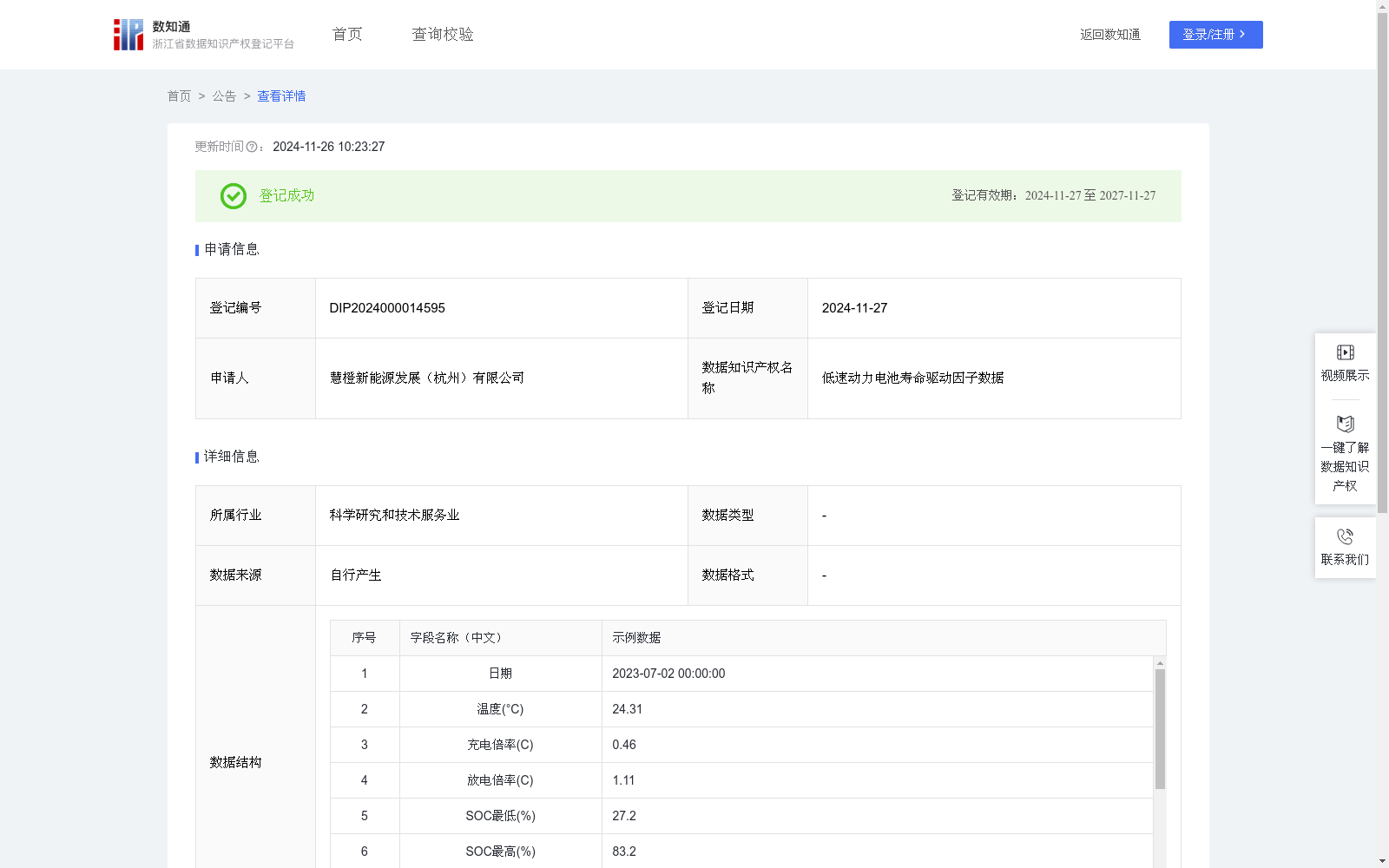
低速动力电池寿命驱动因子数据
收藏资源简介:
随着低速电动车市场快速发展,准确掌握电池寿命影响因素变得尤为重要。在BMS开发方面,这些数据可用于制定充放电策略、设计温度管理系统、控制电池均衡以及开发寿命预测算法。在车辆运营管理层面,数据可用于优化车队充电调度、制定维护保养计划、监测电池健康状态和评估使用成本。在产品设计优化方面,这些数据对散热系统设计、充电系统匹配和性能参数优化具有重要指导意义。通过分析寿命驱动因子数据,可以帮助制造商、经销商和用户更好地理解和管理电池寿命。这些数据和分析成果主要面向低速动力电池的日常使用管理,通过合理应用这些数据,可以有效提升电池使用寿命,优化运营效率,实现成本的有效控制。这对于推动低速电动车行业的健康发展具有重要的实践意义。)温度应力计算:温度应力 = 基准应力(1.0) + 温度偏差系数;2)SOC应力计算:SOC应力 = 基准应力(1.0) + SOC越限应力 + SOC范围应力,SOC最低值<20%:每低1%增加0.02应力,SOC最高值>80%:每高1%增加0.02应力;3)倍率应力计算:倍率应力 = 基准应力(1.0) + 充电倍率应力 + 放电倍率应力;4)容量保持率计算:容量保持率 = 100% - (温度应力 + SOC应力 + 倍率应力) × 循环次数/100;5)剩余寿命预测:预计剩余寿命 = 标称寿命(8年) × (当前容量保持率/100%)。
With the rapid development of the low-speed electric vehicle (LSEV) market, accurately grasping the influencing factors of battery lifespan has become particularly critical. For Battery Management System (BMS) development, this dataset can be used to formulate charge-discharge strategies, design thermal management systems, regulate battery balancing, and develop lifespan prediction algorithms. In terms of vehicle operation management, the data can optimize fleet charging scheduling, develop maintenance plans, monitor battery health status, and evaluate usage costs. For product design optimization, this dataset provides important guidance for heat dissipation system design, charging system matching, and performance parameter optimization. By analyzing lifespan driving factor data, manufacturers, distributors and end users can better understand and manage battery lifespan. This dataset and its analysis results are primarily targeted at the daily operation and management of low-speed power batteries. Through the rational application of this data, the service life of batteries can be effectively extended, operational efficiency optimized and costs effectively controlled, which holds significant practical significance for promoting the healthy development of the low-speed electric vehicle industry. 1) Temperature stress calculation: Temperature stress = Reference stress (1.0) + Temperature deviation coefficient; 2) SOC stress calculation: SOC stress = Reference stress (1.0) + SOC over-limit stress + SOC range stress. For SOC lower than 20%: 0.02 additional stress per 1% decrease; for SOC exceeding 80%: 0.02 additional stress per 1% increase; 3) Rate stress calculation: Rate stress = Reference stress (1.0) + Charging rate stress + Discharging rate stress; 4) Capacity retention rate calculation: Capacity retention rate = 100% - (Temperature stress + SOC stress + Rate stress) × Number of cycles / 100; 5) Remaining lifespan prediction: Predicted remaining lifespan = Nominal lifespan (8 years) × (Current capacity retention rate / 100%).