
ReXSonoVQA
收藏资源简介:
ReXSonoVQA是由哈佛大学医学院团队构建的首个面向超声操作流程理解的视频问答基准数据集,包含514个从YouTube公开教学视频中截取的超声操作片段,涵盖249道选择题和265道开放式问题。该数据集聚焦三大核心能力评估:动作-目标推理、伪影解决与优化、流程上下文规划,通过时间戳标注和事件日志结构化呈现探头操作与成像目标的动态关联。数据经过严格的盲测筛选和干扰项优化,旨在推动超声培训指导系统和机器人自动化中的感知算法开发,解决传统静态图像评估无法捕捉的动态操作逻辑问题。
ReXSonoVQA is the first video question answering benchmark dataset for ultrasound procedural understanding, developed by a team from Harvard Medical School. Comprising 514 ultrasound procedural clips extracted from publicly available YouTube tutorial videos, it includes 249 multiple-choice questions and 265 open-ended questions. This dataset focuses on three core competency assessments: action-target reasoning, artifact resolution and optimization, and procedural context planning. It structurally presents the dynamic associations between probe operations and imaging targets via timestamp annotations and event logs. The dataset has undergone rigorous blind screening and distractor optimization, aiming to promote the development of perception algorithms for ultrasound training guidance systems and robotic automation, addressing the limitation of traditional static image assessments that fail to capture dynamic procedural logic.
ReXSonoVQA 数据集概述
数据集基本信息
- 数据集名称: ReXSonoVQA (Ultrasound Video Benchmark)
- 核心用途: 评估视觉语言模型在超声视频理解任务上的性能。
- 数据形式: 基于YouTube超声视频构建的问答对基准测试集。
数据内容与规模
- 问题总数: 657个
- 多项选择题 (MCQ): 320个
- 自由问答题 (Free Response): 337个
- 视频来源: 所有视频片段均来自YouTube,无需本地视频文件。
- 标注信息: 包含人工整理的视频元数据,用于定位YouTube视频中的相关片段及超声内容区域。
数据结构与文件
基准测试数据
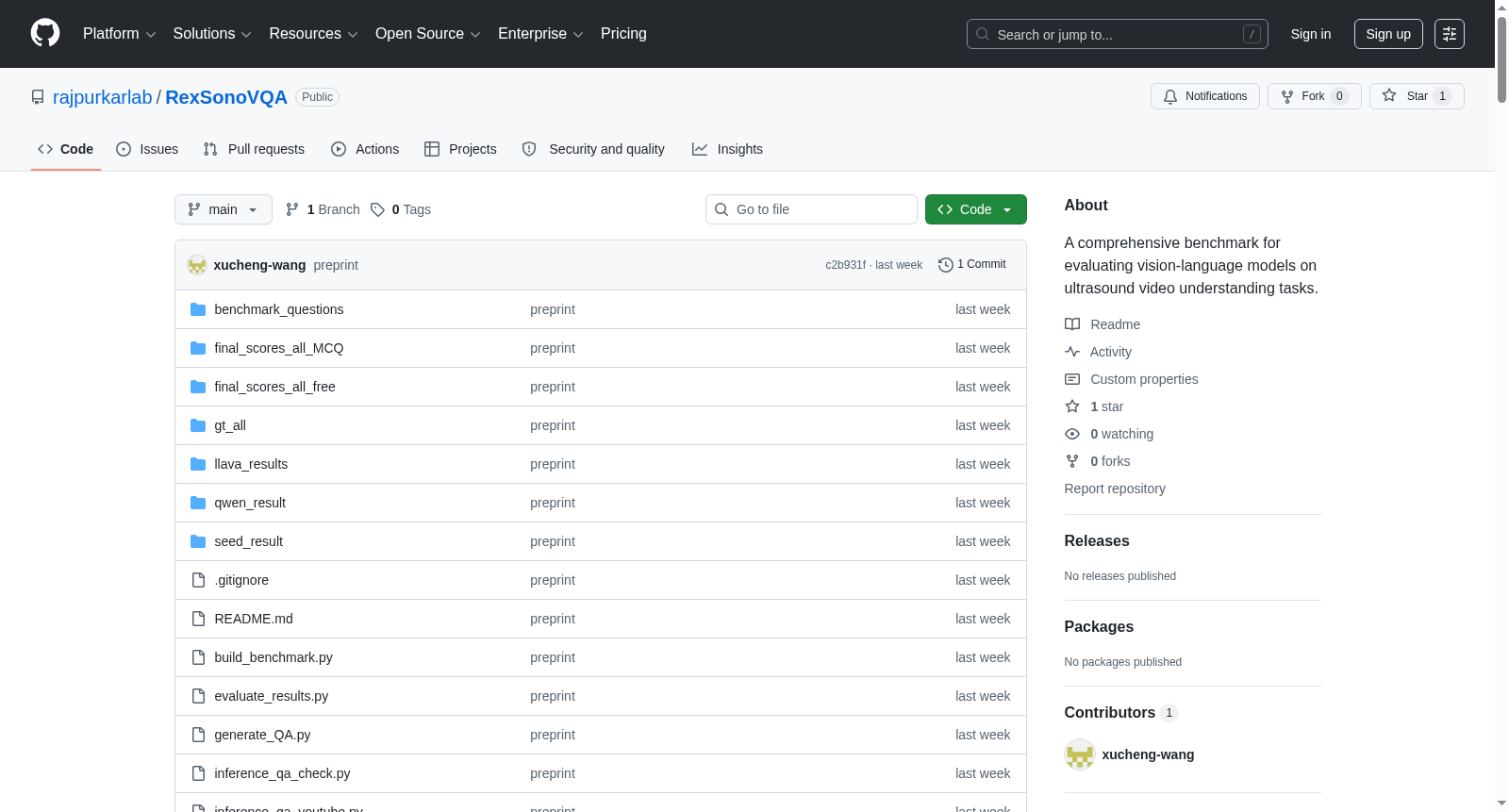
benchmark_questions/: 基准测试问题mcq/: 存放多项选择题 (320个)free/: 存放自由问答题 (337个)
gt_all/: 存放从视频中提取的结构化地面真值标注。video_metadata_new.json: 核心元数据文件,将每个基准测试视频映射到其YouTube源。包含:- YouTube URL
- 起始/结束时间戳 (秒)
- 感兴趣区域 (ROI) 的比例坐标 (用于裁剪超声内容区域)
支持脚本与工具
- 推理脚本:
inference_qa_youtube.py(通过YouTube流直接处理视频片段) - 评估脚本:
evaluate_results.py(使用LLM-as-judge评估模型预测结果) - 基准构建脚本 (供参考):
build_benchmark.py,generate_QA.py,refine_MCQ.py,inference_qa_check.py
数据格式详情
视频元数据格式 (video_metadata_new.json)
json { "视频标识名": { "youtube_url": "https://www.youtube.com/watch?v=...", "start_time": 18.31, "end_time": 131.69, "roi": { "x_prop": 0.459016, "y_prop": 0.297917, "w_prop": 0.440281, "h_prop": 0.4375 } } }
- 问题中的时间戳 (
time_start,time_end) 相对于视频内容本身,映射到YouTube时间为start_time + time_start。
问题数据格式
每个JSON文件中的问答项包含以下字段: json { "question": "问题文本...", "answer": "标准答案", "groundtruth": "原始转录的详细信息", "question_type": "问题类型", "time_start": 0.0, "time_end": 10.5, "keep": true }
keep字段表示该问题是否通过了盲测质量控制。
问题类型
- Type1_ActionGoalReasoning: 正在执行什么操作及原因 (目标/靶向视图)
- Type2_ArtifactResolutionOptimization: 解决伪影/模糊性:发生了什么变化及原因
- Type3_ProcedureContextPlanning: 当前步骤/阶段,下一步是什么及原因 (流程协议)
评估方法
- 多项选择题 (MCQ): 使用准确率 (预测答案与正确答案字母的精确匹配)。
- 自由问答题 (Free Response): 使用由Gemini 3 Pro作为LLM法官评分的0-2分制:
2分: 结论正确且视觉证据正确1分: 部分正确 (结论或证据有误)0分: 不正确、不相关或幻觉答案
使用要求与依赖
- 主要Python库:
google-genai,openai - 外部工具:
yt-dlp: 用于YouTube流解析ffmpeg: 用于片段提取和ROI裁剪
- 支持的VLM后端:
gemini,qwen,seed(使用需提供相应API密钥)
基线结果
- 数据集中提供了基线模型的评估结果:
final_scores_all_MCQ/: 多项选择题的基线结果final_scores_all_free/: 自由问答题的基线结果
- 1ReXSonoVQA: A Video QA Benchmark for Procedure-Centric Ultrasound Understanding哈佛大学医学院·生物医学信息学系 · 2026年


