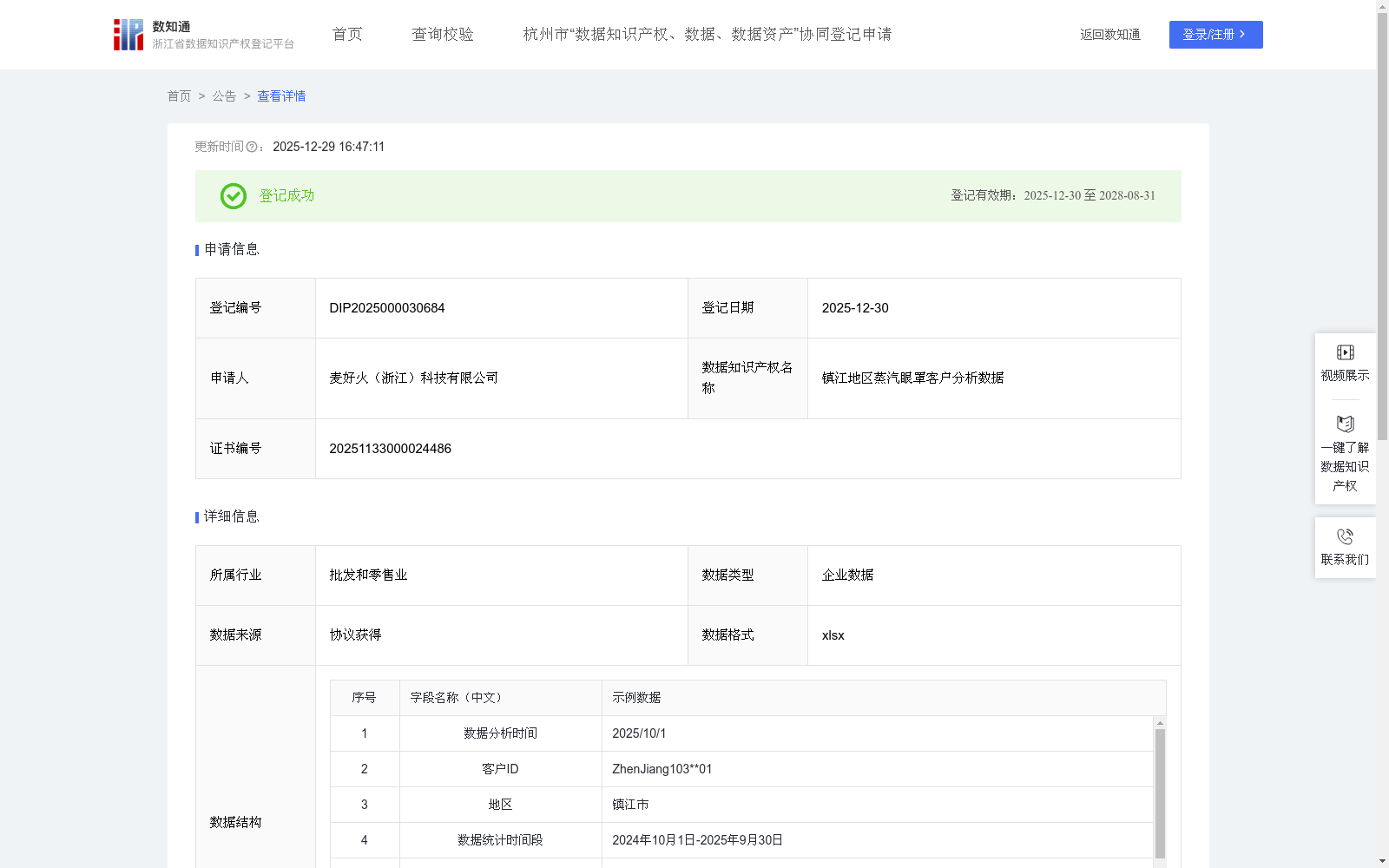
镇江地区蒸汽眼罩客户分析数据
收藏资源简介:
采集镇江地区蒸汽眼罩客户的最近一次购买时间R(天数)和购买频率F(次数)、购买总金额M(元),采用RFM模型对客户进行价值评级,用RFM分析方法把客户分为ABCD四级,对细分过后的不同客户采取相应营销策略,进行精准有效的运营。针对不同等级客户制定差异化管理策略:对 A 级客户建立专属维护机制,配备专属顾问、优先响应需求,通过定制化服务巩固核心关系;对 B 级客户实施成长激励管理,以消费频次奖励、新品优先体验等方式,推动其向 A 级进阶;对 C 级客户强化基础服务管理,以稳定的权益保障、定期需求回访提升留存率;对 D 级客户开展唤醒式管理,结合消费偏好推送定向权益,激活潜在需求。提升客户的忠诚度和复购率。通过对客户进行分级管理,满足不同等级客户的个性化需求,为美妆个护等同行业企业提供客户分级管理的数据支撑,帮助其高效匹配客户需求,落地精准个性化服务,提升市场竞争力。1、数据处理:对镇江地区采集到的客户数据进行脱敏、降噪、清洗、聚集、分析。2、数据加工:运用RFM模型结合最近一次购买时间R(天数)和购买频率F(次数)、购买总金额M(元)的得分排名对客户进行一个综合排名,最终得出一个RFM总评分。a.提取出客户最近一次购买时间R(天数)、购买频率F(次数)和购买总金额M(元)进行分类,运用IF+RANK函数将最近一次购买时间R(天数)时间间隔最短的客户,按照1-5评分,排名前20%(含20%)的客户得5分,排名>20%且≤40%的客户获得4分,排名>40%且≤60%的客户得3分,排名>60%且≤80%的客户得2分,排名>80%的客户得1分。b.根据客户购买频率F(次数)从高到底依次对客户进行评分,将6次以上(含6次)的客户在购买频率F(次数)的分数评为5分,4~5次评为4分,3次评为3分,2次评为2分,1次评为1分。c.根据购买总金额M(元),运用IF+RANK函数将购买总金额从高到低排序,按照1-5评分,排名前20%(含20%)的客户得5分,排名>20%且≤40%的客户得4分,排名>40%且≤60%的客户得3分,排名>60%且≤80%的客户得2分,排名>80%的客户得1分。RFM得分=0.3*(R得分)+0.3*(F得分)+0.4*(M得分) 评分≥4分的为A级客户,3分≤RFM得分< 4分的为B级客户,2分≤RFM得分< 3分的为C级客户,RFM得分< 2分的为D级客户。
This dataset collects the recency of last purchase (R, measured in days), purchase frequency (F, number of purchases) and total purchase amount (M, in Yuan) of customers who purchased steam eye masks in the Zhenjiang region. The RFM model is adopted to conduct customer value rating, and customers are classified into four tiers (A, B, C, D) via RFM analysis. Targeted marketing strategies are implemented for each segmented customer group to carry out precise and efficient operation management. Differentiated management strategies are formulated for customers of different tiers: For Level A customers, establish exclusive maintenance mechanisms, allocate dedicated consultants, prioritize demand responses, and consolidate core relationships through customized services; For Level B customers, implement growth incentive management, encourage them to advance to Level A via means such as purchase frequency rewards and priority access to new products; For Level C customers, strengthen basic service management, improve customer retention rate through stable rights and benefits protection and regular demand follow-up surveys; For Level D customers, carry out wake-up management, push targeted rights and benefits based on their consumption preferences to activate potential demands, thereby enhancing customer loyalty and repurchase rate. Through customer tiered management, personalized needs of customers in different tiers are met, providing data support for customer tiered management for enterprises in the same industry such as the beauty and personal care industry. This helps enterprises efficiently match customer demands, implement precise personalized services, and enhance their market competitiveness. 1. Data Processing: Perform data desensitization, denoising, cleaning, aggregation and analysis on the customer data collected from the Zhenjiang region. 2. Data Calculation and Refinement: Use the RFM model combined with the score rankings of recency of last purchase (R, in days), purchase frequency (F, number of purchases) and total purchase amount (M, in Yuan) to conduct a comprehensive ranking of customers, and finally obtain an overall RFM score. a. Extract the recency of last purchase (R, in days), purchase frequency (F, number of purchases) and total purchase amount (M, in Yuan) of customers for classification. Use the IF and RANK functions to score customers based on their recency of last purchase: customers with the shortest time interval (i.e., the top 20% including 20% of the ranked list) get 5 points, those with ranking >20% and ≤40% get 4 points, those with ranking >40% and ≤60% get 3 points, those with ranking >60% and ≤80% get 2 points, and those with ranking >80% get 1 point. b. Score customers based on their purchase frequency (F, number of purchases) in descending order: customers with 6 or more purchases get 5 points, those with 4-5 purchases get 4 points, those with 3 purchases get 3 points, those with 2 purchases get 2 points, and those with 1 purchase get 1 point. c. Based on the total purchase amount (M, in Yuan), use the IF and RANK functions to sort customers in descending order of total purchase amount, and score them on a scale of 1-5: the top 20% including 20% of the ranked list get 5 points, those with ranking >20% and ≤40% get 4 points, those with ranking >40% and ≤60% get 3 points, those with ranking >60% and ≤80% get 2 points, and those with ranking >80% get 1 point. The overall RFM score is calculated as: RFM Score = 0.3 * (R Score) + 0.3 * (F Score) + 0.4 * (M Score). Customers with an RFM score ≥4 are classified as Level A customers, those with 3 ≤ RFM Score < 4 are Level B customers, those with 2 ≤ RFM Score < 3 are Level C customers, and those with RFM Score < 2 are Level D customers.