SAMPL4-FEAT
收藏资源简介:
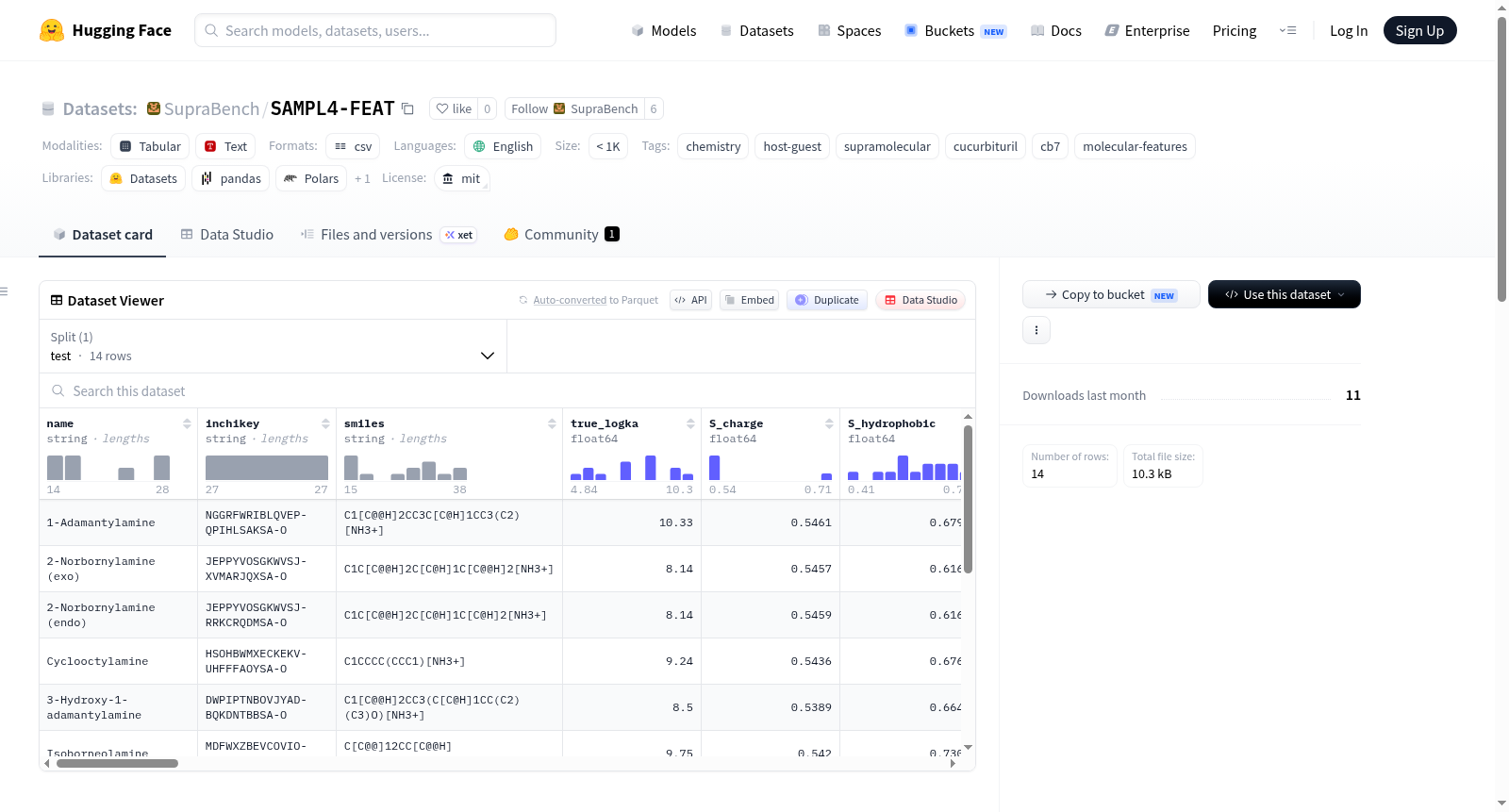
SAMPL4-FEAT数据集是一个用于化学信息学和宿主-客体相互作用研究的特征表,源自SAMPL4宿主-客体盲预测挑战。该数据集专注于14种CB[7](葫芦[7]脲)客体分子,提供每个客体的分子身份信息(包括通用名称、InChIKey和质子化SMILES)、实验测定的结合常数对数(true_logka),以及一系列计算衍生的特征。这些特征包括13个归一化评分(范围在[0,1]之间),涵盖电荷、疏水性、刚性、去溶剂化、堆积、占据率、形状、构象多样性、玻尔兹曼浓度、门户、可及性、取向和不良基团暴露等方面;以及24个原始物理/对接描述符,如对接得分、构象能量、到空腔中心的距离、到门户的距离、插入深度、堆积系数、占据率、疏水占据率、形状互补性、立体碰撞、客体与CB7的最小距离、构象到模板的RMSD、门户兼容性、正中心到门户距离、正中心取向、电荷可及性、门户面向可及性、氢键计数、氢键几何、羰基氧接触计数、疏水接触、极性接触惩罚、不良基团门户暴露和去溶剂化惩罚。数据集规模为14个样本(每个客体一行),共41个字段,适用于机器学习模型的特征工程、分子性质预测、宿主-客体结合亲和力建模等任务。
The SAMPL4-FEAT dataset is a feature table for chemoinformatics and host-guest interaction research, derived from the SAMPL4 host-guest blind prediction challenge. This dataset focuses on 14 CB[7] (cucurbit[7]uril) guest molecules, providing molecular identity information for each guest (including common names, InChIKey, and protonated SMILES), experimentally determined binding constant logarithm (true_logka), and a series of computationally derived features. These features include 13 normalized scores ranging from 0 to 1, covering aspects such as charge, hydrophobicity, rigidity, desolvation, packing, occupancy, shape, conformational diversity, Boltzmann concentration, portal, accessibility, orientation, and undesirable group exposure; as well as 24 raw physical/docking descriptors, including docking score, conformational energy, distance to the cavity center, distance to the portal, insertion depth, packing coefficient, occupancy, hydrophobic occupancy, shape complementarity, steric clashes, minimum distance between guest and CB7, RMSD of conformation to template, portal compatibility, distance between positive center and portal, positive center orientation, charge accessibility, portal-facing accessibility, hydrogen bond count, hydrogen bond geometry, carbonyl oxygen contact count, hydrophobic contacts, polar contact penalty, undesirable group portal exposure, and desolvation penalty. The dataset contains 14 samples (one row per guest), with a total of 41 fields, and is applicable to tasks such as feature engineering for machine learning models, molecular property prediction, and host-guest binding affinity modeling.
数据集概要
SAMPL4-FEAT 是一个面向超分子化学的分子特征数据集,专为 CB[7](葫芦[7]脲)宿主-客体分子 的绑定预测任务设计。该数据集源自 SAMPL4 盲测挑战,包含 14 个客体分子 的物理和对接推导特征。
- 许可协议:MIT License
- 语言:英语
- 标签:化学、宿主-客体、超分子、葫芦脲、CB7、分子特征
- 大小:少于 1,000 条样本
- 配置:仅包含一个默认配置,数据文件为
sampl4_features.csv,划分为测试集
数据列(共 41 列)
身份与标签列(4 列)
name:客体的常用名称inchikey:标准 InChIKey 标识符smiles:用于对接的质子化 SMILES 字符串true_logka:实验测定的结合常数 logKa(以 10 为底)。数据源自 SAMPL4 挑战(Isaacs 实验室,ITC/NMR 方法),由 ΔG 在 298 K 下转换得到。注意:2-降冰片胺的 exo/endo 两种构型共享 logKa = 8.14
归一化得分(13 列)
所有 S_* 得分取值在 [0, 1] 范围内:
S_charge:电荷相关得分S_hydrophobic:疏水性S_rigidity:刚性S_desolvation:去溶剂化S_packing:堆积效果S_occupancy:占据度S_shape:形状互补性S_conformer_diversity:构象多样性S_boltzmann_concentration:玻尔兹曼浓度S_portal:门户效应S_accessibility:可及性S_orientation:取向S_bad:不良接触
原始物理/对接描述符(24 列)
DockingScore:对接得分Pose_Energy:构象能量Distance_to_Cavity_Center:距空腔中心距离Distance_to_Portal:距门户距离Insertion_Depth:插入深度Packing_Coefficient:堆积系数Occupancy:占据度Hydrophobic_Occupancy:疏水占据度Shape_Complementarity:形状互补性Steric_Clash:空间位阻Guest_CB7_Min_Distance:客体与 CB7 最小距离Pose_RMSD_to_Template:构象相对于模板的 RMSDPortal_Compatibility:门户兼容性Positive_Center_to_Portal_Distance:正电中心到门户距离Positive_Center_Orientation:正电中心取向Charge_Accessibility:电荷可及性Portal_Facing_Accessibility:面向门户的可及性HBond_Count:氢键数量HBond_Geometry:氢键几何品质Carbonyl_Oxygen_Contact_Count:羰基氧接触次数Hydrophobic_Contact:疏水接触Polar_Contact_Penalty:极性接触惩罚Bad_Group_Portal_Exposure:不良基团门户暴露Desolvation_Penalty:去溶剂化惩罚
包含的客体分子(14 个)
- 1-金刚烷胺 (1-Adamantylamine)
- 2-降冰片胺(外型)(2-Norbornylamine exo)
- 2-降冰片胺(内型)(2-Norbornylamine endo)
- 环辛胺 (Cyclooctylamine)
- 3-羟基-1-金刚烷胺 (3-Hydroxy-1-adamantylamine)
- 异冰片醇胺 (Isoborneolamine)
- 环庚胺 (Cycloheptylamine)
- 环己胺 (Cyclohexylamine)
- 新戊胺 (Neopentylamine)
- 对苯二甲胺 (p-Xylylenediamine)
- 1-(2-氨基乙基)哌嗪 (1-(2-Aminoethyl)piperazine)
- 反式-1,2-二氨基环己烷 (trans-1,2-Diaminocyclohexane)
- 反式-4-氨基环己醇 (4-Aminocyclohexanol trans)
- 6-氨基-1-己醇 (6-Amino-1-hexanol)
引用来源
Muddana, H. S., et al. The SAMPL4 host–guest blind prediction challenge: an overview. J. Comput. Aided Mol. Des. (2014). https://pubmed.ncbi.nlm.nih.gov/24459881