
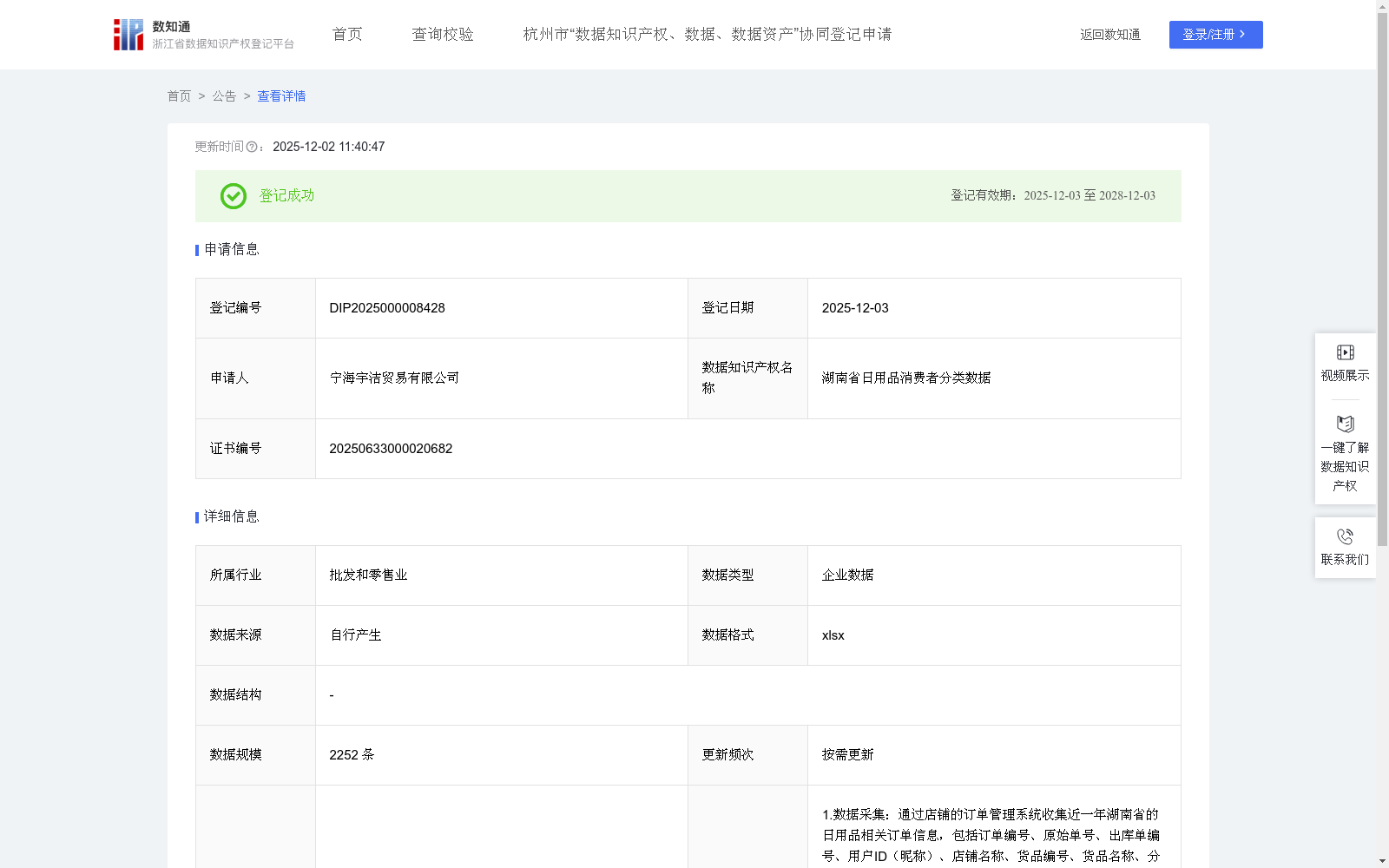
湖南省日用品消费者分类数据
收藏浙江省数据知识产权登记平台2025-12-02 更新2025-12-03 收录
下载链接:
https://www.zjip.org.cn/home/announce/trends/8408665
下载链接
链接失效反馈官方服务:
资源简介:
对消费者进行分级可以帮助企业更准确地识别湖南省不同消费能力和消费需求的消费者群体分布。针对不同级别的消费者,企业可以制定个性化的营销策略,如为C级消费者提供性价比更高的选择,大促时也可以通过客服推送相关产品推荐。新进入广东市场的相关同行可以通过分析A级、B级消费者密集分布的省内区域,根据数据进行参考后为实体店选址。通过了解本企业核心用户(A级)的消费占比和偏好同时帮助同行企业识别市场空白和机会,实现错位竞争,避免陷入同质化价格战。1.数据采集:通过店铺的订单管理系统收集近一年湖南省的日用品相关订单信息,包括订单编号、原始单号、出库单编号、用户ID(昵称)、店铺名称、货品编号、货品名称、分类、货品数量、收货地区、下单时间。2.数据处理:将数据清洗,去除重复数据,确保每个订单只被计算一次,纠正错误数据,如订单编号重复但内容不同,需进行人工核查或删除重复项,对于缺失的字段,如收货地区不明确,需根据其他信息(如物流信息)进行补充或标记为未知;3.数据加工:以“用户ID(昵称)”为唯一标识,对单个用户的所有订单进行汇总。统计在近一年的时间范围内该用户在店铺内的所有日用品订单。将该用户所有符合上述条件的订单中的“货品数量”进行加总,得到该用户的“累计下单数量”。对湖南省所有用户的 “累计下单数量” 进行加总,得到 “本省货品数量总数”。用户消费占比(即“单个用户多订单累计占比”)=累计下单数量/本省货品数量总数*100%(保留小数点后两位)当该数值大于1%时,则消费者等级为A;当该数值大于0.5%且小于等于1%时,则消费者等级为B,其余为C。
Consumer tiering helps enterprises more accurately identify the distribution of consumer groups with different consumption capabilities and demands in Hunan Province. For consumers at different tiers, enterprises can develop personalized marketing strategies. For example, provide more cost-effective options for Class C consumers, and push relevant product recommendations via customer service during big promotion events. Relevant competitors newly entering the Guangdong market can analyze the intra-provincial regions where Class A and B consumers are densely distributed, and use the data as a reference for physical store site selection. By understanding the consumption proportion and preferences of the enterprise's core users (Class A), it can also help peer enterprises identify market gaps and opportunities, achieve differentiated competition, and avoid falling into homogeneous price wars.
1. Data Collection: Collect daily necessities order information related to Hunan Province from the past year through the store's order management system, including order number, original order number, delivery order number, user ID (nickname), store name, product number, product name, category, product quantity, receiving area, and order time.
2. Data Cleaning and Preprocessing: Clean the data by removing duplicate entries to ensure each order is counted exactly once. Correct erroneous data: for orders with duplicate order numbers but different content, manually verify them or delete the duplicates. For missing fields such as unclear receiving area, supplement the information based on other details (e.g., logistics information) or mark it as "unknown".
3. Data Aggregation and Calculation: Use "user ID (nickname)" as the unique identifier to aggregate all orders of a single user. Count all daily necessities orders placed by the user at the store within the past year. Sum the "product quantity" from all eligible orders of the user to obtain the user's "total order quantity". Sum the "total order quantity" of all users in Hunan Province to obtain the "total provincial product quantity". The user's consumption proportion (i.e., "cumulative proportion of a single user's multiple orders") = (total order quantity / total provincial product quantity) * 100% (rounded to two decimal places). Consumers are classified as Class A if this value is greater than 1%; Class B if the value is greater than 0.5% and less than or equal to 1%; and Class C otherwise.
提供机构:
宁海宇洁贸易有限公司
创建时间:
2025-06-20
搜集汇总
数据集介绍
背景与挑战
背景概述
该数据集是湖南省日用品消费者分类数据,包含2252条企业数据,用于对消费者进行分级(A、B、C级),以帮助企业制定个性化营销策略和实体店选址。数据基于用户订单信息,通过算法计算消费占比进行分类,支持市场分析和竞争策略制定。
以上内容由遇见数据集搜集并总结生成


