
全球人口调查数据集(1950-2018)
收藏国家青藏高原科学数据中心2021-04-19 更新2024-03-01 收录
下载链接:
https://data.tpdc.ac.cn/zh-hans/data/ece5509f-2a2c-4a11-976e-8d939a419a6c
下载链接
链接失效反馈官方服务:
资源简介:
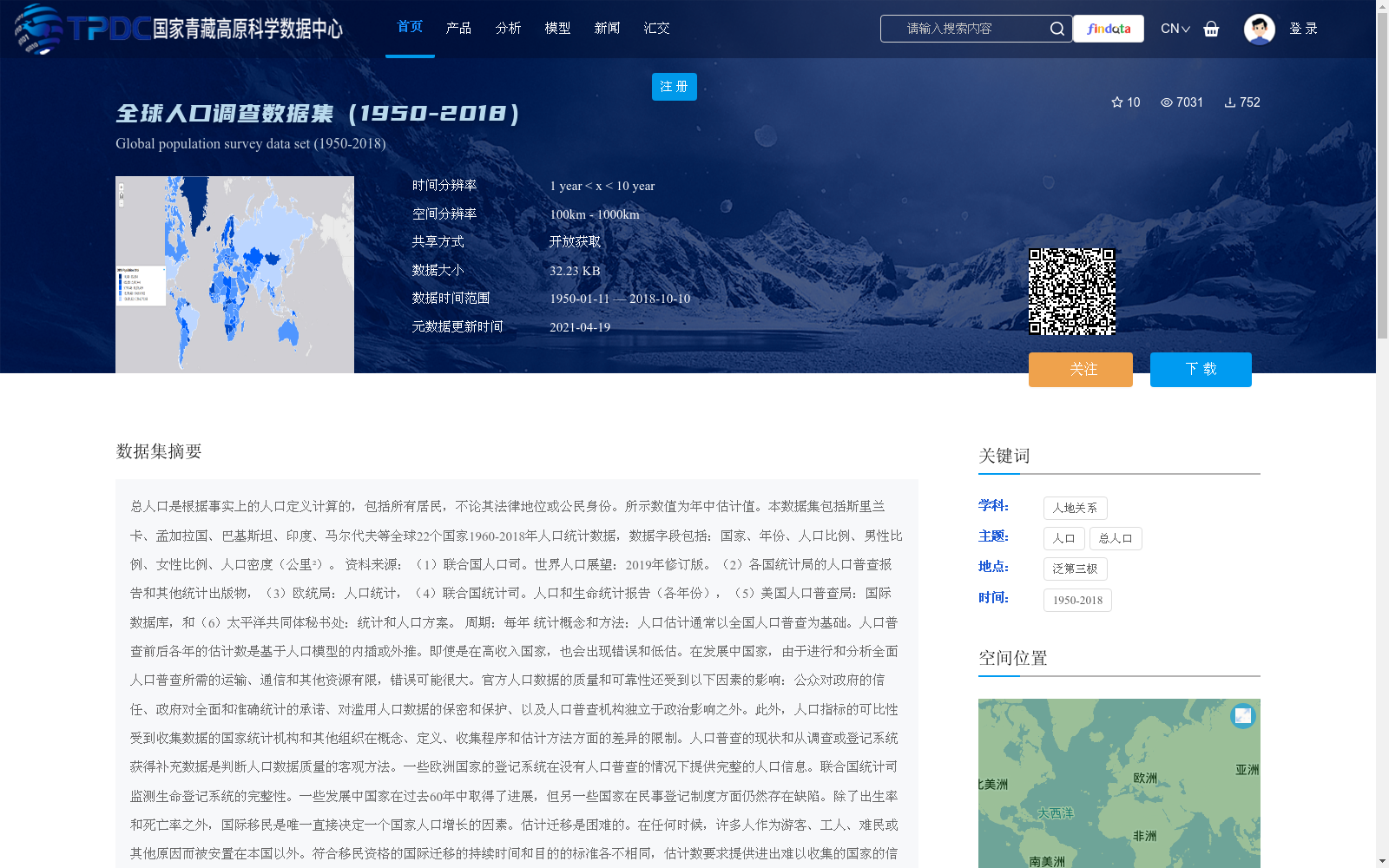
总人口是根据事实上的人口定义计算的,包括所有居民,不论其法律地位或公民身份。所示数值为年中估计值。本数据集包括斯里兰卡、孟加拉国、巴基斯坦、印度、马尔代夫等全球22个国家1960-2018年人口统计数据,数据字段包括:国家、年份、人口比例、男性比例、女性比例、人口密度(公里²)。
资料来源:(1)联合国人口司。世界人口展望:2019年修订版。(2)各国统计局的人口普查报告和其他统计出版物,(3)欧统局:人口统计,(4)联合国统计司。人口和生命统计报告(各年份),(5)美国人口普查局:国际数据库,和(6)太平洋共同体秘书处:统计和人口方案。
周期:每年
统计概念和方法:人口估计通常以全国人口普查为基础。人口普查前后各年的估计数是基于人口模型的内插或外推。即使是在高收入国家,也会出现错误和低估。在发展中国家,由于进行和分析全面人口普查所需的运输、通信和其他资源有限,错误可能很大。官方人口数据的质量和可靠性还受到以下因素的影响:公众对政府的信任、政府对全面和准确统计的承诺、对滥用人口数据的保密和保护、以及人口普查机构独立于政治影响之外。此外,人口指标的可比性受到收集数据的国家统计机构和其他组织在概念、定义、收集程序和估计方法方面的差异的限制。人口普查的现状和从调查或登记系统获得补充数据是判断人口数据质量的客观方法。一些欧洲国家的登记系统在没有人口普查的情况下提供完整的人口信息。联合国统计司监测生命登记系统的完整性。一些发展中国家在过去60年中取得了进展,但另一些国家在民事登记制度方面仍然存在缺陷。除了出生率和死亡率之外,国际移民是唯一直接决定一个国家人口增长的因素。估计迁移是困难的。在任何时候,许多人作为游客、工人、难民或其他原因而被安置在本国以外。符合移民资格的国际迁移的持续时间和目的的标准各不相同,估计数要求提供进出难以收集的国家的信息。根据联合国人口司世界人口前景数据库中的中变量,从基准年开始,利用到2050年按年龄和性别分列的死亡率、生育率和移民假设,对人口预测进行预测。
Total population is calculated in accordance with the de facto population definition, which encompasses all residents regardless of their legal status or citizenship. The values presented are mid-year population estimates. This dataset contains population statistics for 22 countries worldwide including Sri Lanka, Bangladesh, Pakistan, India, the Maldives, and others, covering the period from 1960 to 2018. The data fields include: country, year, population proportion, male proportion, female proportion, and population density (per km²).
Data sources: (1) United Nations Population Division. World Population Prospects: 2019 Revision. (2) Population census reports and other statistical publications from national statistical bureaus, (3) Eurostat: Population Statistics, (4) United Nations Statistics Division. Demographic and Life Statistics Reports (various years), (5) U.S. Census Bureau: International Database, and (6) Secretariat of the Pacific Community: Statistics and Population Programme.
Data frequency: Annual
Statistical concepts and methods: Population estimates are typically grounded in national population censuses. Estimates for years preceding or following a census are generated through interpolation or extrapolation based on demographic models. Errors and undercounts can arise even in high-income countries. In developing countries, errors can be considerable due to limited resources such as transportation, communication, and other necessities for conducting and analyzing a full population census. The quality and reliability of official population data are further affected by factors including public trust in government, governmental commitment to comprehensive and accurate statistics, confidentiality safeguards against misuse of population data, and the independence of population census agencies from political interference. Furthermore, the comparability of population indicators is constrained by disparities in concepts, definitions, data collection procedures, and estimation methods across national statistical agencies and other organizations worldwide. The status of national population censuses and supplementary data sourced from surveys or registration systems serve as objective means for evaluating the quality of population data. Some European countries utilize civil registration systems to provide complete population data in the absence of a population census. The United Nations Statistics Division monitors the completeness of civil registration systems. Some developing countries have made progress over the past six decades, while others still face deficiencies in their civil registration systems. Aside from birth rates and death rates, international migration is the sole factor that directly determines a country's population growth. Estimating migration flows is challenging. At any given time, numerous individuals reside outside their home countries as tourists, migrant workers, refugees, or for other reasons. The criteria for defining qualifying international migration—including duration and purpose of stay—vary across contexts, and migration estimates require data on cross-border movements into and out of countries that are often difficult to obtain. Based on the medium variant in the World Population Prospects database of the United Nations Population Division, population projections are developed using age- and sex-disaggregated mortality, fertility, and migration assumptions through to 2050, starting from the base year.
提供机构:
董文
创建时间:
2020-03-07
搜集汇总
数据集介绍
背景与挑战
背景概述
该数据集是一个全球人口调查数据集,覆盖1950年至2018年,包含斯里兰卡、孟加拉国、巴基斯坦、印度、马尔代夫等22个国家1960-2018年的人口统计数据,主要字段包括国家、年份、人口比例、性别比例和人口密度。数据来源于联合国人口司、各国统计局等多个权威机构,以表格形式提供,具有开放获取的特点,适用于人口研究和人地关系分析。
以上内容由遇见数据集搜集并总结生成


