
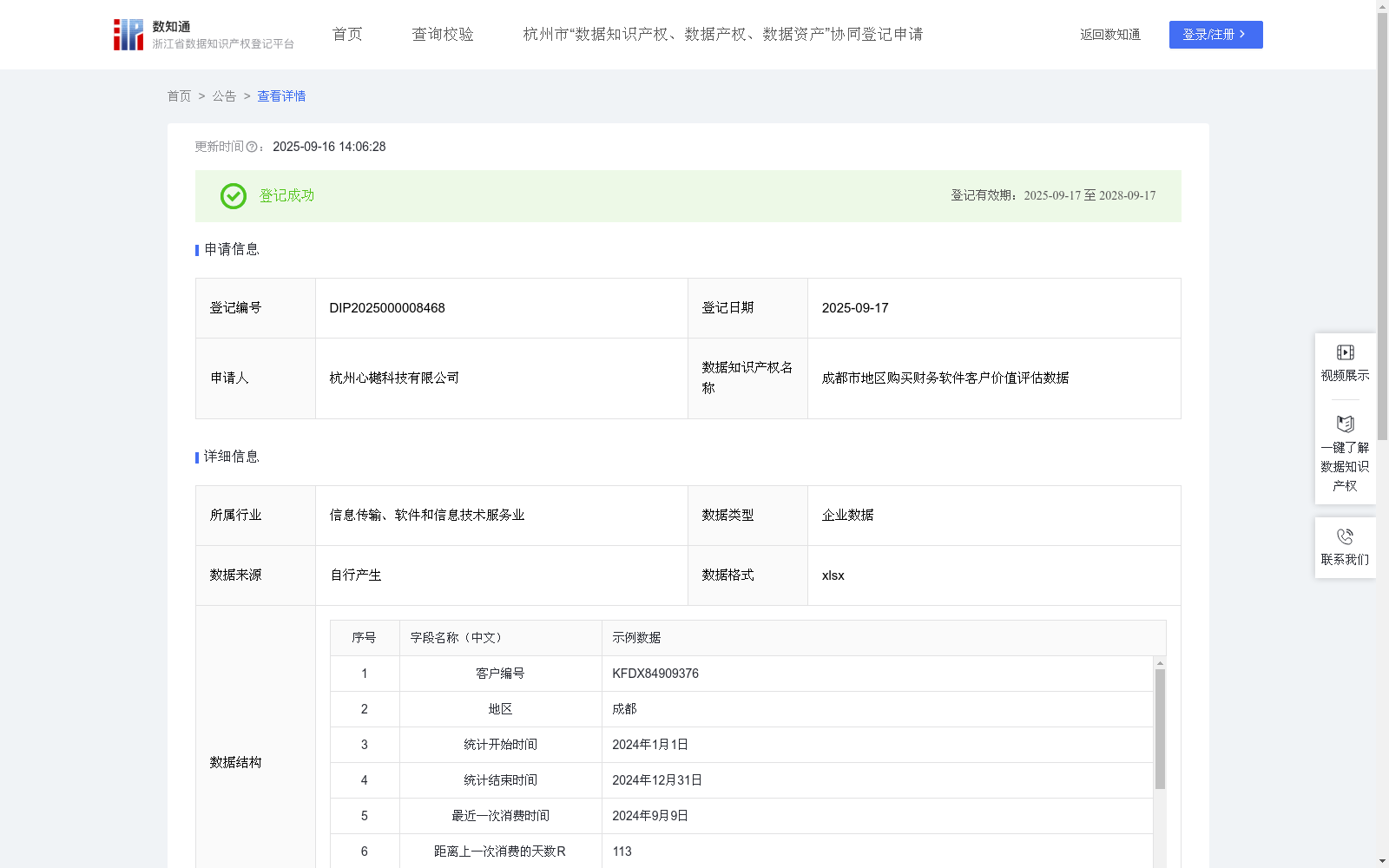
成都市地区购买财务软件客户价值评估数据
收藏浙江省数据知识产权登记平台2025-09-16 更新2025-09-17 收录
下载链接:
https://www.zjip.org.cn/home/announce/trends/180512
下载链接
链接失效反馈官方服务:
资源简介:
采集销售记录表中成都市地区的数据,通过客户距离上一次消费的天数R、统计时间内消费频次F和统计时间内消费金额M(元),采用RFM模型对客户进行价值评级,实现精准化运营。通过对成都市地区客户价值分层管理,满足不同价值客户的个性化需求:- 对A级客户:每月进行一次回访维护,提供专属优惠和VIP服务,增强客户忠诚度;- 对B级客户:每季度进行一次回访维护,提供定制化产品推荐,提升客户价值;- 对C级客户:每半年进行一次回访维护,通过促销活动激活消费潜力;- 对D级客户:每年进行一次回访维护,评估客户流失风险,实施挽留策略。此外,该模型可为本地区客户群体高度重叠企业提供不同价值类型的客户个性化服务的数据支持,帮助企业优化营销资源分配,提高营销效率和投资回报率。1. 数据处理:对从销售记录表中采集到的数据进行脱敏、降噪、清洗、聚集、分析,确保数据质量和准确性。2. 数据加工:运用RFM模型结合客户在2024年1月1日至2024年12月31日期间的消费行为数据,从三个维度评估客户价值:-距离上一次消费的天数R ;- 客户在2024年1月1日至2024年12月31日之间的统计时间内消费频次F;- 客户在2024年1月1日至2024年12月31日之间的统计时间内消费金额M(元)。3. 评分规则:a. R值评分:将客户按最近一次消费时间距今的天数从小到大排序,分为5等份。最近消费的前20%客户获得5分,接下来的20%获得4分,以此类推。注意:R值越小,表示客户越活跃,得分越高。b. F值评分:将客户按消费频次从高到低排序,分为5等份。消费频次最高的前20%客户获得5分,接下来的20%获得4分,以此类推。c. M值评分:将客户按消费金额从高到低排序,分为5等份。消费金额最高的前20%客户获得5分,接下来的20%获得4分,以此类推。4. 综合评分计算:RFM综合得分 = 0.3*(R得分)+ 0.3*(F得分)+ 0.4*(M得分);权重分配反映了消费金额在客户价值评估中的相对重要性。5. 客户等级划分: - A级客户:RFM得分 ≥ 4分,高价值客户,需重点维护; - B级客户:3分 ≤ RFM得分 < 4分,中高价值客户,有发展潜力;- C级客户:2分 ≤ RFM得分 < 3分,中低价值客户,需激活;- D级客户:RFM得分 < 2分,低价值客户,维护成本高;6. 动态更新:模型每年更新一次,确保客户分类的时效性和准确性,支持企业及时调整客户关系管理策略。
This dataset collects regional sales record data of Chengdu City, and adopts the RFM model to conduct customer value rating for precise operation management. Through hierarchical management of customer value in Chengdu, it meets the personalized demands of customers with different value tiers:
- Class A Customers: Conduct return visits and maintenance once a month, provide exclusive discounts and VIP services to enhance customer loyalty;
- Class B Customers: Conduct return visits and maintenance once per quarter, provide customized product recommendations to elevate customer value;
- Class C Customers: Conduct return visits and maintenance once every six months, activate consumption potential via promotional activities;
- Class D Customers: Conduct return visits and maintenance once a year, assess customer churn risk and implement retention strategies.
Furthermore, this model can provide data support for enterprises with highly overlapping local customer groups to deliver personalized services for customers of various value types, helping enterprises optimize marketing resource allocation, improve marketing efficiency and return on investment.
1. Data Processing: Desensitize, denoise, clean, aggregate and analyze the data collected from sales record sheets to ensure data quality and accuracy.
2. Data Processing: Apply the RFM model combined with customer consumption behavior data from January 1, 2024 to December 31, 2024, to evaluate customer value from three dimensions:
- R: Number of days since the customer's last consumption;
- F: Customer's consumption frequency during the statistical period from January 1, 2024 to December 31, 2024;
- M: Customer's total consumption amount during the statistical period from January 1, 2024 to December 31, 2024 (in yuan).
3. Scoring Rules:
a. R-value Scoring: Sort customers in ascending order of the number of days since their last consumption, and divide them into 5 equal segments. The top 20% of customers with the most recent consumption get 5 points, the next 20% get 4 points, and so on. Note: A smaller R-value indicates more active customers and a higher score.
b. F-value Scoring: Sort customers in descending order of consumption frequency, and divide them into 5 equal segments. The top 20% of customers with the highest consumption frequency get 5 points, the next 20% get 4 points, and so on.
c. M-value Scoring: Sort customers in descending order of total consumption amount, and divide them into 5 equal segments. The top 20% of customers with the highest consumption amount get 5 points, the next 20% get 4 points, and so on.
4. Comprehensive Score Calculation: RFM Comprehensive Score = 0.3*(R Score) + 0.3*(F Score) + 0.4*(M Score); The weight distribution reflects the relative importance of consumption amount in customer value assessment.
5. Customer Tier Classification:
- Class A Customers: RFM score ≥ 4 points, high-value customers requiring key maintenance;
- Class B Customers: 3 ≤ RFM score < 4, medium-high-value customers with development potential;
- Class C Customers: 2 ≤ RFM score < 3, medium-low-value customers in need of activation;
- Class D Customers: RFM score < 2, low-value customers with high maintenance costs;
6. Dynamic Update: The model is updated once annually to ensure the timeliness and accuracy of customer classification, and support enterprises in timely adjustment of customer relationship management strategies.
提供机构:
杭州心樾科技有限公司
创建时间:
2025-06-20
搜集汇总
数据集介绍
背景与挑战
背景概述
该数据集包含721条成都地区财务软件客户的RFM评估数据,通过消费天数、频次和金额进行价值分层,用于企业精准营销和客户关系管理。数据每年更新,基于xlsx格式存储,适用于信息传输和软件行业。
以上内容由遇见数据集搜集并总结生成


