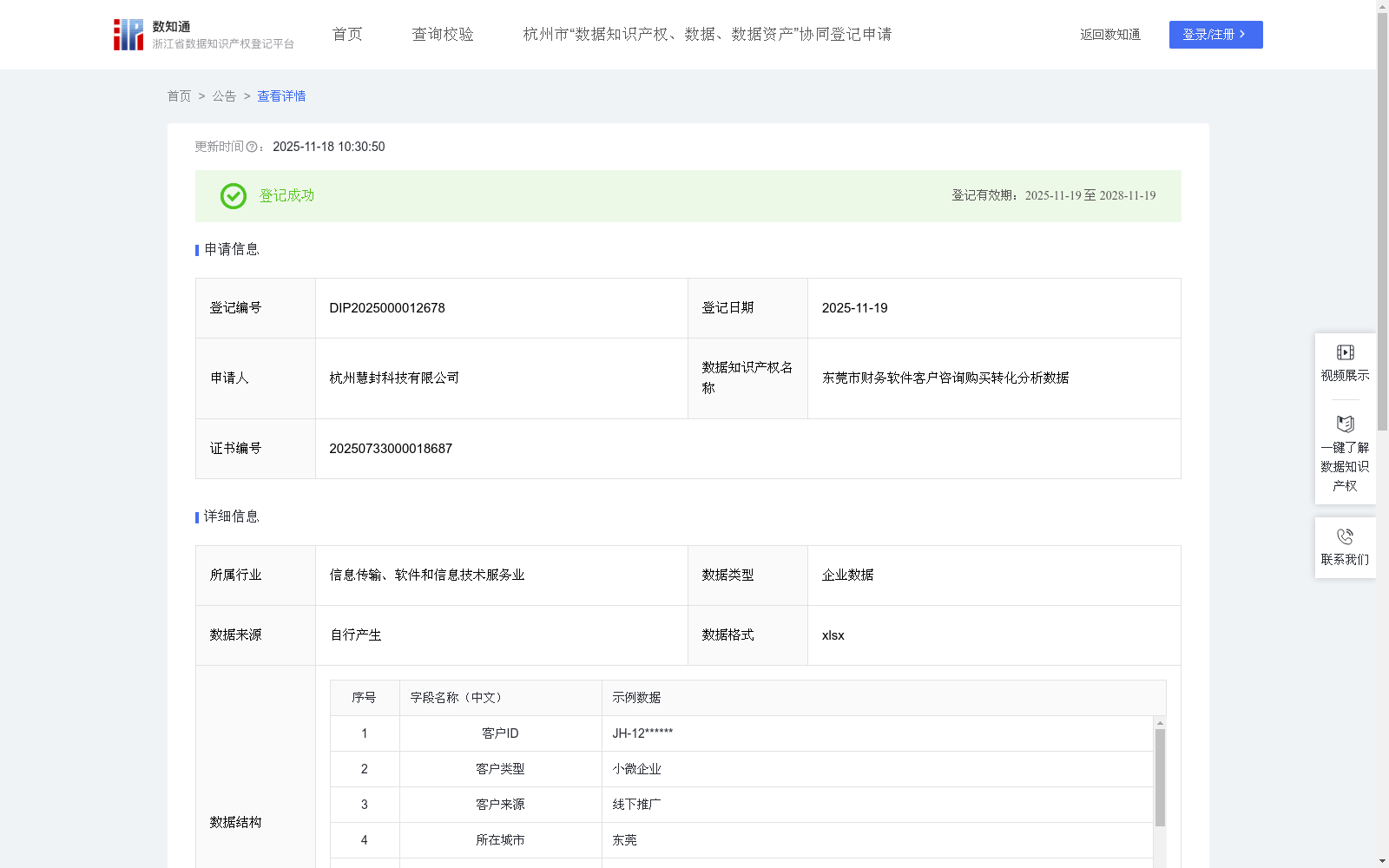
东莞市财务软件客户咨询购买转化分析数据
收藏资源简介:
为更好了解东莞市地区客户对财务软件咨询转化情况,需要对客户咨询信息进行数据分析。通过客户意向度、需求明确性、满意度进行综合分析。公司可以根据分析出来的客户咨询等级制定不同的专业人员进行服务跟进;行业可以根据分析的客户咨询数据,制定行业营销策略;院校可以根据分析的客户咨询数据,了解当前行业的需求情况,进行招生及就业指导;发布财务软件行业的咨询转化报告,可以为政府、企业、培训机构等提供数据化支持。通过多维度评分体系,对客户咨询购买转化评估,为企业制定差异化营销策略提供数据支持。一、客户意向度评分(1-5分):1分:无任何购买意向,仅做了解;2分:有一定了解意愿,但购买意向较低;3分:有购买意向,但仍有较多顾虑;4分:购买意向较强,正在对比选择;5分:购买意向强烈,近期有购买计划。二、客户需求明确性评分(1-5分):1分:完全不明确自身需求;2分:需求模糊,表述不清;3分:有一定需求方向,但细节不明确;4分:需求较明确,能清晰描述主要需求;5分:需求非常明确,对功能、模块等有具体要求。三、客户满意度评分(1-5分,针对咨询服务):1分:非常不满意,对咨询服务体验差;2分:不太满意,咨询服务存在较多问题;3 分:一般,基本满足咨询需求;4分:比较满意,咨询服务较专业;5分:非常满意,对咨询服务认可度高。四、综合评分(0-5分):计算方式:综合评分=客户意向度评分×0.4+客户需求明确性评分×0.3+客户满意度评分×0.3。五、最终评级:A级(高转化潜力)、B级(中等转化潜力)、C级(低转化潜力)、D级(暂无意向);最终评级算法(基于综合评分):A级:综合评分4.0-5.0分,高转化潜力,安排客户经理跟进,每周沟通回访;B级:综合评分3.0-3.9分,中等转化潜力,安排金牌销售跟进,每月沟通回访;C级:综合评分2.0-2.9分,低转化潜力,安排销售跟进,每季度回访;D级:综合评分0-1.9分,暂无意向,留存数据,安排销售跟进,每年度回访。
To better understand the consulting-to-conversion status of financial software customers in Dongguan City, data analysis of customer consulting information is required. Comprehensive analysis will be conducted based on three dimensions: customer intent, demand clarity, and customer satisfaction. Enterprises can develop targeted service follow-up plans with dedicated professionals based on the analyzed customer consulting tiers; the industry can formulate industry-wide marketing strategies using the analyzed customer consulting data; educational institutions can understand current industry demand trends to adjust enrollment and employment guidance based on the data; releasing a financial software industry consulting conversion report can provide data-driven support for governments, enterprises, training institutions, and other relevant stakeholders. A multi-dimensional scoring system is adopted to evaluate the consulting-to-purchase conversion of customers, providing data support for enterprises to develop differentiated marketing strategies. 1. Customer Intent Score (1-5 points): 1 point: No purchase intent, only seeking general information; 2 points: Has a certain willingness to learn, but low purchase intention; 3 points: Has purchase intent but still has many concerns; 4 points: Strong purchase intent, currently comparing alternative options; 5 points: Extremely strong purchase intent, with a planned purchase in the near future. 2. Customer Demand Clarity Score (1-5 points): 1 point: Completely unclear about their own needs; 2 points: Vague demands with unclear descriptions; 3 points: Has a certain demand direction but unclear specific details; 4 points: Relatively clear demands, able to clearly describe core requirements; 5 points: Extremely clear demands, with specific requirements for functions, modules, and other aspects. 3. Customer Satisfaction Score (1-5 points, for consulting services): 1 point: Very dissatisfied, with poor consulting service experience; 2 points: Moderately dissatisfied, with multiple issues in the consulting service; 3 points: Average, basically meeting consulting needs; 4 points: Relatively satisfied, with relatively professional consulting services; 5 points: Extremely satisfied, with high recognition of the consulting service. 4. Comprehensive Score (0-5 points): Calculation formula: Comprehensive Score = Customer Intent Score × 0.4 + Customer Demand Clarity Score × 0.3 + Customer Satisfaction Score × 0.3. 5. Final Rating: Grade A (High Conversion Potential), Grade B (Medium Conversion Potential), Grade C (Low Conversion Potential), Grade D (No Current Intent). Final rating algorithm based on comprehensive score: - Grade A: Comprehensive score 4.0-5.0, high conversion potential, assign customer account managers to conduct weekly follow-up communications; - Grade B: Comprehensive score 3.0-3.9, medium conversion potential, assign top sales representatives to conduct monthly follow-up communications; - Grade C: Comprehensive score 2.0-2.9, low conversion potential, assign sales representatives to conduct quarterly follow-up communications; - Grade D: Comprehensive score 0-1.9, no current intent, retain the data, assign sales representatives to conduct annual follow-up communications.