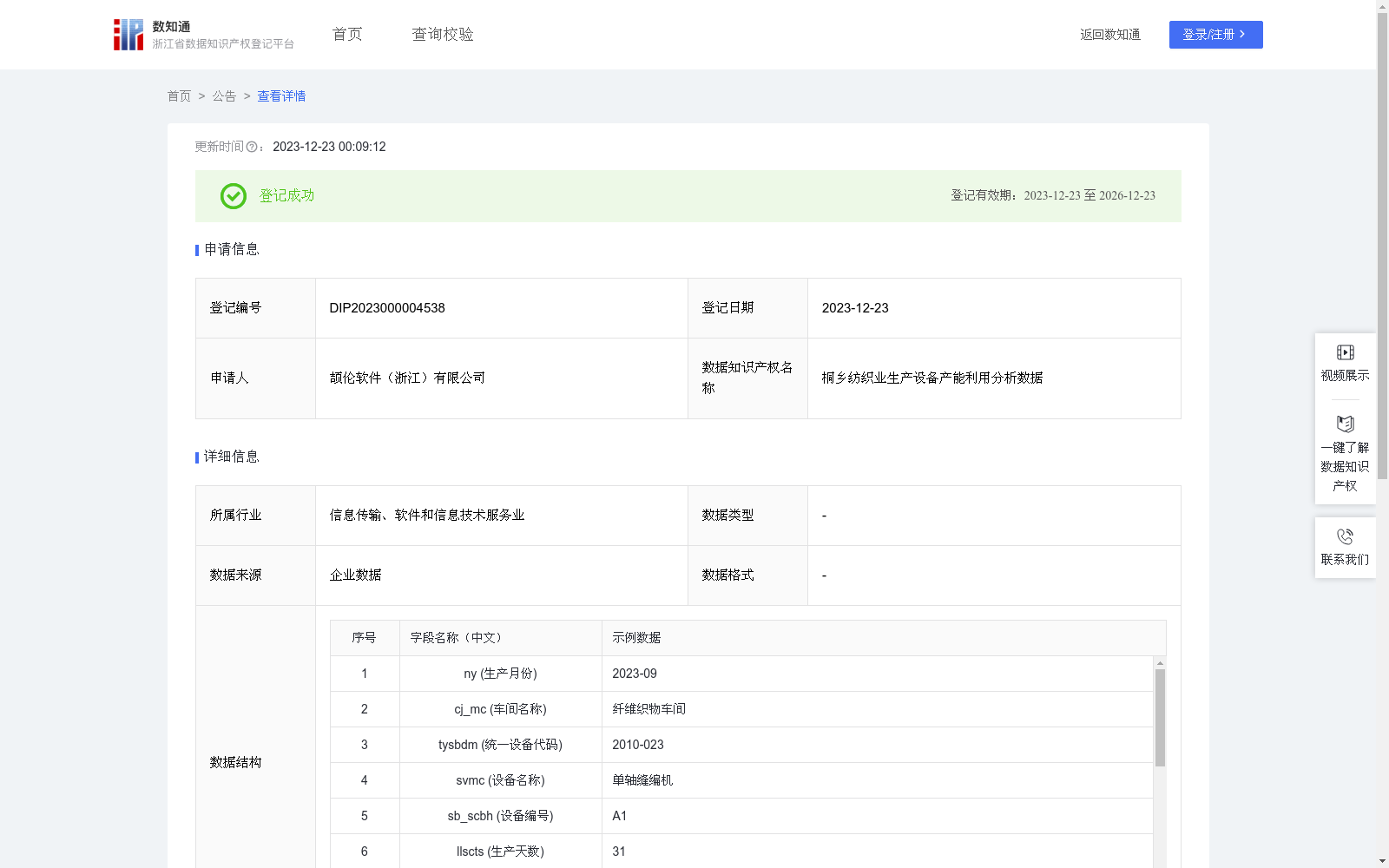
桐乡纺织业生产设备产能利用分析数据
收藏资源简介:
设备产能利用率分析的应用场景十分广泛,具体体现在以下方面:1.生产计划和调度:设备产能利用率分析可以帮助生产计划和调度人员更好地了解设备的生产能力、瓶颈和限制,从而更加准确地制定生产计划和调度方案,提高生产效率和减少生产成本。2.工艺优化和改进:通过对设备产能利用率的深入分析,可以发现生产工艺中存在的问题和瓶颈,从而采取针对性的工艺优化和改进措施,提高设备的生产效率和产品质量。3.产能规划和预测:通过对设备产能利用率的趋势分析和预测,可以帮助企业更好地规划未来的产能需求,提前做好产能规划和准备工作,避免产能不足或过剩的情况出现。4.决策支持:设备产能利用率分析可以为企业管理层提供有关设备使用状况的准确数据和信息,帮助其更好地了解企业的生产状况和运营情况,从而做出更加科学、合理的决策。设备产能利用率分析在生产计划、工艺优化、设备维护、产能规划和决策支持等多个方面都具有重要的应用价值。生产设备产能利用算法规则包含以下方面: 1.数据采集:通过生产系统模块采集设备每日生产运行数据,进一步按月度统计汇总,进行设备运转及产量月度数据。2、数据校验:基于每台设备设备标准参数换算月度理论参照数据模型,对比、校对确保数据的有效性、合法性和准确性。3、数据处理:通过使用WebService的方式连接数据库检索和统计结果,实现数据存储、读写、计算和转存等交互操作。关于部门、车间、设备代码、日期等字段通过唯一主键进行多表关联,在每个月份最后一天,分别统计分析形成成果数据,并依次计算每台设备的月度理论产量和实际成品产量。公式:月度理论产量=理论开机时长×每小时理论产量,实际成品产量=优等品产量+合格率产量,产能利用率=(实际成品产量/月度理论产量)×100%;所有重量计量单位为(KG)精确一位小数,计算结果为百分比且保留两位小数。设备产能利用率是衡量设备生产效率的重要指标,帮助企业改进生产计划、工艺优化、设备维护、产能规划和决策支持等,从而改善企业的整体生产效率。
The application scenarios of equipment capacity utilization rate analysis are extensive, which are specifically reflected in the following aspects: 1. Production Planning and Scheduling: Equipment capacity utilization rate analysis can help production planning and scheduling personnel better understand the production capacity, bottlenecks and constraints of equipment, so as to formulate production plans and scheduling schemes more accurately, improve production efficiency and reduce production costs. 2. Process Optimization and Improvement: Through in-depth analysis of equipment capacity utilization rate, problems and bottlenecks existing in the production process can be identified, and targeted process optimization and improvement measures can be taken to improve equipment production efficiency and product quality. 3. Capacity Planning and Forecasting: Through trend analysis and forecasting of equipment capacity utilization rate, enterprises can better plan future capacity demands, make capacity planning and preparation in advance, and avoid situations of insufficient or excess capacity. 4. Decision Support: Equipment capacity utilization rate analysis can provide accurate data and information about equipment usage status for enterprise management, helping them better understand the production and operation status of the enterprise, so as to make more scientific and reasonable decisions. Equipment capacity utilization rate analysis has important application value in multiple aspects such as production planning, process optimization, equipment maintenance, capacity planning and decision support. The algorithm rules for production equipment capacity utilization include the following aspects: 1. Data Collection: Collect daily production and operation data of equipment through the production system module, then further summarize and aggregate it on a monthly basis to form monthly data on equipment operation and output. 2. Data Validation: Convert the monthly theoretical reference data model based on the standard parameters of each equipment, and compare and proofread to ensure the validity, legality and accuracy of the data. 3. Data Processing: Connect to the database to retrieve and count results via WebService, realizing interactive operations such as data storage, reading/writing, calculation and transfer. Fields such as department, workshop, equipment code and date are associated across multiple tables through unique primary keys. On the last day of each month, statistical analysis is conducted to form result data, and the monthly theoretical output and actual finished product output of each equipment are calculated sequentially. Formula: Monthly Theoretical Output = Theoretical Startup Duration × Theoretical Output per Hour; Actual Finished Product Output = Output of Superior-quality Products + Output of Qualified Products; Capacity Utilization Rate = (Actual Finished Product Output / Monthly Theoretical Output) × 100%. All weight measurement units are (KG) with one decimal place precision, and the calculation result is a percentage retained to two decimal places. Equipment capacity utilization rate is an important indicator for measuring equipment production efficiency, helping enterprises improve production planning, process optimization, equipment maintenance, capacity planning and decision support, thereby improving the overall production efficiency of the enterprise.