tts-realspeech-dpo-en-de
收藏资源简介:
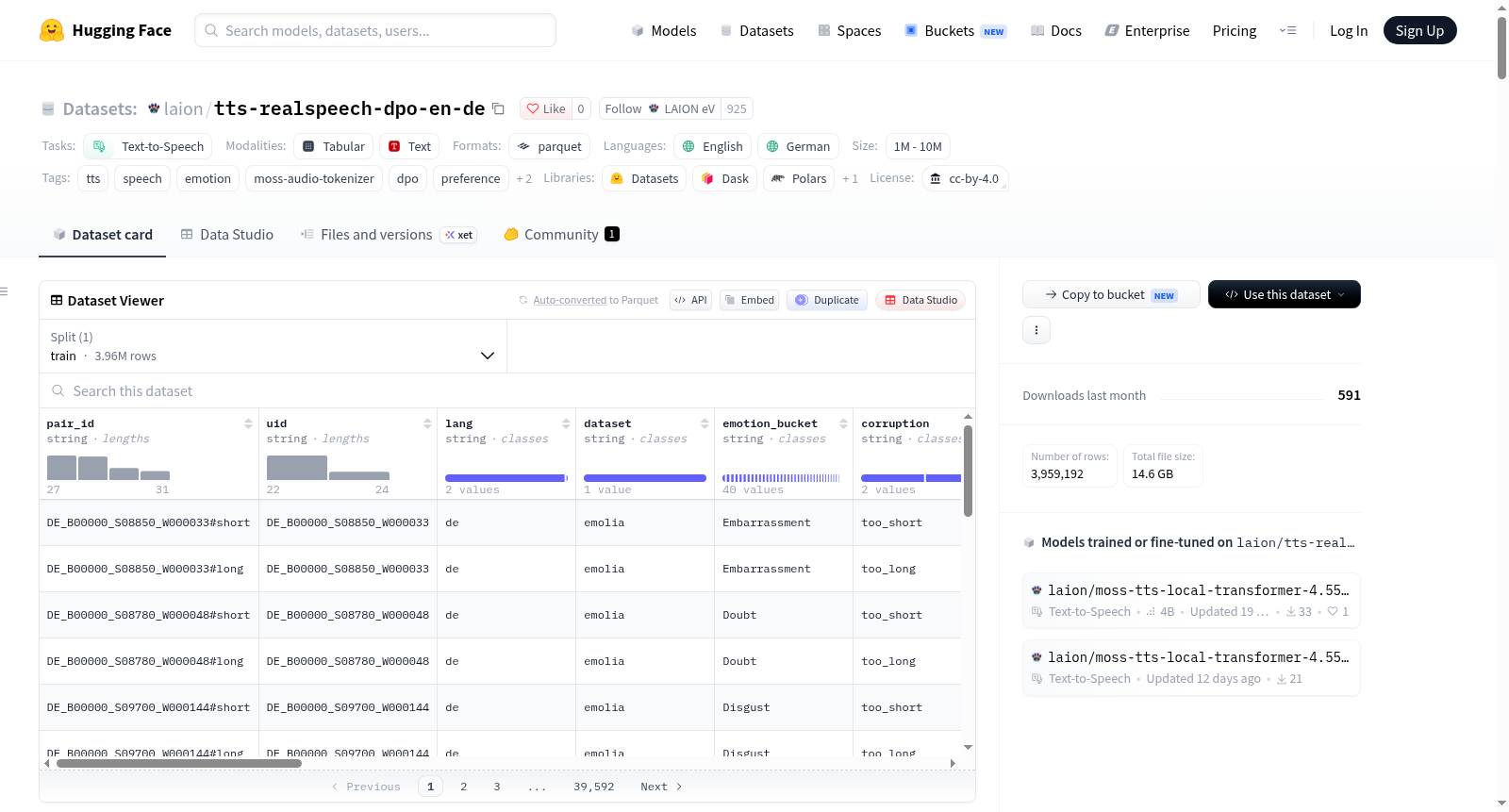
LAION TTS Real-Speech DPO (EN+DE) 是一个用于文本到语音(TTS)偏好学习的多语言数据集,包含英语和德语,共3,959,192个偏好对。每个偏好对由“chosen”(真实录音)和“rejected”(损坏版本)组成,其中损坏通过两种方式生成:提前停止(too_short)或过度延长(too_long)。该数据集基于 laion/tts-realspeech-sft-en-de 语料库构建,旨在为TTS模型提供对比学习信号,帮助模型学习生成更自然的语音。 数据集的构建方法包括: - 对于“too_short”损坏,在语言学合理的边界处(句子、从句或停顿)截断真实录音,保留25-75%的音频,且至少1.5秒和3个单词。 - 对于“too_long”损坏,将真实录音后附加其他材料(不同文本的另一个话语或短退化片段)。 数据集使用MOSS-Audio-Tokenizer-v2,每个帧包含12个令牌,帧率为12.5帧/秒。所有损坏点均对齐到整帧。 数据来源包括: - Emolia(CC-BY-4.0):英语和德语。 - KartoffelPhon(CC-BY-4.0):德语和少量英语。 - Multilingual LibriSpeech(MLS,CC-BY-4.0):仅德语。 选择过程中,使用公式 score = norm(genuineness) + norm(blend) + 2 * norm(emotion_strength) 对行进行排序,其中所有项均为经验累积分布函数(ECDF)百分位数。每个情感桶(emotion_bucket)要求情感强度在全部语料库中处于前10%,且原始强度大于1.0,同时是该片段情感强度排名前三的情感之一。 数据集包含以下字段:pair_id、uid、lang、dataset、emotion_bucket、corruption、caption、text、ref_uid、chosen_moss、chosen_frames、rejected_moss、rejected_frames、moss_n_vq、frame_tokens、cut_kind、cut_word_index、cut_time_s、cut_frame、cut_tokens、donor_uid、donor_kind、donor_frames。 注意事项: - 英语侧99.8%来自Emolia,存在语料库偏差。 - 德语侧由Emolia(约44%)、KartoffelPhon(约53%)和MLS(约3%)混合组成。 - 情感标签来自模型预测,而非人工标注。 - 真实性和混合度在(语料库×语言)内归一化。 - 参考音频覆盖率为44.6%,且大多数参考来自同一会话,可能存在信道混淆。 - 文本重复仅在语言内按精确匹配去除。 - 音频为原始编码格式(MP3或FLAC)。 - 包含Sexual Lust和Pain情感桶,可根据需要过滤。
LAION TTS Real-Speech DPO (EN+DE) is a multilingual dataset for text-to-speech (TTS) preference learning, containing English and German, with a total of 3,959,192 preference pairs. Each preference pair consists of chosen (real recording) and rejected (corrupted version), where corruption is generated in two ways: early stopping (too_short) or excessive prolongation (too_long). The dataset is built upon the laion/tts-realspeech-sft-en-de corpus and aims to provide contrastive learning signals for TTS models to help them learn to generate more natural speech. The construction method includes: for too_short corruption, truncating the real recording at linguistically reasonable boundaries (sentence, clause, or pause), retaining 25-75% of the audio, with a minimum of 1.5 seconds and 3 words; for too_long corruption, appending additional materials (another utterance of different text or short degraded segments) to the real recording. The dataset uses MOSS-Audio-Tokenizer-v2, with 12 tokens per frame and a frame rate of 12.5 frames per second. All corruption points are aligned to whole frames. Data sources include: Emolia (CC-BY-4.0): English and German; KartoffelPhon (CC-BY-4.0): German and a small amount of English; Multilingual LibriSpeech (MLS, CC-BY-4.0): German only. Selection uses the formula score = norm(genuineness) + norm(blend) + 2 * norm(emotion_strength), where all terms are empirical cumulative distribution function (ECDF) percentiles. Each emotion bucket requires emotion strength to be in the top 10% of the entire corpus, with raw strength greater than 1.0, and among the top three emotions of that segment. The dataset contains the following fields: pair_id, uid, lang, dataset, emotion_bucket, corruption, caption, text, ref_uid, chosen_moss, chosen_frames, rejected_moss, rejected_frames, moss_n_vq, frame_tokens, cut_kind, cut_word_index, cut_time_s, cut_frame, cut_tokens, donor_uid, donor_kind, donor_frames. Notes: 99.8% of the English side comes from Emolia, introducing corpus bias; the German side is a mixture of Emolia (~44%), KartoffelPhon (~53%), and MLS (~3%); emotion labels are from model predictions, not human annotations; genuineness and blend are normalized within (corpus × language); reference audio coverage is 44.6%, and most references come from the same session, potentially causing channel confusion; text deduplication is only exact match within language; audio is in original encoding format (MP3 or FLAC); includes Sexual Lust and Pain emotion buckets, which can be filtered as needed.
数据集概述
LAION TTS Real-Speech DPO (EN+DE) 是一个用于文本转语音(TTS)模型偏好优化(DPO)训练的数据集,包含约 395.9 万对偏好样本(3,959,192 pairs),语言覆盖英语和德语。
数据集构成
- 总样本数:3,959,192 对偏好样本(英语 1,974,660 · 德语 1,984,532)
- 偏好对结构:每个样本包含一个
chosen(真实录音音频)和一个rejected(同一音频被破坏的版本) - 破坏方式:分为
too_short(提前停止)和too_long(过度延长)两类,模拟 TTS 模型常见的两种失败模式 - 来源:基于
laion/tts-realspeech-sft-en-de构建,使用 MOSS-Audio-Tokenizer-v2 进行音频编码
破坏机制
too_short(截断)
- 基于词级时间戳,在语言上合理的边界处截断,优先级为:句子 > 子句 > 停顿(≥0.3 秒静音间隙)
- 截断需保留原话语的 25–75%,且音频 ≥1.5 秒、≥3 个词
- 截断时间对齐到完整 MOSS 帧(每帧 12 个 token,约 80 ms)
too_long(扩展)
- 在
chosen后附加额外音频材料,来源为:- 另一句不同文本的话语(50%)
- 短退化片段(50%,来自 SFT 集中的
distractor行)
数据来源与许可
| 语料库 | 许可 | 包含情况 |
|---|---|---|
| Emolia | CC-BY-4.0 | 是(英 + 德) |
| KartoffelPhon | CC-BY-4.0 | 是(德 + 少量英) |
| Multilingual LibriSpeech (MLS) | CC-BY-4.0 | 仅德语 |
| EuroSpeech | 其他(逐议会条款) | 排除 |
EuroSpeech 因许可问题被排除,原因是其音频受议会版权约束(如英国议会音频为议会版权),不符合开放再分发要求。
情感标签机制
- 使用 Empathic Insight 模型预测情感,非人工标注
- 每行进入某情感桶需满足三个条件:
- 该情感百分位 ≥ 0.90
- 原始得分 > 1.0(排除填充)
- 该情感属于该片段的前三大情感
- 验证结果:100% 的行中,桶情感确实出现在其标题中
关键技术与指标
- MOSS 编码:每帧 12 个 token(80 ms),非 32 个 —— 已在所有 3,959,192 对上验证无违规
- 标题生成:使用
capfix.fix_one()函数,修复了极性反转和绝对情感阈值问题 - 引用音频:44.6% 的行有参考音频(
ref_uid),用于条件生成
主要限制
- 英语侧单一来源:99.8% 英语行来自 Emolia,存在语料库偏差
- 语言间材料差异:德语大量基于 LibriVox 有声书,与英语素材格式不同
- 情感标签为模型预测,非人工标注
- 无“无主导情感”行:该数据集不包含情感中性样本
- 音频格式不一:Emolia 和 KartoffelPhon 为 MP3,MLS 为 48 kHz FLAC
- 包含 Lust 和 Pain 等敏感情感桶,需根据应用场景筛选