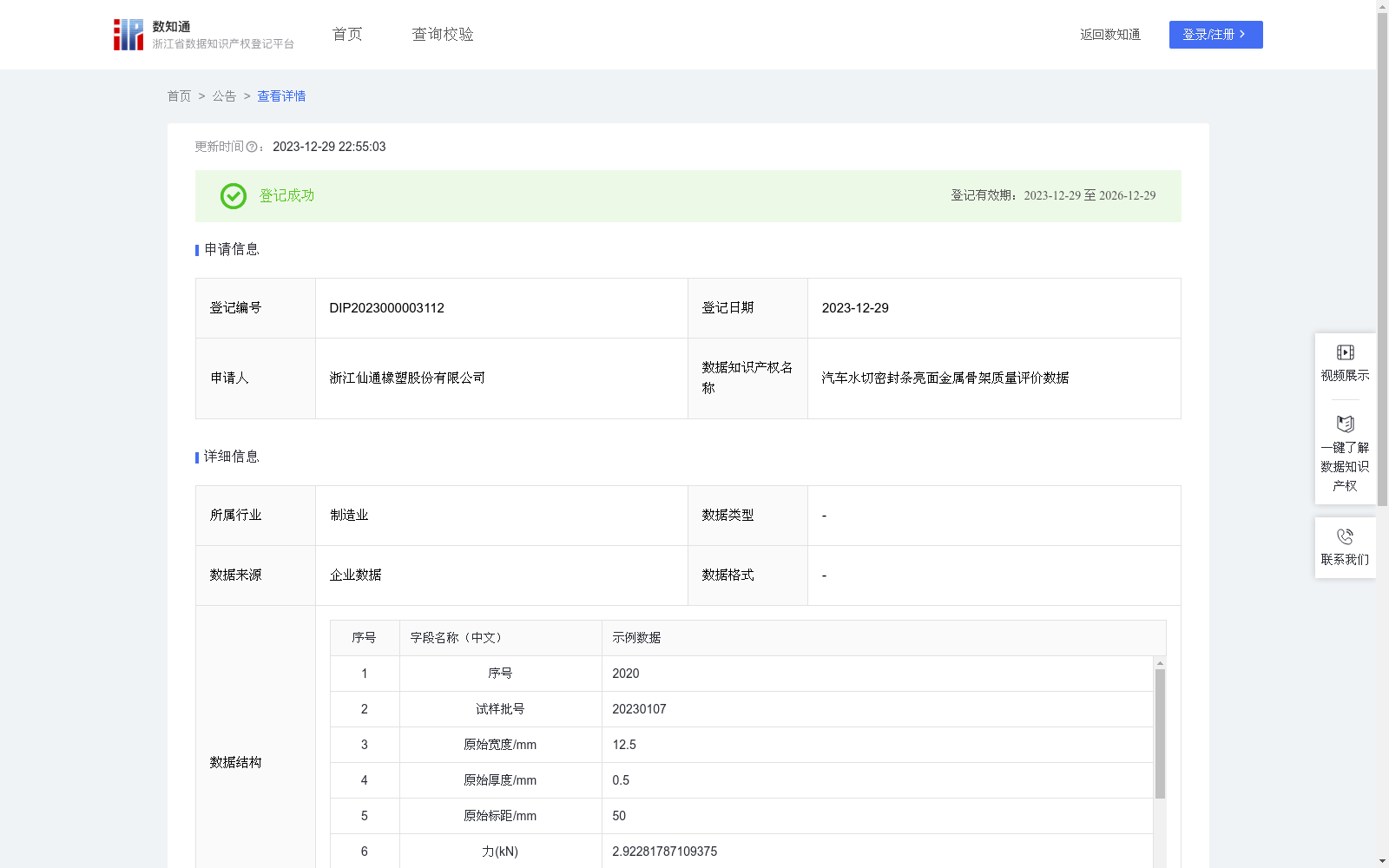
汽车水切密封条亮面金属骨架质量评价数据
收藏资源简介:
汽车密封条主要由金属骨架以及包覆在金属骨架上的橡胶组成,金属骨架主要起到支撑作用,保持橡胶的形状,确保密封条安装后的安全性和密封性。金属骨架的力学性能是保证密封条机械性能的重要参数之一,力学性能不足的金属骨架密封条容易在生产、运输、安装、使用等过程中极易发生断裂等损坏。金属骨架的力学性能通常通过抗拉强度和断裂伸长率来体现。本数据主要用于监测本公司内部生产及流通领域密封条金属骨架质量情况,通过检测数据并经计算后可以判断密封条中金属骨架的力学性能是否符合国家汽车行业及客户技术要求的质量标准,避免因产品力学性能不足导致的产品质量问题。1、样品采集:根据GB/T 228.1-2021 附录E的技术要求制取标准试样,用测厚仪和游标卡尺分别测出待测样条的原始厚度和原始宽度,并画出两条间隔50mm±0.5mm的原始标距; 2、样品测试:将试样对称地夹在拉力试验机的上、下夹持器上,使拉力均匀地分布在待测样条的横截面上,拉伸速度设置为10mm/min,点击触控面板上的"开始"按钮进行测试 ; 3.数据采集:每组样品测试完成之后采集该样品的位移(mm)和力(kN);4、数据计算:位移÷原始标距×100%=断裂伸长率(%);力×1000÷(原始厚度×原始宽度)=抗拉强度(MPa);5、根据该样品的技术要求,抗拉强度最大值≥400MPa,且断裂伸长率最大值≥20%即记为合格品,任一参数不满足技术要求即记为不合格品,用于作出该材料力学性能是否合格的判定依据。
Automotive rubber seals are mainly composed of a metal skeleton and rubber coated on the metal skeleton. The metal skeleton primarily serves a supporting role, maintaining the shape of the rubber and ensuring the safety and sealing performance of the seal after installation. The mechanical properties of the metal skeleton are one of the important parameters ensuring the mechanical performance of the rubber seal. Seals with metal skeletons having insufficient mechanical properties are prone to damage such as fracture during production, transportation, installation, and use. The mechanical properties of the metal skeleton are usually characterized by tensile strength and elongation at break. This dataset is mainly used to monitor the quality of metal skeletons in rubber seals during the company's internal production and circulation links. By collecting and calculating test data, we can determine whether the mechanical properties of the metal skeleton in the seal meet the quality standards specified by the national automotive industry and customer technical requirements, thereby avoiding product quality issues caused by insufficient mechanical properties of the products. 1. Sample Collection: Prepare standard specimens in accordance with the technical requirements specified in Appendix E of GB/T 228.1-2021. Measure the original thickness and original width of the test strip using a thickness gauge and a vernier caliper respectively, and draw two original gauge marks with an interval of 50mm ± 0.5mm. 2. Sample Testing: Clamp the specimen symmetrically on the upper and lower grips of the tensile testing machine to ensure that the tensile force is evenly distributed across the cross-section of the test strip. Set the stretching speed to 10mm/min, and click the "Start" button on the touch panel to conduct the test. 3. Data Collection: Collect the displacement (mm) and force (kN) of each specimen after the test is completed for the group of samples. 4. Data Calculation: Elongation at break (%) = (Displacement / Original Gauge Length) × 100%; Tensile strength (MPa) = (Force × 1000) / (Original Thickness × Original Width). 5. Qualification Judgment: According to the technical requirements of the specimen, a specimen is classified as a qualified product if its maximum tensile strength is ≥400MPa and its maximum elongation at break is ≥20%; otherwise, it is classified as an unqualified product. This serves as the basis for judging whether the mechanical properties of the material meet the requirements.