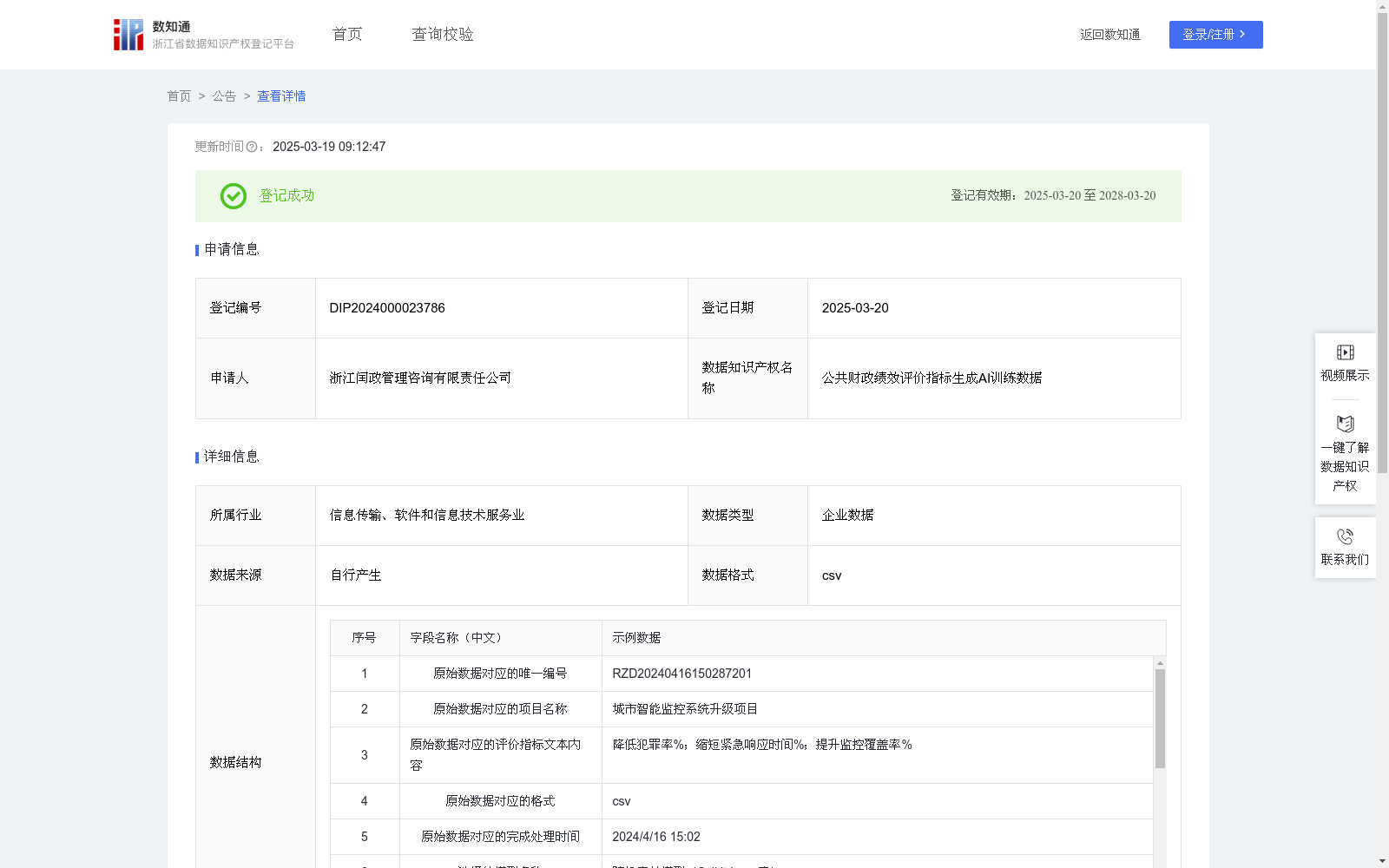
公共财政绩效评价指标生成AI训练数据
收藏资源简介:
本数据集的核心价值在于为公共财政绩效评价指标生成人工智能模型的开发和优化提供了一个标准化、系统化的数据驱动框架。具体应用场景包括但不限于:(1)基于随机森林算法的AI模型训练:以本数据集为指引,开发者可以训练和测试基于随机森林算法的公共财政绩效评价指标生成AI模型,提高模型预测、生成公共财政项目关键绩效评价指标的能力。(2)模型性能基准:本数据集为公共财政绩效评价指标生成AI模型提供了性能评估的基准,通过这些评估结果,可以为未来在相同领域内开发的AI模型设定性能目标,并提供一个可靠的参考标准,确保新模型能够达到或超越现有的最佳性能。(3)跨领域应用:本数据集的训练方法可迁移到其他领域(如企业管理、社会服务等)的绩效评价体系,提高资源配置的效率和效果。1.数据来源:(1)原始数据为公司处理形成的公共财政绩效评价指标信息数据集。(2)对原始数据对应的唯一编号、项目名称、评价指标文本内容、格式和完成处理时间进行记录。 2.数据集划分:(1)将原始数据集随机划分为训练集、验证集和测试集,其中训练集占比80%,测试集和验证集各占比10%。(2)确保数据在各个集合中的分布均匀,以反映整体数据特征。 3.模型选择和训练:(1)选择Scikit-learn库中的随机森林模型。(2)使用准备好的训练集对模型进行训练,针对不同训练集输入不同的初始训练参数,并进行记录。(3)通过网格搜索和交叉验证调整模型参数,不断优化训练参数和模型性能,对最终训练参数进行记录。 4.模型验证:(1)使用验证集对训练好的模型进行验证,评估模型的泛化能力。(2)根据验证集上的性能反馈,调整模型参数并进行记录。 5.模型评估:使用测试集数据对模型进行最终评估,检查模型的准确性、召回率、F1分数、AUC-ROC曲线下面积等指标。 6.模型优化建议:根据评估结果,给出模型优化建议,如调整学习率、增加正则化、改变网络结构等。
The core value of this dataset lies in providing a standardized, systematic data-driven framework for the development and optimization of AI models for generating public fiscal performance evaluation indicators. Specific application scenarios include but are not limited to: 1. AI model training based on Random Forest algorithm: Guided by this dataset, developers can train and test AI models for generating public fiscal performance evaluation indicators based on the Random Forest algorithm, thereby enhancing the model's ability to predict and generate key performance evaluation indicators for public fiscal projects. 2. Model performance benchmark: This dataset provides a performance evaluation benchmark for AI models that generate public fiscal performance evaluation indicators. Through these evaluation results, performance goals can be set for AI models developed in the same field in the future, and a reliable reference standard can be provided to ensure that new models can meet or exceed the current best performance. 3. Cross-domain application: The training method of this dataset can be transferred to performance evaluation systems in other fields (such as corporate management, social services, etc.), improving the efficiency and effectiveness of resource allocation. 1. Data Source: (1) The original data is a dataset of public fiscal performance evaluation indicator information processed by the company. (2) Record the unique number, project name, evaluation indicator text content, format and completion processing time corresponding to the original data. 2. Dataset Partitioning: (1) Randomly partition the original dataset into training set, validation set and test set, where the training set accounts for 80%, and the test set and validation set each account for 10%. (2) Ensure uniform distribution of data across each set to reflect the overall data characteristics. 3. Model Selection and Training: (1) Select the Random Forest model from the Scikit-learn library. (2) Use the prepared training set to train the model, input different initial training parameters for different training sets, and record them. (3) Adjust model parameters through grid search and cross-validation, continuously optimize the training parameters and model performance, and record the final training parameters. 4. Model Validation: (1) Use the validation set to validate the trained model and evaluate the generalization ability of the model. (2) Adjust the model parameters and record them based on the performance feedback on the validation set. 5. Model Evaluation: Use the test set data to conduct a final evaluation of the model, checking indicators such as accuracy, recall rate, F1 score, and area under the AUC-ROC curve. 6. Model Optimization Suggestions: Based on the evaluation results, provide model optimization suggestions, such as adjusting the learning rate, adding regularization, changing the network structure, etc.