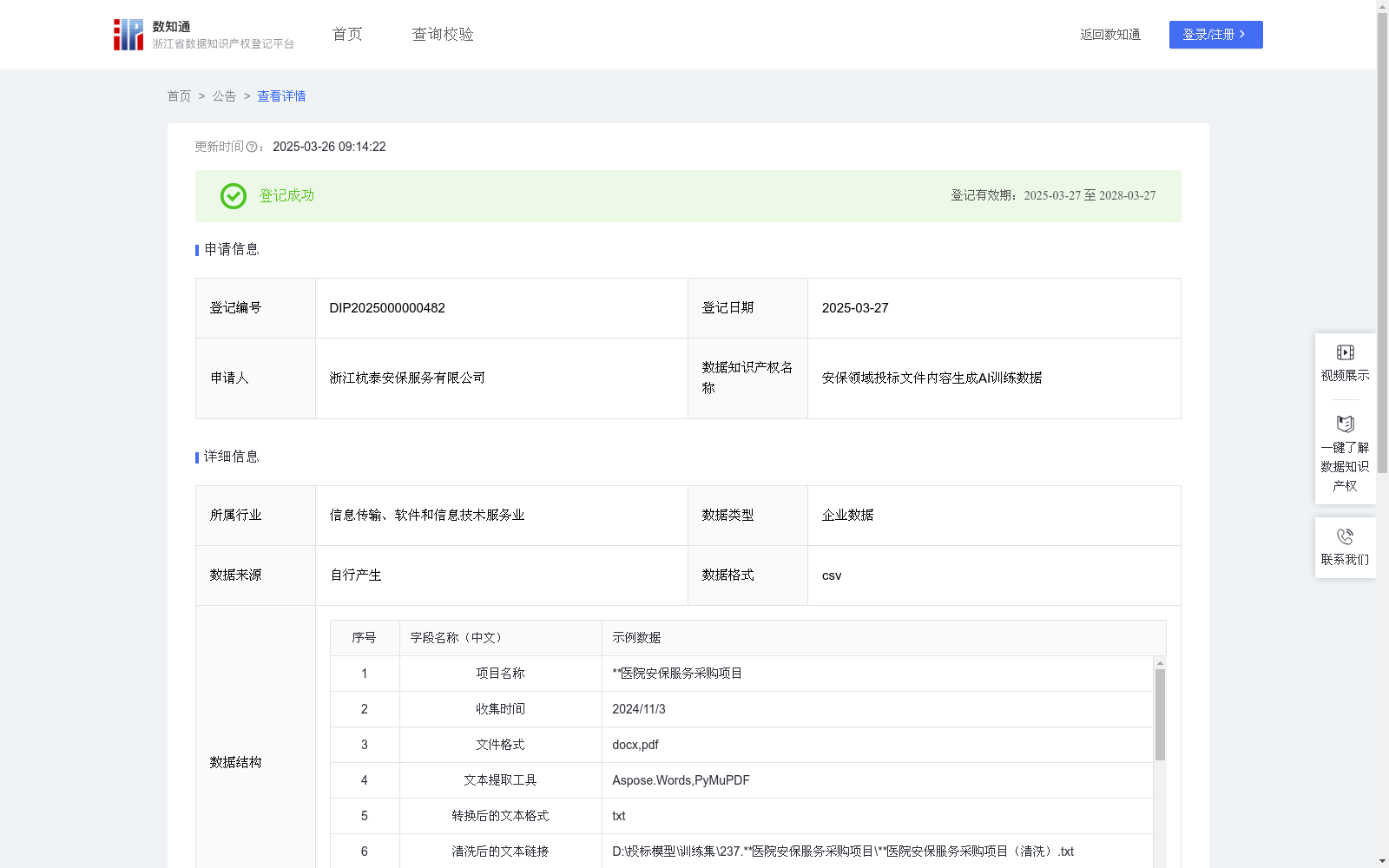
安保领域投标文件内容生成AI训练数据
收藏资源简介:
本数据集的核心价值在于其为开发高效、精准的安保领域投标文件AI生成系统提供了全面且准确的信息基础。通过对历史投标文件和采购需求的收集、文本提取、清洗、标注、特征提取、特征工程、模型训练和评估等过程,本数据集被加工成为高质量的训练用数据集,不仅涵盖了安保领域的广泛项目需求,还包含了丰富的技术方案和商务条款,使得AI模型在接受训练时能够深入学习并掌握投标文件内容的复杂性。在使用本数据集进行训练后,AI模型能够更加准确地识别安保领域项目的具体需求,进而在实际应用中生成与招标需求高度匹配的投标文件内容,提高投标效率和竞争力。1.数据收集:收集公司安保领域历史投标文件及其对应的采购需求文件(doc、docx和pdf格式),记录收集时间和项目名称。 2.文本提取、统一格式和清洗:用Aspose.Words工具(针对doc和docx格式)和PyMuPDF工具(针对pdf格式)对文件进行解析,提取文本内容。将提取的文本内容转换为统一的txt格式。对文本进行清洗,去除无用的符号、空白行等。 3.文本标注和特征提取:在KernAI Refinery工具辅助下,结合人工对文本进行标注,识别和标记关键信息。使用BERT算法提取文本中的关键词和语义信息,为模型训练提供重要特征。 4.特征工程:通过递归特征消除(RFE)选择最有影响的特征。通过组合现有的特征来创建新的特征,如组合投标文件中的不同参数。对特征进行必要的数学转换,以提高模型性能。 5.数据集划分:将特征工程处理后的数据集划分为训练集、验证集和测试集。 6.模型训练:选择开源的ChatGLM-6B作为文本生成模型,使用训练集对模型进行微调训练,记录训练周期,并在验证集上进行调优。 7.模型评估与优化:使用测试集评估模型的性能(准确率、召回率),并记录评估日期。
The core value of this dataset lies in providing a comprehensive and accurate information foundation for developing an efficient and accurate AI-powered bidding document generation system for the security industry. Through processes including collection of historical bidding documents and procurement requirements, text extraction, cleaning, annotation, feature extraction, feature engineering, model training and evaluation, this dataset has been refined into a high-quality training dataset. It not only covers a wide range of project requirements in the security industry, but also includes abundant technical proposals and commercial clauses, enabling AI models to deeply learn and grasp the complexity of bidding document content during training. After being trained with this dataset, AI models can more accurately identify the specific requirements of security industry projects, and thus generate bidding document content highly matching the tender requirements in practical applications, improving bidding efficiency and competitiveness. 1. Data Collection: Collect historical security industry bidding documents and their corresponding procurement requirement documents (in doc, docx and pdf formats), and record the collection time and project name. 2. Text Extraction, Unified Formatting and Cleaning: Parse the files using Aspose.Words (for doc and docx formats) and PyMuPDF (for pdf formats) to extract text content. Convert the extracted text into a unified txt format. Clean the text by removing useless symbols, blank lines and other redundant content. 3. Text Annotation and Feature Extraction: With the assistance of the KernAI Refinery tool, perform manual annotation on the text to identify and mark key information. Use the BERT algorithm to extract keywords and semantic information from the text, providing important features for model training. 4. Feature Engineering: Select the most impactful features via Recursive Feature Elimination (RFE). Create new features by combining existing ones, such as combining different parameters in bidding documents. Perform necessary mathematical transformations on the features to improve model performance. 5. Dataset Split: Split the dataset processed through feature engineering into training, validation and test sets. 6. Model Training: Select the open-source ChatGLM-6B as the text generation model, perform fine-tuning training on the model using the training set, record the training cycle, and conduct tuning on the validation set. 7. Model Evaluation and Optimization: Evaluate the model's performance (accuracy, recall) using the test set, and record the evaluation date.